
Hi there!
Here is your latest dose of “Buy the Umbrella”, a short list of interesting things I’ve been reading and thinking about during the week.
Tweet
Oil prices have risen ~80% since the start of 2021 as demand has rebounded more quickly than initially anticipated by investors.
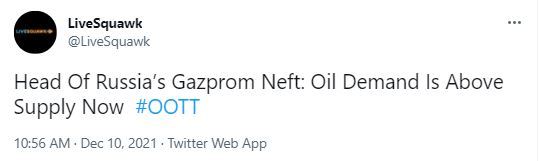
Alexander Dyukov, the head of Russian oil producer Gazprom Neft, stated last week that oil demand currently "slightly exceeds supply". Dyukov believes that the "situation should stabilize soon" due to uncertainty over new Covid-19 variants, which have the potential to slow the global economy.
Dyukov goes on to say that it would be logical for the OPEC+ deal to be extended beyond 2022, and that if demand continues to exceed supply, "OPEC+ has all the necessary tools and capacities to increase supply and balance the market situation".
Conversely, Reuters published an article that showed OPEC+ can't "turn on the tap much harder", highlighting that OPEC+ have been unable to hit their own planned production targets for September and October. In November, the group was more than half a million barrels per day short of their overall production quota, raising the prospect of a tight market and high oil prices for longer.
Energy Aspects, an energy consultancy firm, backed the view, adding that "recent data support our long-held expectation that a growing number of members are running out of spare capacity".
Meanwhile, Saudi Aramco's CEO Amin Nasser recently pointed out that the industry's spare capacity of 3-4 million barrels per day is providing some comfort to the market. However, he is concerned that "the buffer...might diminish". Nasser adds that "expanding capacity in our industry takes around 5-7 years, and there is not enough investment in the world to increase capacity, this is a huge concern".
Combined, the fact that demand currently exceeds supply, that OPEC+ is unable to hit its own production goals, that the spare capacity could diminish quickly and that it takes 5-7 years to expand capacity, makes oil and gas a particularly appealing sector today for investors, especially given the relatively cheap valuations.
To hear it from one of the world's largest oil traders, the head of Vitol believes that upside price risks remain and that the "possibility of a spike to $100 per barrel is clearly there".
Quotes
"Anyone taken as an individual is tolerably sensible and reasonable - as a member of a crowd, he at once becomes a blockhead."
"An investment in knowledge pays the best interest."
Chart
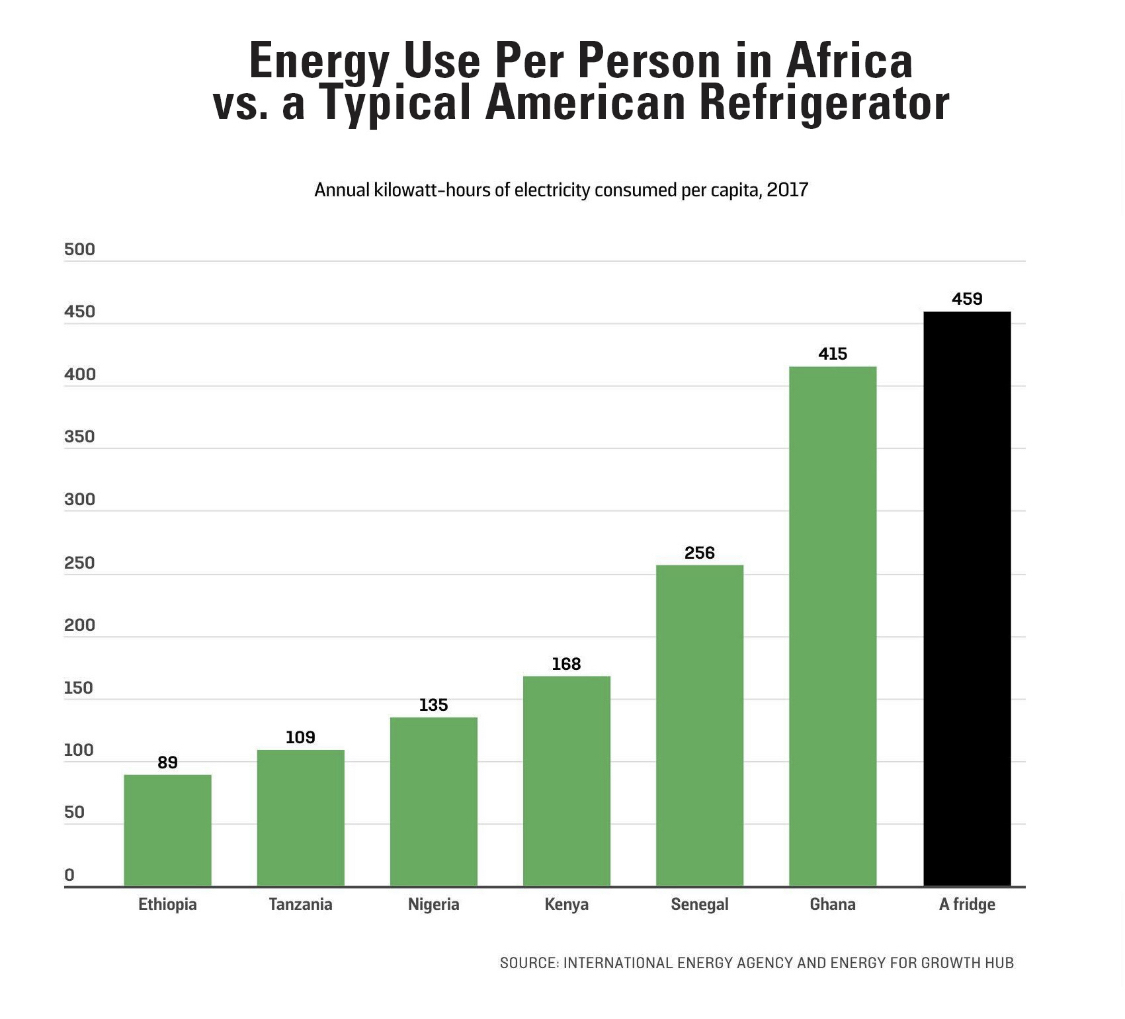
In Buy the Umbrella Issue #2, we showed the disparity of energy usage between developed and developing countries. Even more astonishing is how large the energy consumption gap is between households in the U.S. and much of Africa. The incredible graph below shows that on an annual basis, a typical American fridge alone consumes more electricity than the average person in some African countries.
Article
This week, Bloomberg reported that insiders (corporate executives who are privy to information not available to others) have been selling their shareholdings. So far, $42.9 billion has been sold by the richest 500 people, more than double the amount in 2020. That number rises to a record $63.5 billion in shares when taking into account insiders across the S&P 500 index.
Founders and employees with large fortunes tied to their company's stock tend to hold onto their shares, as their gains are only taxed when realized (i.e. sold). The motivation behind the sales is unclear, yet a number of people are wondering whether they are selling due to the record equity valuations.
Some of the sellers this year include:
Sergey Brin and Larry Page, the co-founders of Alphabet (Google), who had not sold any shares in four years
Elon Musk, the world's richest person, who had not sold any Tesla stock since 2016
Satya Nadella, Microsoft's CEO, sold half his total stake
Michael Dell, the founder of Dell Technologies, who had not sold any stock since Dell's IPO in 2018
Ronald Lauder, heir to Estee Lauder, made his first sales since 2016
Two out of three of the Airbnb co-founders. The third, CEO Brian Chesky, sold shares in December 2020 as part of his company's IPO
Jeff Bezos, the founder of Amazon
Mark Zuckerberg, the founder of Meta (formerly Facebook)
Jack Dorsey, the founder of Twitter
the Walton family, heirs to Walmart
Separately, the Wall Street Journal found that the top 48 executives have collected more than $200 million each from stock sales, nearly four times the average number from 2016-2020 and the highest in a decade.
A professor at the University of Pennsylvania’s Wharton School said that it resembles waves of sales during the twilight of the early 2000s dot-com boom, adding that insiders have a long history of selling at peaks and buying in troughs.
The questions that are worth asking are: what do these insiders know that the rest of us do not and, do their actions suggest that the market's enthusiasm is misplaced?
Until next time...
Thank you for reading this week’s issue. If you found it interesting, please consider sharing it with a like-minded friend or family member.
If you have any questions or feedback, please reach out!
Have a great week.
Why ‘Buy the Umbrella’?
Individuals, many of whom also run businesses and governments, tend to not think of the downside when the present is stable, and the future is looking positive (usually when we feel most in control).
Just because it is currently sunny, does not mean it will never rain. We need to buy the umbrella before it rains. Otherwise, by the time we are running around looking for an umbrella in the middle of a storm, they tend to be in short supply.
At the same time, we cannot allow our awareness of risk to make us fearful, pessimistic, or paranoid, as this too works against us over the long-term.
Having the right mindset in advance is critical. The challenge is getting the right balance between being optimistic about the future and being able to not only withstand future crisis, but in fact grow stronger due to the opportunities they tend to present. It is not enough just to be conservative. One needs to be willing to put cash to work when others feel least comfortable doing it. To do that with confidence, we need to have a foundational understanding of business, markets and human psychology.
Our mission is to learn as much about the world as possible, and in doing so, to try to find investment opportunities with favourable risk/reward characteristics. These should, over the long term, help build sustainable wealth.