
Hi there!
Here is your latest dose of “Buy the Umbrella”, a short list of interesting things I’ve been reading and thinking about during the week.
Tweet
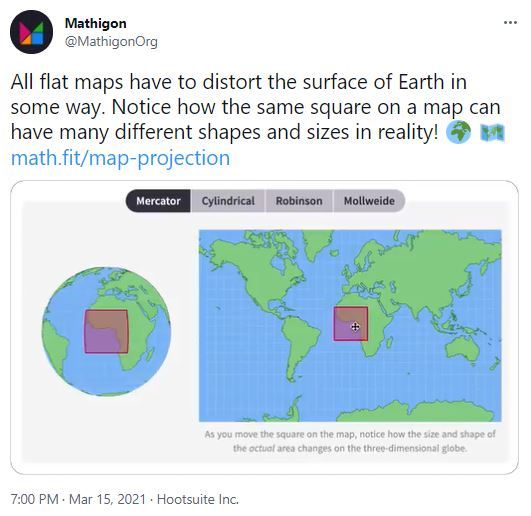
Perception impacts the way we see the world in every manner. For example, maps not only represent our world, but they shape the way we see it.
Many perceive Russia to be multiple times wider (east-west) than Africa. In reality, Russia's maximum width is ~9,000 km, while Africa's is ~7,400 km according to Britannica. This implies that the continent is ~18% smaller. In fact, Africa is the second largest continent after Asia, with Europe being the second smallest.
Traditional maps such as Mercator, designed in the 16th century for navigational use, have tended to show countries incorrectly in proportion to one another. They exaggerate the size of high latitude countries such as those in North America and Europe, while making tropical countries, such as those in Africa and South America, appear smaller than reality.

We can easily challenge our view of the world by looking at it through a different lens. The Peters World Map (below), presents countries in their true proportion to one another and provides a helpful correction to the distortion caused by traditional maps. Now, accurate comparisons become possible.

Why are we talking about maps on Buy the Umbrella? Well, perception matters a great deal when it comes to making financial decisions.
Throughout history, investors' perceptions of fundamentals periodically become detached from reality, similar to how our view of Africa is distorted when looking at a traditional map. This happens at two distinct parts of a market cycle: during the start of a new cycle and towards the end of it. The early stages of a cycle is when investors are most pessimistic. Conversely, towards the latter stages, investors are prone to overconfidence and excess optimism about the future, believing that high returns will continue for years to come.
What separates great investors and business leaders is their ability to take a step back and re-assess the reality, relative to everyone's perception of that reality.
When consensus expectations are at their lowest, the potential for outsized returns are usually at their highest. Conversely, the higher the expectations, the lower the potential upside, as much of the underlying asset's future growth is likely to be priced in.
Importantly, inflated investor expectations and valuations also impact the level of embedded risk, as assets are priced for perfection, leaving little room for error. Any underperformance in the fundamentals can result in a significant decline in pricing. Therefore, when assessing an investment opportunity, one must consider the level of expectations currently priced into the valuation.
Quotes
"Imagination is more important than knowledge"
"I have had dreams and I have had nightmares, but I have conquered my nightmares because of my dreams."
Charts
Initial Public Offerings (IPOs) within North America continue to smash records, with over $515 billion raised from public equity investors so far in 2021, up 30% from 2020, which itself was a record year.
Notably, newly listed US technology companies have not performed well in 2021. This year, more than 50 companies have listed, 23 of those have lost half or more of their value since reaching their highs. This includes Robinhood, which has plummeted 74% from its peak in early August. EV-maker Rivian, which was referred to in Buy the Umbrella Issue #7, has dropped 35% since mid-November, even with IPO investors unable to sell until mid-2022.

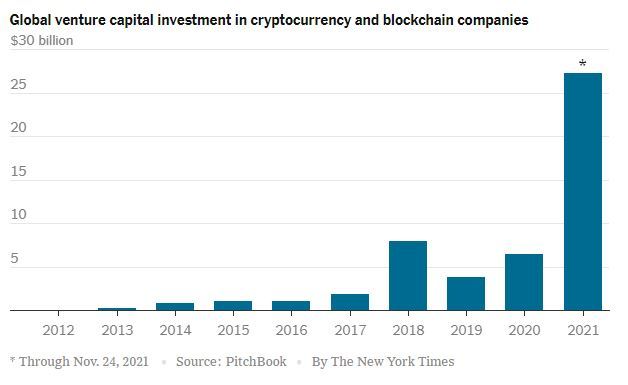
Separately, venture capital investors have bet big on crypto start-ups so far in 2021, investing more than $27 billion globally as of late November. This amounts to more than the previous 10-years combined, according to PitchBook.
Last month, venture capital firm Paradigm, which is run by Fred Ehrsam, a Coinbase co-founder, announced a $2.5 billion crypto fund. This is for now the largest publicly announced fund in the space.
Interestingly, much of this start-up capital has come from the investment arms of more established crypto companies, whose continued growth will depend on the ecosystem expanding. This concentration and heavy involvement seems to undermine the very idea of decentralization that is at the forefront of the industry’s vision.
Things that make you go hmm...
Digital Land
A growing number of firms are acquiring digital land, with the most recent record set at $4.3 million according to the Wall Street Journal. Republic Realm, a firm that develops real estate in the metaverse, confirmed that it paid this sum for land in the virtual world called 'Sandbox'. The land was acquired from videogame company Atari. This acquisition broke the prior record, set by a Canadian investment firm Tokens.com Corp., which acquired virtual land for $2.5 million in 'Decentraland'. The CEO said "this is like buying land in Manhattan 250 years ago as the city is being built". For some, buying digital land is too much to fathom.
Public Equity Inflows
Investors have poured almost $900 billion into equity exchange-traded and long-only funds in 2021, exceeding the combined total from the past 19 years, according to data from Bank of America and EPFR Global.
Article
Two months ago, Bloomberg published a fascinating article titled 'Anyone Seen Tether's Billions?'. It is an insight into an area of the crypto universe known as stablecoins - stable because they are meant to be backed by fiat currencies, like the United States Dollar, as is supposed to be the case with Tether.
Tether appears to be opaque, an antithesis to the idea of cryptocurrencies, which are meant to lead us to a more transparent future. In fact, it seems that Tether acts more like a bank, taking in dollars from people who want to trade crypto by crediting their digital wallets with an equal amount of Tethers in return. The company that issues the currency is known as Tether Holdings, an unregulated offshore entity, with just 28 employees according to LinkedIn.
Tether was able to come up with this financial engineering because normal banks did not want to do business with crypto companies, especially foreign ones.
Much of the concern around Tether is due to its lack of transparency with regards to what is backing it, and whether it is truly backed by dollars. Critics continue to claim that the company does not have enough assets to maintain the one-to-one exchange rate, suggesting that its coin is a fraud.
Given the backdrop in today's markets, where crypto currencies with pictures of dogs can be worth billions of dollars and scammers periodically make fortunes with new schemes, Tether seems like just another distraction.
This is of course until one realizes that Tether Holdings is able to print huge amounts of digital coins pretty much whenever it feels like it. It has printed $55 billion of coins just this year, bringing the total number of Tethers in circulation to $76 billion, an amount that would make it one of the 50 largest banks in the U.S., if it was holding a corresponding $76 billion in real money to back the coins.
To make matters more curious, the CEO is J.L. Van der Velde, is a Dutchman who lives in Hong Kong and seems never to have given an interview or spoken at a conference. The CFO is Giancarlo Devasini, a former plastic surgeon from Italy who was once described on Tether’s website as the founder of a successful electronics business.
Surprisingly, in May 2021, Tether published a report that showed only 2.9% of Tether was backed by cash, with over 65% backed by commercial paper. The company declined to say whether Tether had any Chinese corporate debt exposure.
If the critics are right that Tether is a fraud, the Ponzi scheme could end up being bigger than Bernie Madoff's. A change in the public's perception of the stablecoin is all it takes to unravel it.
Until next time...
Thank you for reading this week’s issue. If you found it interesting, please consider sharing it with a like-minded friend or family member.
If you have any questions or feedback, please reach out!
Have a great week.
Why ‘Buy the Umbrella’?
Individuals, many of whom also run businesses and governments, tend to not think of the downside when the present is stable, and the future is looking positive (usually when we feel most in control).
Just because it is currently sunny, does not mean it will never rain. We need to buy the umbrella before it rains. Otherwise, by the time we are running around looking for an umbrella in the middle of a storm, they tend to be in short supply.
At the same time, we cannot allow our awareness of risk to make us fearful, pessimistic, or paranoid, as this too works against us over the long-term.
Having the right mindset in advance is critical. The challenge is getting the right balance between being optimistic about the future and being able to not only withstand future crisis, but in fact grow stronger due to the opportunities they tend to present. It is not enough just to be conservative. One needs to be willing to put cash to work when others feel least comfortable doing it. To do that with confidence, we need to have a foundational understanding of business, markets and human psychology.
Our mission is to learn as much about the world as possible, and in doing so, to try to find investment opportunities with favourable risk/reward characteristics. These should, over the long term, help build sustainable wealth.