
Hi there!
Here is your latest dose of “Buy the Umbrella”, a short list of interesting things I’ve been reading and thinking about during the week.
Tweet
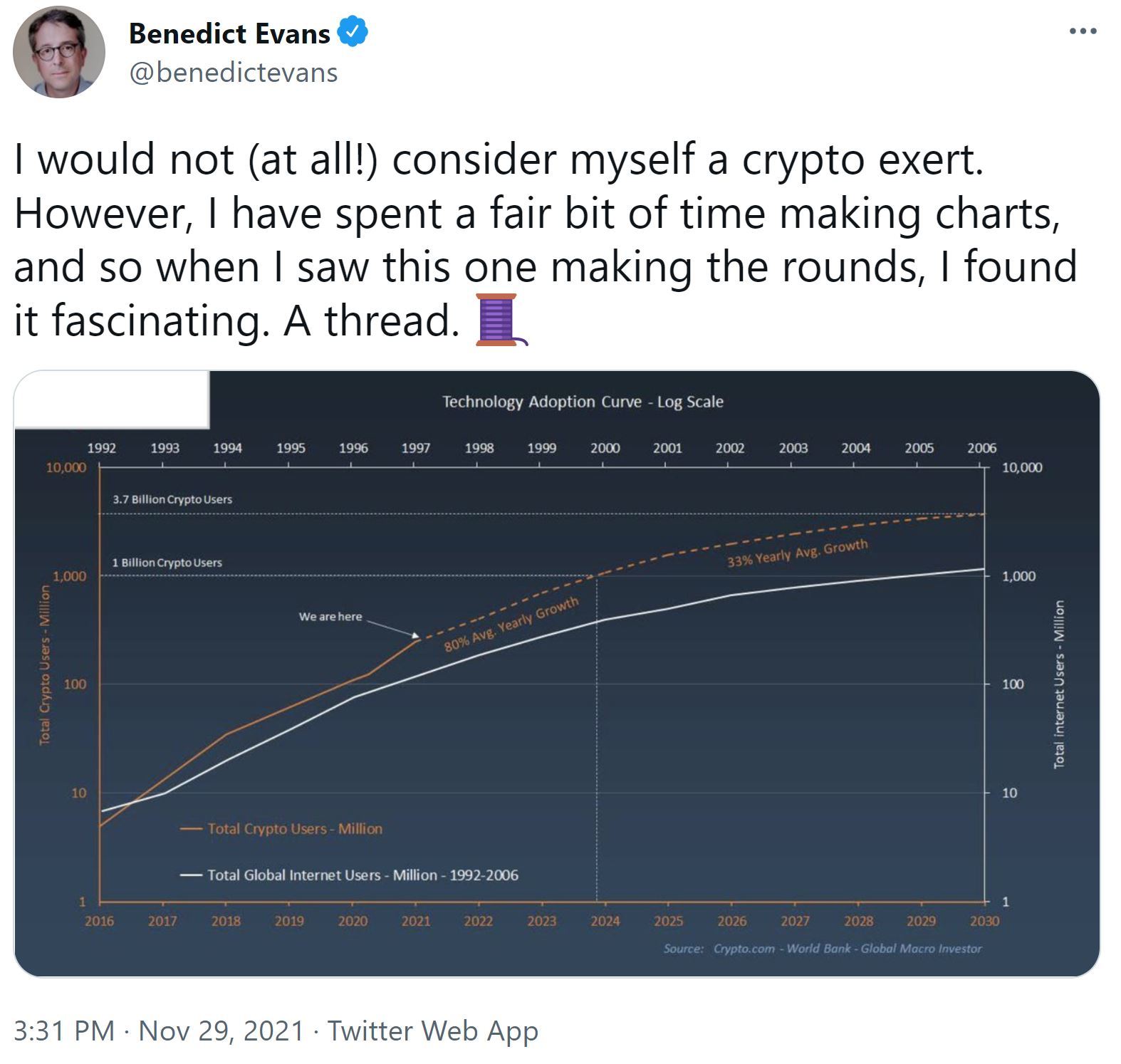
Benedict Evans' Twitter thread is a brilliant reminder of how charts can be used to depict whatever an author wants. The graph in the tweet was taken from a recent deck put together by an investor, looking to raise money for a new fund that will invest in crypto funds.
Evans rightly points out that there are three levers in this chart. Two of these relate to how the data is craftily presented, with shifting timelines and the use of a log scale. The third relates to the aggressive underlying forecasting assumptions, where the investor has used high compounding growth rates over a long time period. Collectively, these three levers give the impression that the assumptions relating to crypto adoption are easily achievable when compared to the adoption curve of the internet from 1992-2006.
Evans recreates the chart using the same data, changing just one of the levers: using a linear scale rather than a log scale on the vertical axis. Strikingly, it now shows an entirely different picture.

The revised chart brings to the forefront the aggressive nature of the underlying assumptions the investor is betting on.
New technologies can certainly be adopted more quickly than prior ones, but what is fascinating here is what happens when an adjustment is made to the starting data point, demonstrating the level of sensitivity.
If we were to re-calculate the forecast with a more recent starting date of June 2021 rather than January 2021 (221 million versus 115 million crypto users globally respectively from Crypto.com), it results in an extra 3.5 billion people using crypto by 2030. This takes the forecasted total number of crypto users over seven billion, which is more than the forecasted global population over the age of 15 in 2030.
The above is a helpful reminder that as excitement over the crypto space continues, it is wise to take a step back and re-visit the underlying assumptions investors are making and how likely they are to be achieved. During the dotcom bubble in the late 1990s, investors similarly used aggressive assumptions in their models to value internet startups. This ultimately resulted in large losses for those who continued to chase richly-valued markets.
Quote
"People don't learn what is imposed upon them but rather what they freely seek, out of desire or need. For people to learn, they need to want to learn."
— The Premonition by Michael Lewis
“The investor’s chief problem — even his worst enemy — is likely to be himself.”
Chart

Impressively, Electric Vehicle (EV) adoption continues to accelerate, accounting for over 10% of total passenger vehicle sales during the latest quarter, up from ~4.5% in the same quarter a year ago.
The EV market continues to heat up globally with legacy car makers introducing dozens of new models to compete with startups like Rivian, the Amazon-backed company.
Rivian, which recently listed on the US stock exchange, was at one point valued at over $150 billion and surpassed Volkswagen's valuation. This made it the largest U.S. company with zero revenue, having produced no vehicles, demonstrating the mania evolving within the EV market.
Reflection of the Month
The Mann Gulch Fire of 1949
During the 1930s, the U.S. Forest Service created an elite team of smokejumpers who parachuted into fires to help put them out.
On a summer day in August 1949, at 4:10pm, 15 young men mostly aged between 17-23 parachuted into what they thought was a small fire. As they landed, they began to hike down into Mann Gulch with heavy gear on their backs and split into smaller groups.
To their right was a steep ridge, to their left a creek. The fire they had been sent to fight burned safely on the other side of the creek, or so they thought.
There were not many trees, just tall grass, but they were unable to see much ahead of them. Roughly a mile down, the creek drained into the Missouri River. Their plan was to walk to the river, cross over the creek and fight the fire with the river at their backs. The river at their backs was there as an escape route.
Now as they neared the river, there came a shocking sight: fire. It had jumped across the creek and now blocked them from the river. Worse, it was moving across the grass towards them. From one moment where the fire had been invisible, to the next, a terrifying wall of flames 30 feet high in-front of them. It was now 5:45pm.
They turned to flee, but their only escape route was up and over a steep ridge. The fire had a tailwind of 30-40 miles an hour and was growing exponentially. Unfortunately for them, grass fires move faster than forest fires. When the men first spotted the fire, it was only moving at 1.2 miles per hour. At 5:55pm, the fire was traveling at 7 miles per hour.
At 5:56pm, ten of the fifteen men had perished, some still carrying their heavy gear. The other five had escaped. Three of these men had dropped their gear and made it over the top of the ridge - although one of them died the next day. Separately, the fourth escapee also died within a day. The fifth, 33-year old leader R. Wagner Dodge, survived.
The most interesting part of the story was how at 5:55pm, with the fire rushing towards the leader at ever greater speeds, he decided to light a second fire, up the hill he needed to climb. As his fire burned the grass in front of him, he walked into it and threw himself onto the ashes. He remained flat on the ground, hearing and feeling the heat from the primary fire which, to his relief, had passed by around him and left him unscathed.
He had asked his men, whom he did not know well, to follow him into the fire he'd set. Unfortunately, they either could not hear him or they thought he'd lost his mind. This later became an accepted fire-fighting strategy, known as an "Escape Fire".
The lessons from this story are applicable not just to fighting fires but also to other areas of life, including investing. The takeaways are:
You cannot wait for the smoke to clear: once you can see things clearly, it is already too late to act
You can't out-run a fire: by the time you start to run, it is already upon you
Identify what is important and drop everything else
Figure out the equivalent of an escape fire
The Mann Gulch Fire captures the difficulty that people have in predicting exponential growth, even when their lives depend on it. Ironically, this is what many investors use to justify today's elevated asset prices.
Until next time...
Thank you for reading this week’s issue. If you found it interesting, please consider sharing it with a like-minded friend or family member.
If you have any questions or feedback, please reach out!
Have a great week.
Why ‘Buy the Umbrella’?
Individuals, many of whom also run businesses and governments, tend to not think of the downside when the present is stable, and the future is looking positive (usually when we feel most in control).
Just because it is currently sunny, does not mean it will never rain. We need to buy the umbrella before it rains. Otherwise, by the time we are running around looking for an umbrella in the middle of a storm, they tend to be in short supply.
At the same time, we cannot allow our awareness of risk to make us fearful, pessimistic, or paranoid, as this too works against us over the long-term.
Having the right mindset in advance is critical. The challenge is getting the right balance between being optimistic about the future and being able to not only withstand future crisis, but in fact grow stronger due to the opportunities they tend to present. It is not enough just to be conservative. You need to be willing to put cash to work when others feel least comfortable doing it. To do that with confidence, we need to have a foundational understanding of business and markets.
Our mission is to learn as much about the world as possible, and in doing so, to try to find investment opportunities with favourable risk/reward characteristics. These should, over the long term, help build sustainable wealth.