
Hi there!
Here is your latest dose of 'Buy the Umbrella', a short list of interesting things I’ve been reading and thinking about during the week.
Tweet
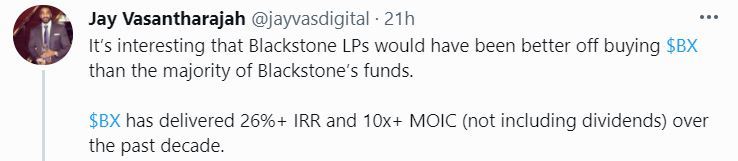
Blackstone's stock, with dividends reinvested, has returned 33% annualized or 1,576% over the last decade. Interestingly, it seems that their stock has generated a better return than most, if not all, of their funds.
Their funds are predominantly targeted towards institutional investors such as pension funds, endowments and sovereign wealth funds, which have been allocating ever larger amounts to alternative investment strategies. This is largely due to the declining potential returns in other asset classes such as fixed income, and the perception that alternative investment strategies offer less volatile returns.
Alternative asset managers, like Blackstone, have seen their assets under management (AUM) grow significantly and as a result, have seen their firms become ever more profitable due to their lucrative fee structure, generating attractive returns for their shareholders.
Quotes
"Make sure that the probability of the unacceptable (i.e. the risk of ruin) is nil."
"It is not power that corrupts but fear. Fear of losing power corrupts those who wield it and fear of the scourge of power corrupts those who are subject to it."
Charts
U.S. Interest Rates
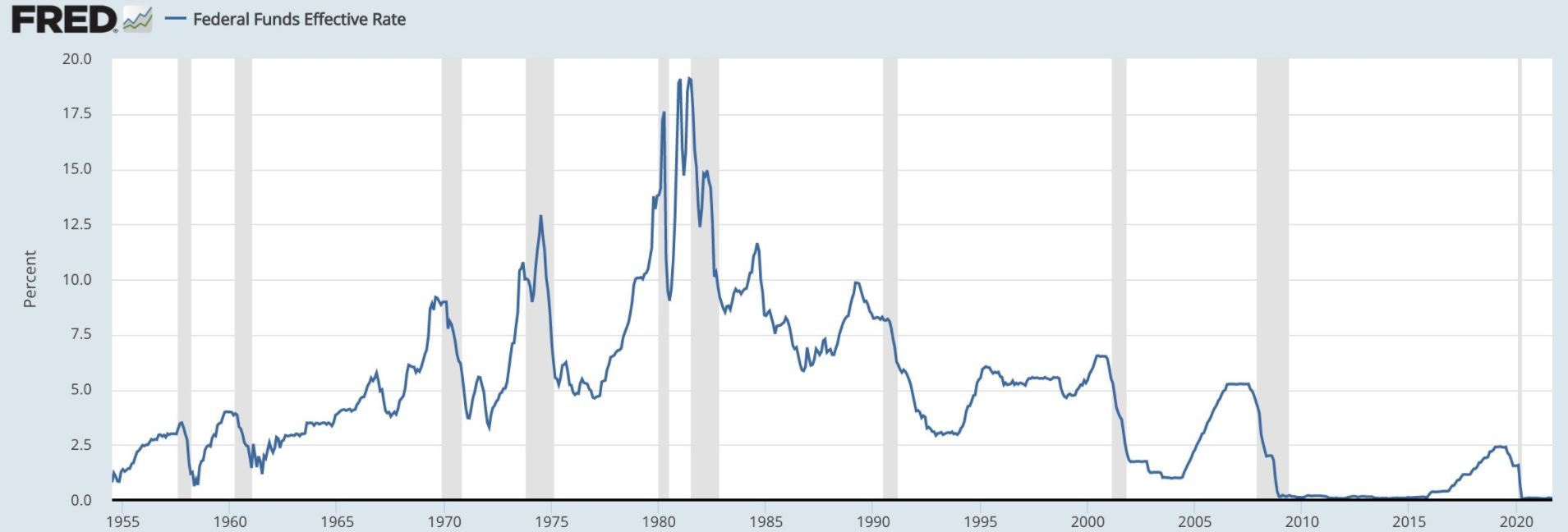
During the global financial crisis, the U.S. Federal Reserve lowered interest rates to zero. Since then, it has struggled to raise them to a more normalized level due to the amount of debt in the system.
Interestingly, as shown by the chart below, interest rates spent 30 years going up between 1955-1985. This peroid was then followed by 40 years of declining borrowing costs.
The big question is whether this peroid will be coming to an end, leading to higher interest rates. Inflation will likely be the key determinant for the future path of interest rates.
Global Emissions
With the 26th UN Climate Change Conference of the Parties (COP26) in session, we have gone through another news cycle about emissions and government net zero targets.
The chart below highlights that there is a clear connection between wealth and consumption emissions, both on the country level and the individual level. The wealthier a country or household is, the higher their lifestyle consumption emissions.
What is shocking however, is the size of the consumption emissions gap between the bottom 50% and the top 10% of households and how this gap grows as a country becomes wealthier.
There are a few interesting exceptions. For example, South Africa's top 10% of households consume more than their counterparts in South Korea, Japan, Italy, Germany and France. This is likely due to the size of the income inequality gap. In South Africa, the richest 10% of the population own more than 85% of household wealth, while over half the population have more liabilities than assets according to the World Inequality Lab. Incredibly, 3,500 adults own more than the poorest 32 million people in the country of 60 million.

Article
Helion Energy is focused on enabling a future with unlimited clean energy by utilizing fusion technology. Fusion occurs when two atoms combine to form a single atom, releasing energy (this is the opposite to the process in existing nuclear reactors, known as fission). It is the same process our sun and other stars use to make energy.
Incredibly, it's has the potential to provide energy that is cheap, clean, plentiful and reliable. Fusion produces energy from deuterium (also known as heavy hydrogen), which is found in water. It would create an inflection point in human history and would ultimately remove our dependence on fossil fuels for electricity.
In 2020, Helion Energy completed their 6th prototype, named Trenta, which runs nearly every day doing fusion. It has completed almost 10,000 high-power pulses and operated under vacuum for 16 months.
Helion Energy became the first private organization to reach plasma temperatures of 100 million degrees Celsius (9 keV). 100 million degrees Celsius is generally considered the minimum temperature required for large amounts of fusion to occur to generate commercial electricity from fusion.
Trenta, which has demonstrated 95% energy efficiency, is still operating today.
"One glass of deuterium, a form of hydrogen found in water (D₂O), can generate 9 million kWh of safe, clean electricity which can power one home for 865 years or can power an electric car for 35 million miles"
Sam Altman, the CEO of OpenAI and former President of Y Combinator, has invested $375m into Helion as part of their latest $500m funding round, having first invested in the company back in 2014.
To read more about the company and their latest round click here or visit the company's FAQ here.
Until next time...
Thank you for reading this week’s issue. If you found it interesting, please consider sharing it with a like-minded friend or family member.
If you have any questions or feedback, please reach out!
Have a great week.
Why ‘Buy the Umbrella’?
Individuals, many of whom also run businesses and governments, tend to not think of the downside when the present is stable, and the future is looking positive (usually when we feel most in control).
Just because it is currently sunny, does not mean it will never rain. We need to buy the umbrella before it rains. Otherwise, by the time we are running around looking for an umbrella in the middle of a storm, they tend to be in short supply.
At the same time, we cannot allow our awareness of risk to make us fearful, pessimistic, or paranoid, as this too works against us over the long-term.
Having the right mindset in advance is critical. The challenge is getting the right balance between being optimistic about the future and being able to not only withstand future crisis, but in fact grow stronger due to the opportunities they tend to present. It is not enough just to be conservative. You need to be willing to put cash to work when others feel least comfortable doing it. To do that with confidence, we need to have a foundational understanding of business and markets.
Our mission is to learn as much about the world as possible, and in doing so, to try to find investment opportunities with favourable risk/reward characteristics. These should, over the long term, help build sustainable wealth.