
Hi there!
Here is your latest dose of ‘Buy the Umbrella’, a short list of interesting things I’ve been reading and thinking about during the week.
Quote
“Past experience, to the extent that it is part of memory at all, is dismissed as the primitive refuge of those who do not have the insight to appreciate the incredible wonders of the present.”
— John Kenneth Galbraith
Charts
Australian residential land value hits a new high
As a percentage of GDP, Australian residential land is now worth more than residential land in Japan at the peak of the epic 1990s bubble.
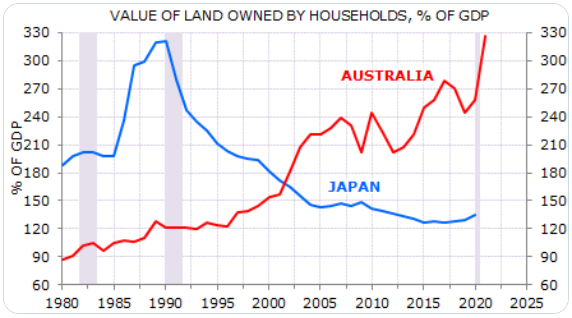
Australian households are amongst the most indebted in the world, which is potentially problematic now that the country's central bank has begun to raise interest rates to fight inflation.
Data from the Bank of International Settlements showed total credit to Australian households amounted to ~120% of GDP, trailing only to Switzerland’s 130% and was far higher than the average of ~75% for developed economies.
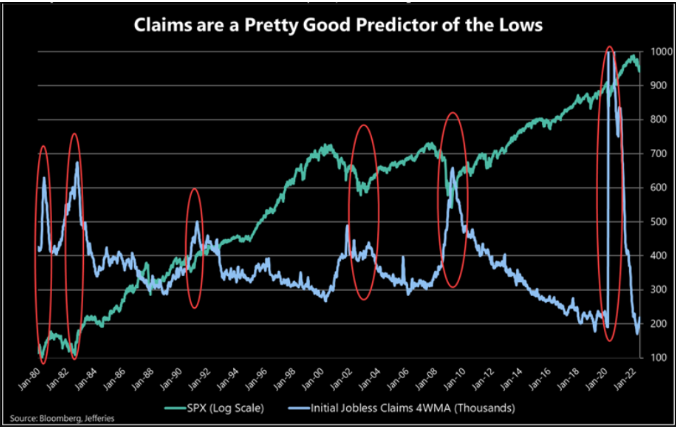
Initial jobless claims as an indicator of market lows
Jefferies put together a chart showing that the S&P500 tends to bottom when jobless claims reach a peak and begins to steadily move downwards. Based on their historical analysis, excluding the anomaly of the mandatory lockdowns and re-openings, it has taken anywhere from five months to three years for the initial jobless claims to peak.
Of course this sort of analysis is easier to do with hindsight, as the unanswerable question is: how do we know when jobless claims have peaked? Peaks and troughs in any time series are only obvious when looking backwards in time.
Articles
Denmark urges its citizens to take shorter showers and dry clothes outside
Europe's energy crisis has hit a new level of severity, with no sign that the region's gas price gains are abating. Households account for ~29% of Denmark's gas usage, therefore the government is trying to pull levers to lower demand.
Denmark is amongst a handful of nations that has had its gas taps switched off by Russia, after it refused to pay for the fuel in Russian rubles. The country is due to get a supply boost from Norway through the new Baltic Pipe in October.
Macron tells Biden that Saudi Arabia and the UAE unable to boost supply significantly
The French President reportedly was told that Saudi Arabia and the UAE are unable to raise oil output significantly. Following the media reports, the UAE Energy Minister released a statement clarifying that "the UAE is producing near to our maximum production capacity based on its current OPEC+ production baseline".
Podcast
The thought-provoking podcast titled "Making Sense of the Market" with Aswath Damodaran, a Professor of Finance at NYU’s Stern School of Business, interviewed by Patrick O'Shaughnessy is a worthwhile listen (podcast and the transcript can be found here).
Here are some of the fascinating takeaways:
Inflation
Damodaran breaks down inflation into two components:
Expected inflation (the more "benign" part of inflation)
Unexpected inflation (the more "deadly" part for investors)
Why is expected inflation considered benign? Investors can build it into their financial assets. Using a simplistic example, let's say there's a bond yielding 8%. If you expect inflation to be 5%, you may feel you are adequately compensated. On the other hand, if unexpectedly you end up with inflation at 9%, the bond's price falls and if you were to hold the bond until maturity, you will have generated a real return of -1%. This is why unexpected inflation is considered deadly.
The 1970s were particularly painful as unexpected inflation regularly came in above expectations and had a significant negative impact on financial assets. In contrast, while inflation was high during the 1980s, investors began to price sufficiently high inflation expectations into financial assets, hence when inflation came in lower than expected, markets rallied.
"My concern with what's been happening in 2021 and 2022 was seeing a pattern that we saw in the seventies, which is people's expectations are set by what they've lived through [...] if you look at the investors in the market in 2021, enter the market in the last 10, 15, 20 years. For those people, the only inflation they've known is low and stable inflation. It takes a while, and this is the behavioural component, for people to adjust their expectations."
The question driving markets is, if we can agree that inflation is unlikely to soon go back down to last decade's trend of 1-1.5% level, where will inflation land between that and the current rate of 8-9%? Inflation is like the genie in a bottle. Once out, it is difficult to put back in place.
Discretionary versus non-discretionary matters in an inflationary environment
For non-discretionary purchases like groceries, retailers can pass on the increase in costs by raising prices. Today, the challenge investors face is that society spends money on a wide range of things that didn't exist during the last inflationary period. For example, we do not know how discretionary or non-discretionary a Netflix subscription is, or how critical it is to upgrade your iPhone when prices are rising by double digits. It looks like we are going to find out soon.
"With Apple, the problem is you've essentially built a $3 trillion, $2.5 trillion company now on a single product."
Inequality
The government is stuck between a rock and a hard place:
"If you had concerns about income inequality coming into this process, it's going to get exacerbated by whatever inflation does, at least at the lowest end of the weight spectrum."
To fight inflation, governments have to reduce demand by pushing the economy into a recession, which hurts exactly the same people.
Real estate
Real assets generally hold up against inflation better than financial assets. It is believed to be the reason why real estate did well during the 1970s.
"The only problem is we screwed up real estate as a physical asset by securitizing it. What's happened as we've securitized real estate is it started to behave more like stocks and bonds."
Misalignment driven by poorly designed incentives
The way the industry ranks investment managers encourages them to not just be risk takers, but reckless risk takers because that is how you end up at the top of the "alpha" list.
"The Hippocratic oath of doing no harm should really be first, front and centre for anybody managing other people's money."
"It's amazing how as human beings when we succeed, we attribute it to our skills. And when we fail, it's always bad luck."
"There are many people who claim to be investors, but they're really playing the momentum game. It's amazing how their top ten stocks happen to be the ten stocks that have gone up the most over the last two years. It's amazing that your value approach gave you those same ten stocks. Traders masquerading as investors."
Interest rates are set by markets
"Interest rates ultimately are not set by the fed, and this is I think the delusion that's driven a lot of bad investing choice over the last fourteen years, is the fed can keep rates at whatever it wants to, no matter what happens."
Damodaran believes investors have been spoiled by a decade of low interest rates which is why inflation is going to be such a painful adjustment process.
Merits of more disclosures
"Have you read the risk section in any prospectus? 50 pages of garbage. [...] Companies have learned to play the game. They've discovered that if you disclose everything, it's like disclosing nothing, you lose perspective. They don't know the big thing versus the small things."
ESG
"I've become more and more convinced that the reason it's [ESG] taken off is it's become a money machine for the people involved."
He believes these people include the asset managers, the investment banks, the consultants, the "experts" and the academics.
"It's [ESG] a feel good scam [...] Your definition of good and my definition of good are going to be very different. [...] They're going to come up with some other buzzword to replace it. Because that is the history of businesses, what was ESG was called SRI and CSR."
Until next time...
Thank you for reading this week’s issue. If you found it interesting, consider sharing it with someone who would enjoy it.
Do you have any questions or thoughts? Please feel free to reach out.
Have a wonderful week.
Why ‘Buy the Umbrella’?
Individuals, many of whom also run businesses and governments, tend to not think of the downside when the present is stable, and the future is looking positive (usually when we feel most in control).
Just because it is currently sunny, does not mean it will never rain. If we are not prepared, once it does begin to rain, we will end up running around looking for an umbrella in the middle of a storm, when they tend to be in short supply. We therefore need to ‘buy the umbrella’ before it rains.
Simultaneously, we cannot allow our awareness of risk to make us fearful, pessimistic, or paranoid, as this too works against us over the long-term.
Having the right mindset in advance is critical. The challenge is getting the right balance between being optimistic about the future and being able to not only withstand future crises, but in fact grow stronger due to the opportunities they tend to present.
It is not enough just to be conservative. One needs to be willing to put our cash to work when others feel least comfortable doing it. To do that with confidence, we need to have a foundational understanding of history, business, markets and human psychology.
Our mission at BTU is to learn as much about the world as possible, and in doing so, to try to find investment opportunities with favourable risk/reward characteristics. These should, over the long term, help build sustainable wealth.