
Hi there!
Here is your latest dose of 'Buy the Umbrella', a short list of interesting things I’ve been reading and thinking about during the week.
Quotes
“If opportunity doesn’t knock, build a door.”
— Milton Berle
Chart
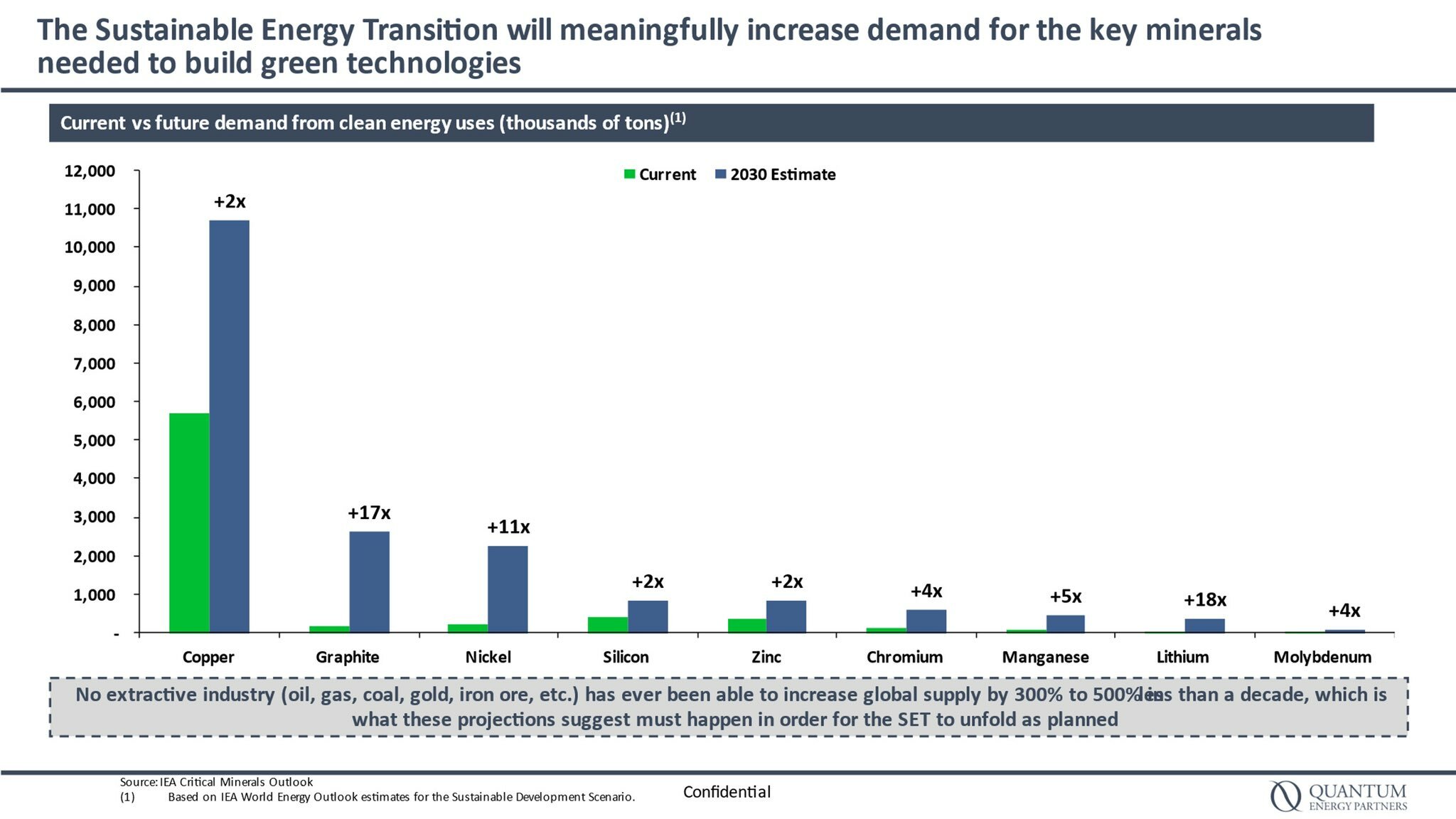
Energy transition will require extraordinary supply increase in key commodities to meet targets
Politicians and environmental activists continue to push for a sustainable energy transition, citing climate change and irreversible harm to our planet. Interestingly, few go into the logistical details and highlight the amount of commodities that we will need to extract in order to accomplish this so-called green transition.
Wil VanLoh, founder & CEO at Quantum Energy Partners, put together this fascinating chart illustrating the current demand for the key minerals versus the expected demand to make this shift happen by the 2030 global target. According to VanLoh, we have never been able to increase the global supply of any extractive industry by 300-500% in a decade, which is what is required.
Looking at the chart makes us wonder: can extracting such huge quantities of these minerals really be considered environmentally friendly?
Article
Apollo and Carlyle see private equity buyout fundraising slowdown
With market volatility remaining high, Apollo, which expected to raise a $25 billion fund in one close by year-end has been forced to adjust its timetable according to Bloomberg. The firm is now preparing to have an initial close at half the original goal. Apollo's CEO Marc Rowan stated that “there’s no way anyone will raise money on the schedule they’ve initially envisioned".
Similarly, Carlyle is also behind schedule for its flagship fund as pension funds and other large institutions face a challenging market backdrop, making them reluctant about locking up more money in illiquid funds. Carlyle's CEO believes that "there is an overcrowding" in private equity.
If the larger and more established players are experiencing a more challenging fundraising environment, it is likely that the smaller players and newer funds are in a difficult spot too?
Working paper
Lawrence Summers recalculated historical inflation readings, allows for apples-to-apples comparison
Some of us may be aware of the highly inflationary environment of the 1970s, when headline inflation eventually peaked at 14.8% in March 1980 and fell to 2.5% by July 1983, following aggressive policy decisions by the Federal Reserve Board under Chairman Paul Volcker.
Last week, the U.S.' Bureau of Labor Statistics reported the official inflation rate hit 8.6% in May. While this may still seem a long way off the inflationary 1970s and early 1980s, it is important to point out that the U.S. government has made meaningful changes to the way it calculates the consumer price index (CPI), a.k.a. the inflation rate, over the decades.
Given today's elevated price pressures, a group of economists, including former treasury secretary Lawrence Summers, published a working paper that recalculated historical readings for the CPI to apply modern-day spending patterns and allows for an apples-to-apples comparison.
Interestingly (perhaps unsurprisingly to some), they found that the current level of inflation is much closer to past inflation peaks than the official series would suggest. The adjusted inflation peak in 1980 ran at 9.1%, half a percentage point above May 2022's level.
In addition, they found that the rate of core CPI disinflation caused by Volcker-era policies is "significantly lower when measured using today’s treatment of housing: only 5 percentage points of decline instead of 11 percentage points in the official CPI statistics". This suggests that to return to 2% core CPI inflation today "will thus require nearly the same amount of disinflation as achieved under Chairman Volcker".
Volcker’s monetary tightening sent the federal funds rate up about 10%, to a peak of 20% in the early 1980s. The current federal funds target range is 1.5%-1.75%.
Video
Stanley Druckenmiller masterclass
Stripe co-founder John Collison interviewed legendary investor Stanley Druckenmiller at the Sohn 2022 conference and unsurprisingly, it is a must-watch for all investors.
Druckenmiller once managed George Soros’ Quantum Fund and shot to fame after helping make a $10 billion bet against the British pound in 1992. He later oversaw $12 billion as president of Duquesne Capital Management before closing his firm in 2010, and turning Duquesne into his family office.
His current macroeconomic view:
“The probabilities of being a soft landing [for the economy] are pretty remote. Historically, I think we’ve only pulled off two or three in history....there’s so much wood to chop. And there’s been such a broad asset bubble going into it.”
“Once inflation has got above 5%... it’s never been tamed without a recession. So if you’re predicting a soft landing, you’re going against decades of history.”
“Given the extent of the asset bubble and the destruction in the markets, given what’s going on in Ukraine, giving zero Covid policy in China, I don’t take a lot of comfort from that.”
“So I assume, and pretty strongly, soon we’re going to have a recession sometime in 2023.”
"My best guess, and this business is about guessing, there are no certainties: we are six months into a bear market that has some room to run."
"Think about the fact that we have had virtually no bankruptcies, this is probably the most disruptive period since the 1890s... if you look across the landscape, there should have been many many bankruptcies but they have been buried by QE..."
Druckenmiller has consistently outperformed the federal reserve in terms of macroeconomic forecasts over the last 20 to 30 years, here's how:
"I don't use what traditional economists use to predict the economy, things like employment and a bunch of top down macro statistics... over time I learned that the inside of the stock market has a very very prescient message about future economic activity. For whatever reason, stocks tend to lead the fundamentals by 6-12 months. Can even go beyond that by looking at industries that lead the economy and industries that lag the economy. The obvious one that everyone knows about is housing, is traditionally been looked at as a leading industry, retail has slightly, capital goods lag. Historically, we do the macro by a compilation of listening to companies and doing a bottoms-up analysis of industries that lead the economy and industries that lag the economy. If the leading industries are turning up or turning down, that's a signal. That has worked beautifully historically."
What the stock market is currently indicating:
"Homebuilders, with supposedly good fundamentals, have all declined 50% from their highs. Trucking industry is down 40%, despite the fact they are reporting record earnings. An industry which is not that much of a leader but is more of a leader than a laggard is the retail industry... a little tainted as retail went to 100% of the wallet [spend] from 85% because we weren't going outside and travelling... but even then, taking that into account retail appears to be much weaker than it should be given what the so-called GDP numbers are printing. Right now there is a signal, albeit early, that there may be trouble ahead... a lot of these things have longer lead times like six months to a year."
On the bond market:
Unfortunately, the last 10 to 11 years, the bond market has not signalled anything because the central banks took it upon themselves to manipulate bond prices. To me, the 10-year [U.S.] treasury is the most important price in the world.
During the interview, Druckenmiller's passion for the investment business shines through. He even addresses the topic directly:
It makes everybody think I'm a hard worker because I'm attracted to the game. There's a life lesson. I've seen young people who looked like they were lazy. When they find their passion, they become very driven. I just happen to be passionate about this particular discipline. I don't know whether I have a hard work ethic. But that's the end result of my passion."
His key advice to new investors:
"Do not invest in the present. The present is not what moves stock prices. Change moves them. I want you to try and envision a different world in a year and a half from now.”
Until next time...
Thank you for reading this week’s issue. If you found it interesting, consider sharing it with someone who would enjoy it.
Do you have any questions or thoughts? Please feel free to reach out.
Have a wonderful week.
Why ‘Buy the Umbrella’?
Individuals, many of whom also run businesses and governments, tend to not think of the downside when the present is stable, and the future is looking positive (usually when we feel most in control).
Just because it is currently sunny, does not mean it will never rain. If we are not prepared, once it does begin to rain, we will end up running around looking for an umbrella in the middle of a storm, when they tend to be in short supply. We therefore need to ‘buy the umbrella’ before it rains.
Simultaneously, we cannot allow our awareness of risk to make us fearful, pessimistic, or paranoid, as this too works against us over the long-term.
Having the right mindset in advance is critical. The challenge is getting the right balance between being optimistic about the future and being able to not only withstand future crises, but in fact grow stronger due to the opportunities they tend to present.
It is not enough just to be conservative. One needs to be willing to put our cash to work when others feel least comfortable doing it. To do that with confidence, we need to have a foundational understanding of history, business, markets and human psychology.
Our mission at BTU is to learn as much about the world as possible, and in doing so, to try to find investment opportunities with favourable risk/reward characteristics. These should, over the long term, help build sustainable wealth.