
Hi there!
Here is your latest dose of 'Buy the Umbrella', a short list of interesting things I’ve been reading and thinking about during the week.
Book of the month
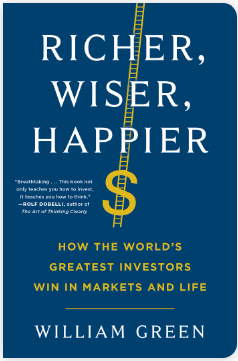
Richer, Wiser, Happier is a brilliant book by financial journalist William Green. Interviewing some of the smartest investors in the world, Green helps us uncover a range of insights such as how the investors maximize their odds of long-term success in markets, what we can draw from their life lessons and how we can improve our own thinking.
The list of investors includes Mohnish Pabrai, Sir John Templeton, Howard Marks, Jean-Marie Eveillard, Joel Greenblatt, Will Danoff, Nick Sleep, Qais Zakaria, Tom Gayner, Charlie Munger, Ed Thorp and Bill Miller.
As Green finds out, "the best investors tend to be open-minded pragmatists who search relentlessly for ways to improve their thinking".
Quote
“The Great Depression in the United States, far from being a sign of the inherent instability of the private enterprise system, is a testament to how much harm can be done by mistakes on the part of a few men when they wield vast power over the monetary system of the country.”
— Milton Friedman
Chart
U.S. households savings rate drops, credit card loans at record highs
During the early stages of the covid-19 pandemic, the U.S. government handed out three separate checks to eligible individuals: $1,200 in April 2020, $600 in December 2020/January 2021 and $1,400 in March 2021.
These handouts were the primary drivers behind a significant boost to the household savings rate (blue line, right axis) and the resultant reduction in credit card and other revolving loans (red line, left axis).
Since the end of these programs, and the consequent inflationary pressures, households now have the lowest savings rate since the global financial crisis and have had to turn to more short-term loans than ever before. The combination has resulted in subprime borrowers missing loan payments faster-than-normal, raising eyebrows given the expected interest rate increases to come over the next few months.

Articles
Pakistan Rupee drops past 200 a dollar with IMF bailout uncertain
On May 19, Pakistan’s currency fell past 200 a dollar for the first time ever as a shortage of dollars threatened to spiral into a full-blown crisis. The country's foreign-exchange reserves now cover less than two months of imports.
Policy makers are in talks with the International Monetary Fund (IMF) to revive a stalled $6 billion loan program. Key conditions would require Prime Minister Shehbaz Sharif to raise fuel and electricity prices, which risks public backlash given inflation is already at 13%. Meanwhile, ousted PM Imran Khan has threatened to add fuel to the fire (no pun intended) by leading street protests calling for early elections.
On May 28, the currency saw some respite which has proven temporary, as the government duly obliged to one of the IMF preconditions by raising fuel prices, paving the way for the release of $1 billion. Further price hikes are expected, in addition to the removal of subsidies on electricity rates.
Separately, the Pakistani government is currently in talks with the Chinese government over the rollover of a $2.3 billion syndicated Chinese loan it paid back in March.
UAE Energy Minister: We are nowhere near peak oil prices
With Brent crude over $123 a barrel, Suhail Al-Mazrouei believes we are "nowhere near" peak oil prices given the expected rebound in Chinese demand, adding further pressure to an already tight oil supply backdrop. The UAE is a key OPEC+ member.
The Energy Minister added that without more global investment in oil and gas, OPEC+ cannot guarantee sufficient supplies as demand continues to rise. Aside from 2-3 members, the rest of OPEC+ members are maxed out in terms of the supply they can bring online. What will happen when the other members run out of spare capacity?
Al-Mazrouei pointed out that prices can reach "unseen" levels if Russian oil and gas is completely taken off the market given we are already "lagging by almost 2.6 million barrels a day, and that’s a lot”.
Note that OPEC+ production has consistently missed their own supply targets, despite every economic incentive to do the opposite and will likely struggle to deliver on recent pledged increases.
Hedge fund D1 which borrowed $2 billion to buy stakes in private companies, braces for plunging valuations
At BTU, we have been concerned about the elevated valuations and the amount of money chasing private companies, particularly within the tech sector. In Issue #13, we raised the fact that exits continue to be a small fraction of deal count, hovering around 10% even during the 10+ year equity bull market.
We are now starting to learn that some hedge funds bet heavily on exciting yet money-losing start-ups. Hedge funds are the least capable of withstanding major valuation shocks given their liquidity mismatch (investors can typically redeem their money within 1-12 months, but are investing in illiquid start-ups with low exit probabilities). This can result in fire sales or worse, a "run on the bank" type scenario.
Bloomberg reported that the industry is "bracing for a reckoning". Hedge funds improved their returns by investing in start-ups (while times were good) and simultaneously lowered their perceived volatility as private companies are revalued less frequently (in industry lingo, this improved their "information ratio"). D1 is certainly not the only hedge fund that followed this strategy. Bloomberg highlights that Tiger Global, Lone Pine Capital, Coatue Management and Viking Global Investors are also the "most active buyers of those assets". Unsurprisingly, Tiger Global has enacted a redemption plan.
China technology stocks rally as optimism builds over regulatory crackdown easing
Investors in Chinese technology stocks have struggled since the government crackdown began towards the end of 2020. This week, there were encouraging signs that the regulatory pressure on the sector may be abating, after the government approved a new batch of video games and regulators ended their year-long probe on Didi, enabling the company to return to domestic app stores after being removed due to national security concerns.
It is expected that Didi will receive a large fine, and may have to offer a 1% equity stake to the state as well as hand over more direct control, following the path of Weibo and Beijing ByteDance Technology, the company behind Douyin and TikTok.
Separately, China is considering reviving Jack Ma's Ant Group IPO which it halted in November 2020. The company is expected to soon receive a long-awaited license that would result in it being regulated more like a bank.
Podcast
Tim Ferriss recently interviewed legendary investor Edward Thorp. The podcast (found here) is a wonderful listen, full of thought-provoking content and wisdom. If you prefer to read the transcript, it is available here.
Here are some of our favourite parts:
Thorp, a mathematician, got into investing having made money at blackjack and from book royalties. When it comes to investing, he believes that most people should simply invest in index funds, rather than try to manage their own portfolios. He does make an exception for those that are really interested in investing:
If you really are interested in investing, it’s worth educating yourself and trying to do it because you will learn a lot about investing. You might actually find a way to win and you’ll learn about how the world works and a lot about life too. The things you learn from what seems like a narrow, specialized field, generalizes very widely to all kinds of things if you’re the kind of person who can take a lesson in one part of life and transport it to another part of life.
Thorp considers himself "very risk averse" despite his track record of very high returns:
If you lose most of your capital, it’s very hard to climb back out. For instance, if you lose 90 percent of your capital, you’ve got to multiply what’s left by 10 in order to get back to even, which means you’ve got to make 900 percent to offset that 90 percent loss. That’s not going to be easy to do. It takes a long time. So you want to avoid really bad outcomes.
He emphasises the importance of learning how to think, not what to think:
If you think fast, it’s kind of emotionally from the gut, responding without really reflecting. You will make a lot of mistakes. Sometimes though it’s a way of saving your life. For example, somebody yells fire, you’re at the door of the theatre, you run out the door immediately, before you find out whether there is a fire.
Some words of wisdom:
What’s important in life, I think is the journey and the people you know and you spend your time with and how you spend your time otherwise also.
One of the things that makes you independent is to accumulate capital because then the capital can grow on its own if it’s simply invested as I described before, in, for example, an index fund. And once you have capital, then you have the chance of independence. If you have enough capital, it will support you indefinitely. So when you’ve achieved that goal, there’s no point in spending time doing anything you don’t like doing if you can help it. I have to do some things you don’t like, like gather all your tax information together every year, or go in for routine medical appointments.
Edward Thorp leaves us with a powerful story and some food for thought:
Joseph Heller wrote his famous book, Catch-22, of which they made a movie way back maybe 50 years ago. I’m not sure exactly when. But it was very well known and famous at the time. And Kurt Vonnegut is well known too for a variety of books. And Joseph Heller died, I’m not sure when, maybe early 2000s. And Kurt Vonnegut was writing in The New Yorker about him. And he said, “Joseph Heller and I were at a hedge fund mogul’s house.” I’m not sure if it was hedge fund mogul, but somebody very, very rich in New York. “And I said to Joseph Heller, ‘You’ve made a lot of money out of Catch-22. This guy makes as much money in a day as you’re ever going to make. He’s got penthouses and yachts and jets and villas and models falling off his arm and so on.'” And Joseph Heller looked back and said, “I have something he’ll never have.” Kurt Vonnegut was puzzled and he said, “What’s that?” Heller said, “I have enough.” And that’s something that people who endlessly chase money to the end don’t figure out: that you can have enough and it’s better than not having enough.
Until next time...
Thank you for reading this week’s issue. If you found it interesting, consider sharing it with someone like-minded.
Do you have any questions or thoughts? Please feel free to reach out.
Have a wonderful week.
Why ‘Buy the Umbrella’?
Individuals, many of whom also run businesses and governments, tend to not think of the downside when the present is stable, and the future is looking positive (usually when we feel most in control).
Just because it is currently sunny, does not mean it will never rain. If we are not prepared, once it does begin to rain, we will end up running around looking for an umbrella in the middle of a storm, when they tend to be in short supply. We therefore need to ‘buy the umbrella’ before it rains.
Simultaneously, we cannot allow our awareness of risk to make us fearful, pessimistic, or paranoid, as this too works against us over the long-term.
Having the right mindset in advance is critical. The challenge is getting the right balance between being optimistic about the future and being able to not only withstand future crises, but in fact grow stronger due to the opportunities they tend to present.
It is not enough just to be conservative. One needs to be willing to put our cash to work when others feel least comfortable doing it. To do that with confidence, we need to have a foundational understanding of history, business, markets and human psychology.
Our mission at BTU is to learn as much about the world as possible, and in doing so, to try to find investment opportunities with favourable risk/reward characteristics. These should, over the long term, help build sustainable wealth.