
Hi there!
Here is your latest dose of “Buy the Umbrella”, a short list of interesting things I’ve been reading and thinking about during the week.
Tweet

Sara Blakely's story is inspiring.
At the age of 27, Blakely started Spanx with $5,000 in savings from selling fax machines and had no business experience. Just over 20-years later, she has built the company into a $1bn+ business that Blackstone recently announced it was taking a majority stake in.
To learn the full story, check out Sahil Bloom's Twitter thread.
Quote
"Beliefs are hypotheses to be tested, not treasures to be guarded."
"The forest was shrinking, but the Trees kept voting for the Axe, for the Axe was clever and convinced the Trees that because his handle was made of wood, he was one of them."
— Turkish Proverb
Charts
Allocations by investors towards equities are at an all-time high, eclipsing the levels from the dot-com bubble in 2000...
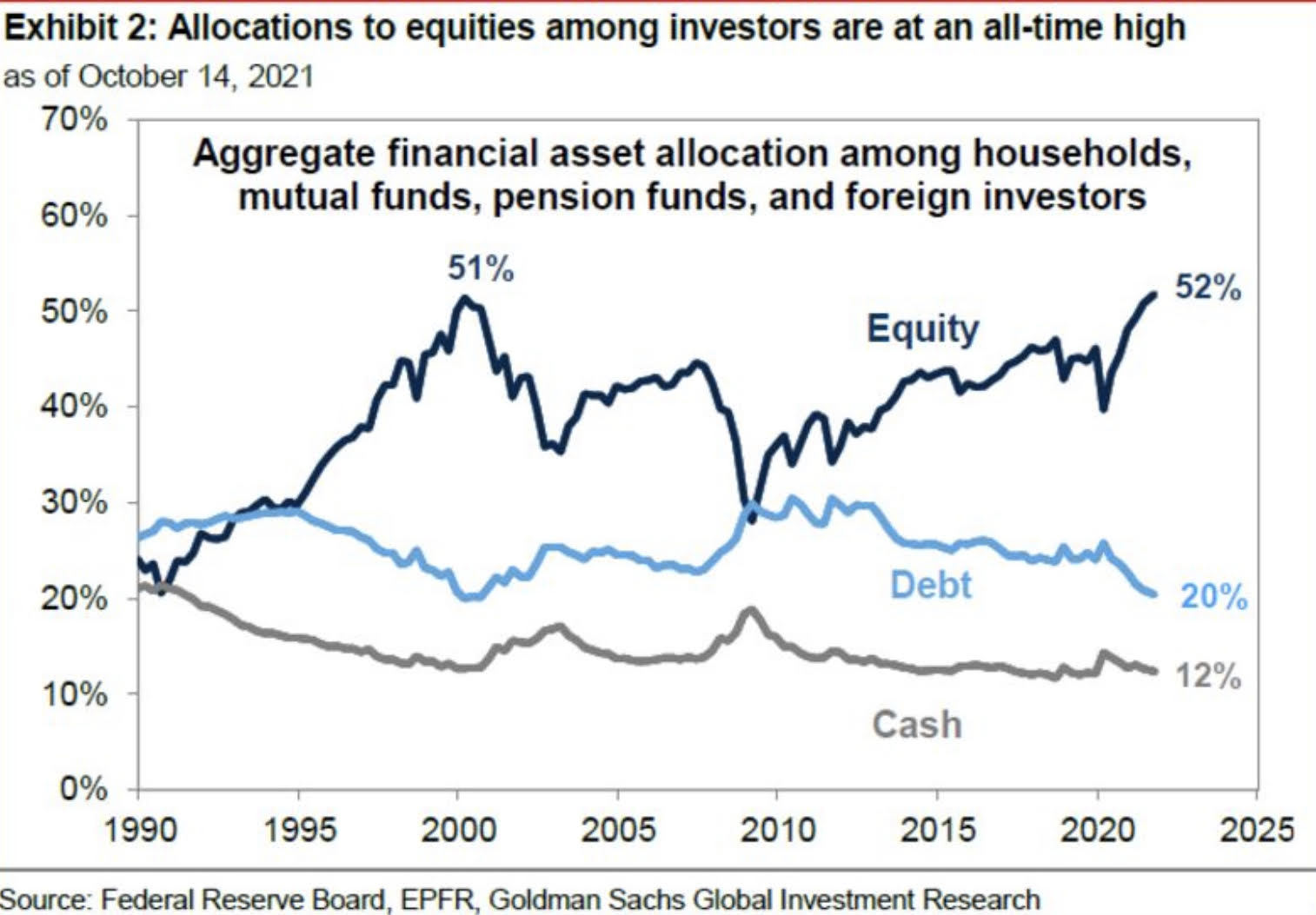
The above chart becomes particularly interesting when paired with the chart below, which shows that S&P500's operating margins are at a record high.
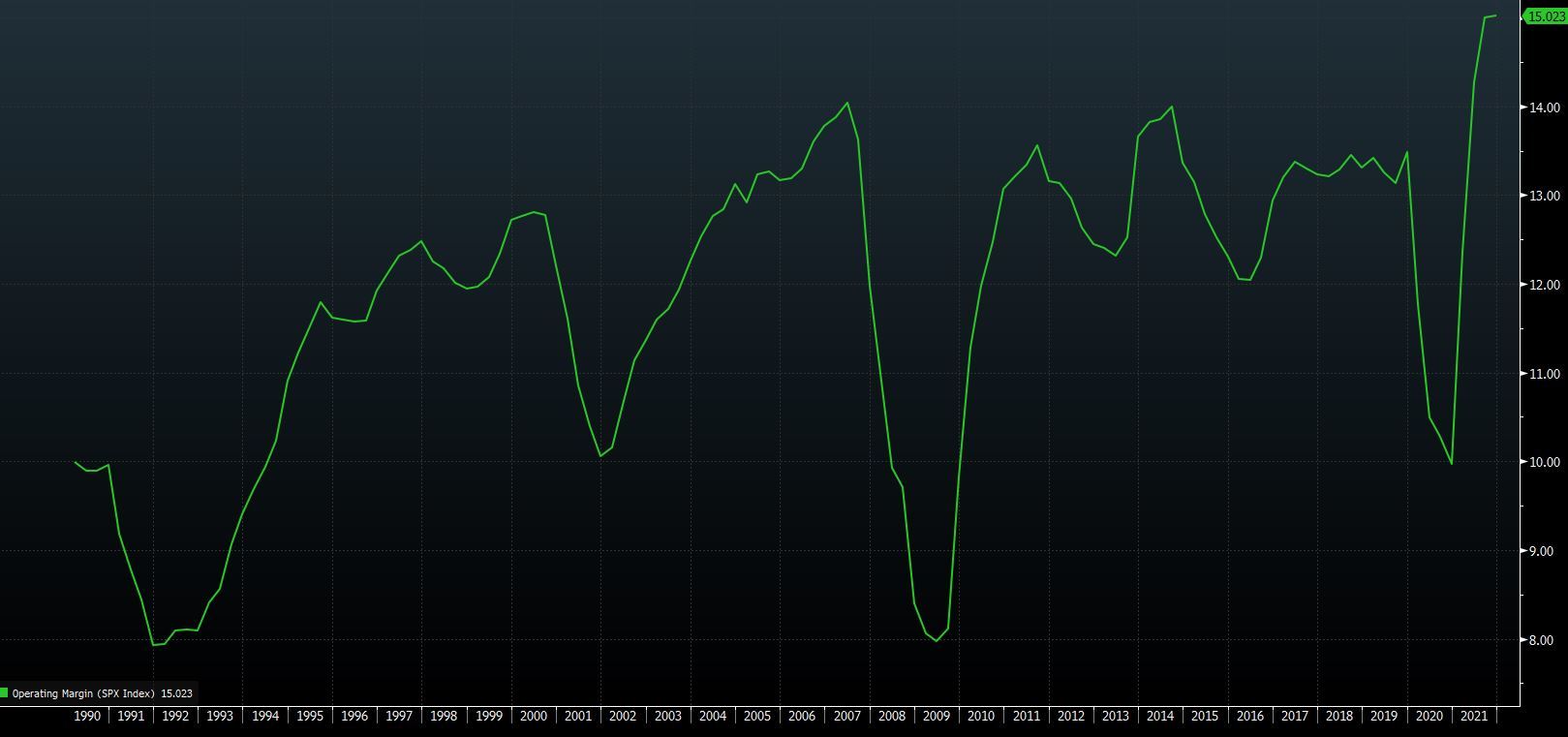
Is it possible that earnings will fail to live up to expectations in 2022/23 due to continued supply constraints and rising cost pressures? Could we therefore be at (or near) peak margins? If so, will market valuations take a hit in response to potentially lower profitability or, will companies find ways to cut costs in other areas (i.e. lean into digital transformation projects)?
Things that make you go hmm...
1. Trump's social media company 'TRUTH' recently listed. It’s market value evolution is as follows:
20th Oct 2021: $380 million
29th Oct 2021: $3.1 billion
2. Tesla's market value evolution:
1st Jan 2020: $75 billion
1st Jan 2021: $669 billion
29th Oct 2021: $1.11 trillion
3. Exxon vs. Amazon
Exxon Mobil
Market value on 29th Oct 2021: $249 billion
Operating cash flow & free cash flow year-to-date: $31.0bn & $20.2bn
Amazon
Market value on 29th Oct 2021: $1.67 trillion
Operating cash flow & free cash flow year-to-date: $24.2bn & -$17.9bn
Article
Bloomberg reported that the Chinese authorities told billionaire Hui Ka Yan to use his personal wealth to alleviate China Evergrande’s deepening debt crisis.
This would be a fascinating development if true, as it signals that Beijing are reluctant to pursue a government rescue, even as the crisis spreads to other developers and sours sentiment in the local real estate market.
Most importantly, it signals to other companies across the country that reckless risk taking will not be accepted at the cost of tax payers and therefore shareholders and creditors will be wiped out in the event of self-inflicted distress.
To read the full Bloomberg article, click here.
Until next time...
Thank you for reading this week’s issue. If you found it interesting, please consider sharing it with a like-minded friend or family member.
If you have any questions or feedback, please reach out!
Have a great week.
Why ‘Buy the Umbrella’?
Individuals, many of whom also run businesses and governments, tend to not think of the downside when the present is stable, and the future is looking positive (usually when we feel most in control).
Just because it is currently sunny, does not mean it will never rain. We need to buy the umbrella before it rains. Otherwise, by the time we are running around looking for an umbrella in the middle of a storm, they tend to be in short supply.
At the same time, we cannot allow our awareness of risk to make us fearful, pessimistic, or paranoid, as this too works against us over the long-term.
Having the right mindset in advance is critical. The challenge is getting the right balance between being optimistic about the future and being able to not only withstand future crisis, but in fact grow stronger due to the opportunities they tend to present. It is not enough just to be conservative. You need to be willing to put cash to work when others feel least comfortable doing it. To do that with confidence, we need to have a foundational understanding of business and markets.
Our mission is to learn as much about the world as possible, and in doing so, to try to find investment opportunities with favourable risk/reward characteristics. These should, over the long term, help build sustainable wealth and enable financial freedom.