
Hi there!
Here is your latest dose of “Buy the Umbrella”, a short list of interesting things I’ve been reading and thinking about during the week.
Quote
“Everything that can be counted does not necessarily count; everything that counts cannot necessarily be counted.”
— Albert Einstein
Charts
Private sector sensitivity to rising interest rates
In BTU issue #12 we shared a chart of U.S. households' transition towards fixed-rate mortgages and away from adjustable-rate mortgages, helping cushion households from rising interest rates.
Furthermore, corporates and households' direct sensitivity to higher interest rates should be relatively low given the loan-to-deposit ratio at US banks is at a 50+ year low. In fact, the private sector currently sits on $5.8 trillion of gross savings therefore, all else equal, 200 basis points increase in interest rates on these assets would add $116 billion per year to gross income. Of course, other variables will not remain constant. Nonetheless, could a rate hike perversely stimulate demand? More importantly, will we therefore need more rate hikes in order to tame spending and bring down inflation?
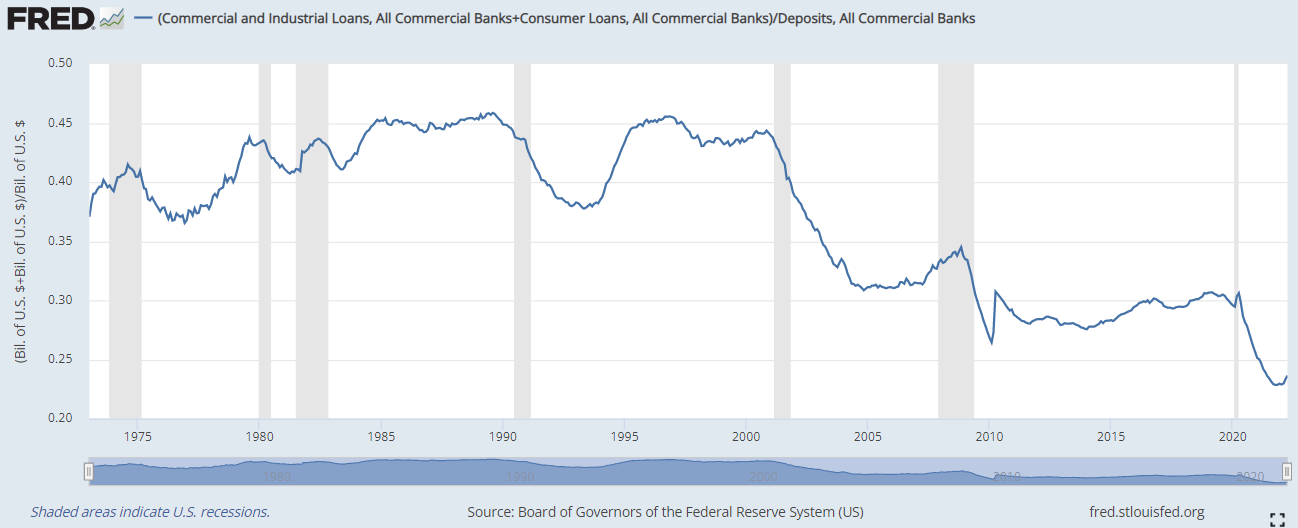
We must not forget that monetary policy acts with a long and unpredictable lag. The Fed believes it can take anywhere from 3-24 months to impact the economy, and the effects on inflation "tend to involve even longer lags, perhaps one to three years, or more".
Oil market structure continues to be bullish
The International Energy Agency's (IEA) chief believes that the current energy crisis is "much bigger" than the oil shocks of the 1970s and that it would also last longer.
This is illustrated by U.S. inventories which continue to decline and are currently below the 5-year average. The U.S. Energy Information Administration (EIA) currently believes this will begin to resolve itself during the second half of this year and into 2023. The EIA has so far persistently underestimated the strength of oil demand - what happens if demand continues to outpace supply?
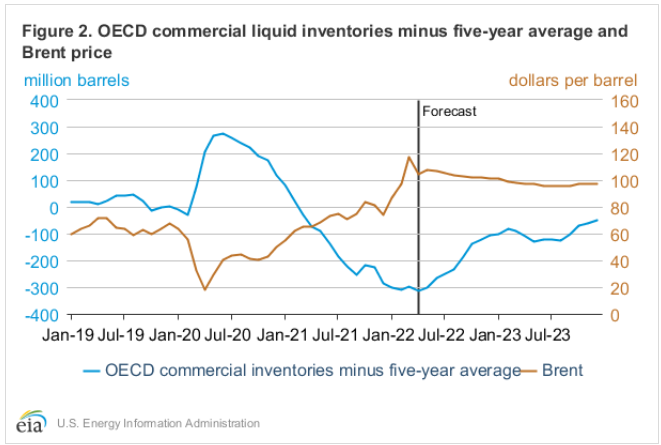
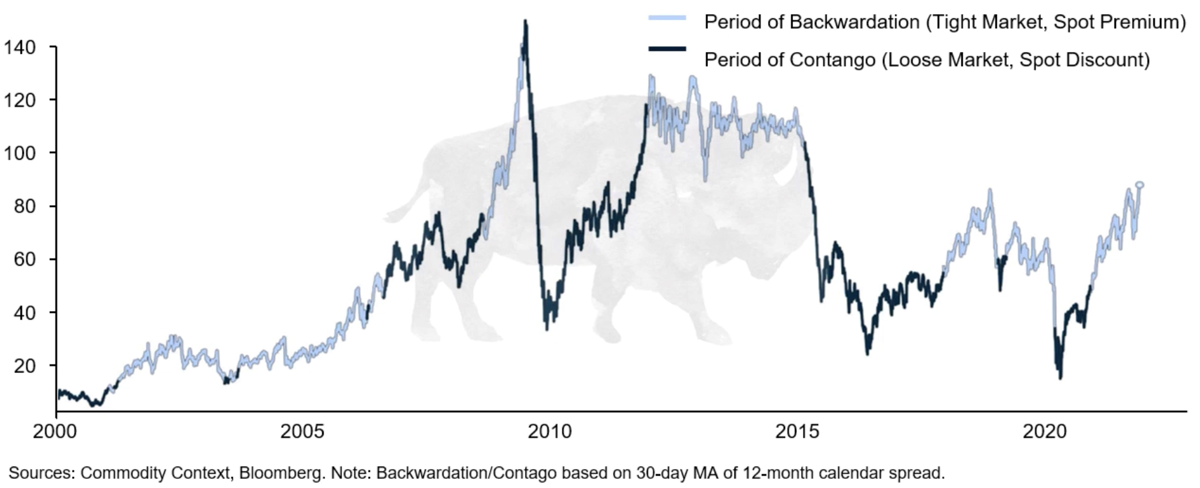
In addition, the IEA chief believes that Europe could face fuel shortages this summer due to tight oil markets. Demonstrating the global squeeze, oil markets are currently in backwardation (i.e. oil sold and delivered today is more expensive than oil stored and delivered in the future), which historically has been bullish for oil prices as per the chart below:
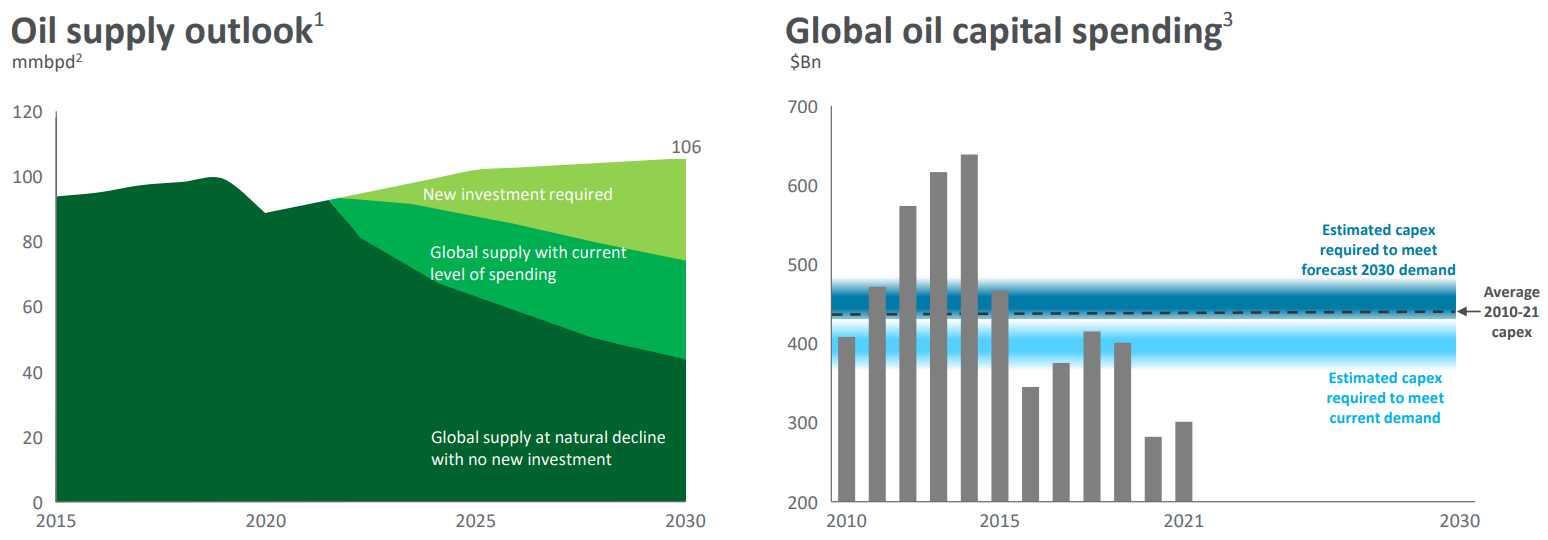
Saudi Aramco, which produced 13 million barrels of oil equivalent per day in Q1 2022, highlighted the need for substantial new investments to compensate for the decline in existing fields. In the graph below, the dark green area shows the global supply at natural decline with no new investment, while the lightest green shows the additional level of investment needed on top of what is already planned to ensure oil supply can meet 2030 demand.
Management believe at least $400 billion per year in capital investment is needed to meet current demand, yet upstream investment continues to be materially below that level, as highlighted by the bar chart. This suggests higher oil prices are likely to be with us for a while.
Food prices continue their two-year-long upward trajectory
In nominal terms, the World Bank's Food Commodity Price Index hit a record high in April 2022. These developments are being closely tracked by the World Bank and discussed in a chart-filled blog post which is helpful read to understand what got us to this point. The World Bank expects food prices to rise ~20% this year before easing in 2023, although it is not clear what will drive the easing.
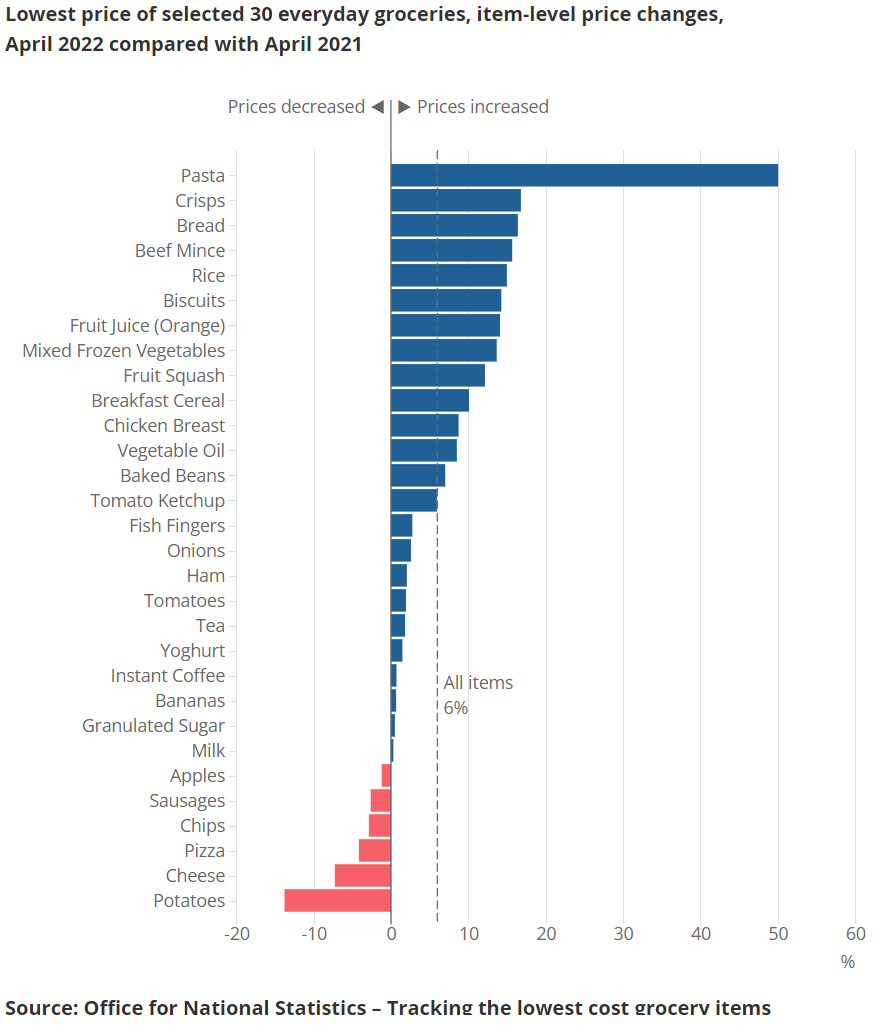
In the U.K., the Office for National Statistics (ONS) has found a "substantial range of price movement" for the lowest-cost grocery items:
Article
Dubai saw the biggest increase in high-end property prices globally
In 2021, Dubai's prime real-estate prices rose 56%, according to Knight Frank. This is believed to be a result of the government’s nimble response to the coronavirus which boosted investor confidence and pulled in money from around the world. Incredibly, the move topped every other major city and far exceeded increases of 1.3% in London, 3.6% in New York and 19% in San Francisco.
Investor report
Bridgewater have published a 10-page update from their CIOs titled "What was coming is now upon us" and is a worthwhile read.
A few interesting takeaways:
While we have had two federal reserve interest rate hikes and a series of further hikes are priced in, Bridgewater note that the market is discounting a high likelihood of easing following the hikes, which is atypical.
"The yield curve is flat from three years to thirty years, discounting either no risk premium in bonds or a significant easing after a moderate tightening cycle".
A big supply/demand "hole" is developing in the bond market, given the fed is expected to start unwinding its balance sheet, foreigners are selling and the U.S. government is issuing more bonds. Who will step in to bridge the gap?
Discounted earnings have "not changed much" despite a clear present value effect on equities for the most liquidity-sensitive, longer-duration cash flow companies.
Nominal GDP growth continues to be "well above" levels of interest rates, which "supports the self-reinforcing nature of nominal spending, income, and credit growth". This difference in the U.S. is as wide as any time in the past six decades.
Nominal growth rates are high and have "a lot of momentum" however, real growth is weakening as economies approach capacity constraints. As a result, "increasingly high nominal spending is being absorbed by prices, so you get less real stuff for your money". Low growth and high inflation (aka stagflation) is challenging for central bankers as they are "forced to choose between two undesirable outcomes: tighten to control inflation at the cost of an economic downturn, or don't tighten and allow a higher level of inflation".
Things that make you go hmm...
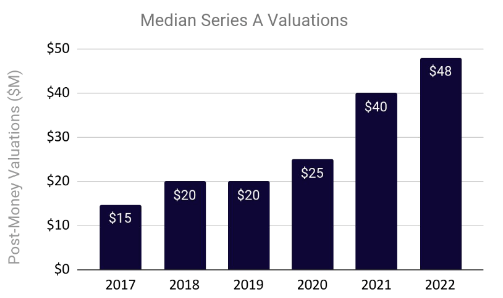
Frothy valuations have driven median venture capital Series A post-money valuations higher by 92% over the last two years alone according to Pitchbook data. It is likely that venture capitalists who "won" deals based solely on paying the highest price will probably have a tough time going forward.
Until next time...
Thank you for reading this week’s issue. If you found it interesting, consider sharing it with someone like-minded.
Do you have any questions or thoughts? Please feel free to reach out.
Have a wonderful week.
Why ‘Buy the Umbrella’?
Individuals, many of whom also run businesses and governments, tend to not think of the downside when the present is stable, and the future is looking positive (usually when we feel most in control).
Just because it is currently sunny, does not mean it will never rain. If we are not prepared, once it does begin to rain, we will end up running around looking for an umbrella in the middle of a storm, when they tend to be in short supply. We therefore need to ‘buy the umbrella’ before it rains.
Simultaneously, we cannot allow our awareness of risk to make us fearful, pessimistic, or paranoid, as this too works against us over the long-term.
Having the right mindset in advance is critical. The challenge is getting the right balance between being optimistic about the future and being able to not only withstand future crises, but in fact grow stronger due to the opportunities they tend to present.
It is not enough just to be conservative. One needs to be willing to put our cash to work when others feel least comfortable doing it. To do that with confidence, we need to have a foundational understanding of history, business, markets and human psychology.
Our mission at BTU is to learn as much about the world as possible, and in doing so, to try to find investment opportunities with favourable risk/reward characteristics. These should, over the long term, help build sustainable wealth.