
Hi there!
Here is your latest dose of “Buy the Umbrella”, a short list of interesting things I’ve been reading and thinking about during the week.
Quote
“The history of the stock market shows many periods of twenty years or more when stock prices ended up precisely where they began.”
— Peter Bernstein
Charts
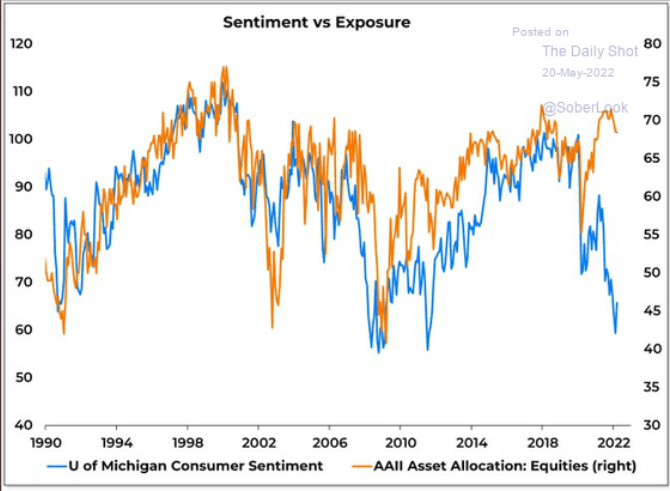
Equity allocations remain high despite declining U.S. consumer sentiment
U.S. equity market exposure continues to be at an elevated level according to the latest AAII survey, despite a rapid deterioration in consumer sentiment. In fact, consumer sentiment is already near the levels hit during the Global Financial Crisis in 2007-2008.
Given the close relationship these two variables have had over the last thirty years, could it be possible that a further sell off by institutional investors is lurking? Or will consumer sentiment rebound rapidly? A divergence this extreme is unlikely to hold up for long.
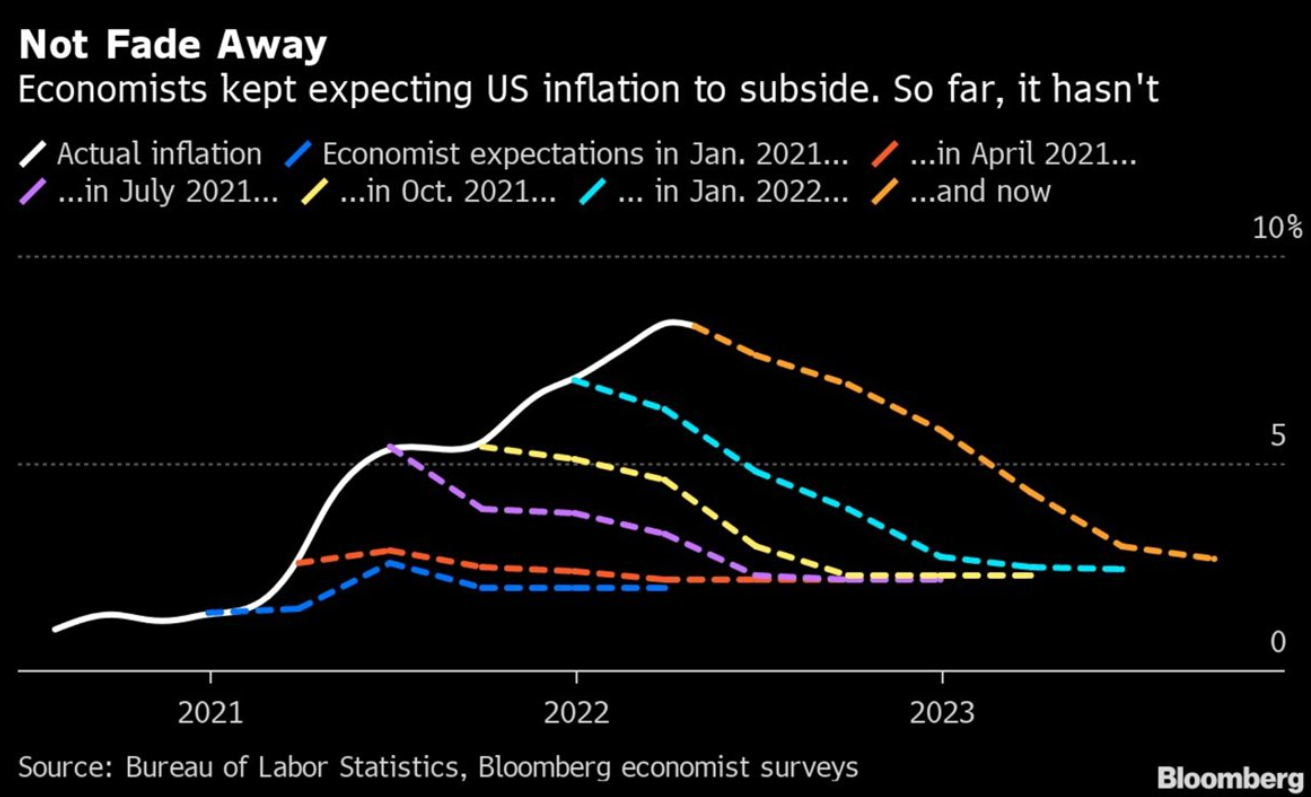
Inflation expectations continue to move higher
Since 2020, economists have had to push their US inflation expectations higher every few months. Despite this, they continue to believe that inflation will rapidly revert to approximately 2%.
The chart below is a helpful reminder to keep an open mind with regards to the future as no-one has a crystal ball, whether they are economists or even central bankers as per this tweet.
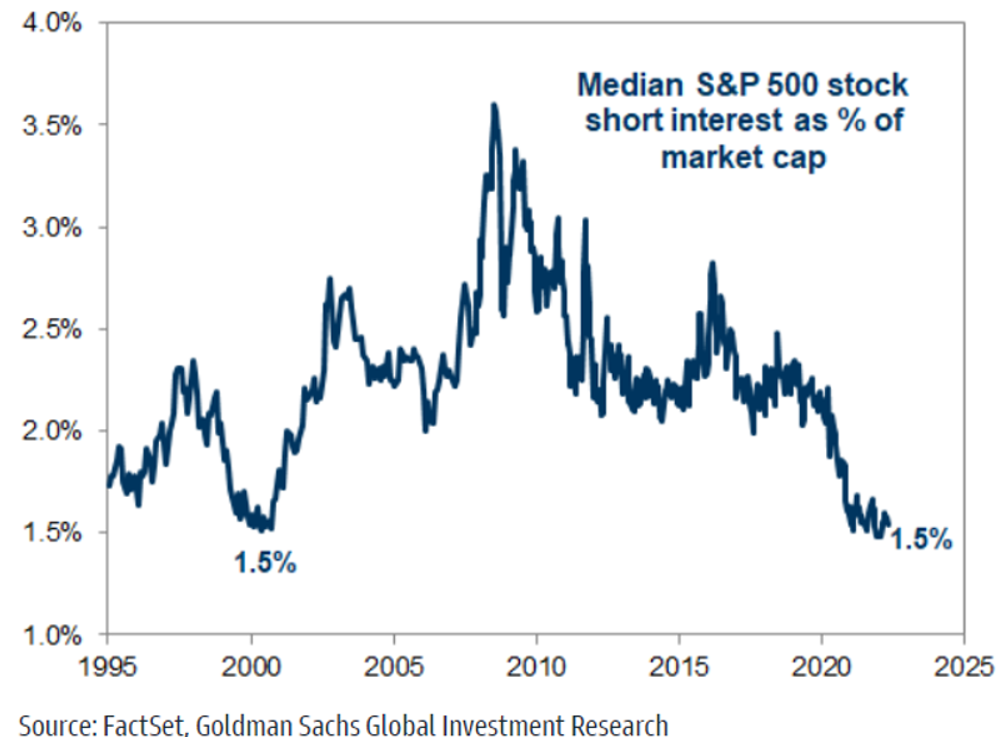
Short-interest at 1999/2000 lows
Goldman Sachs put together an incredible chart, showing that bearish bets against S&P500 stocks is at a low last seen as the dotcom bubble was about to deflate. Remember the saying: "history doesn't repeat itself but it often rhymes".
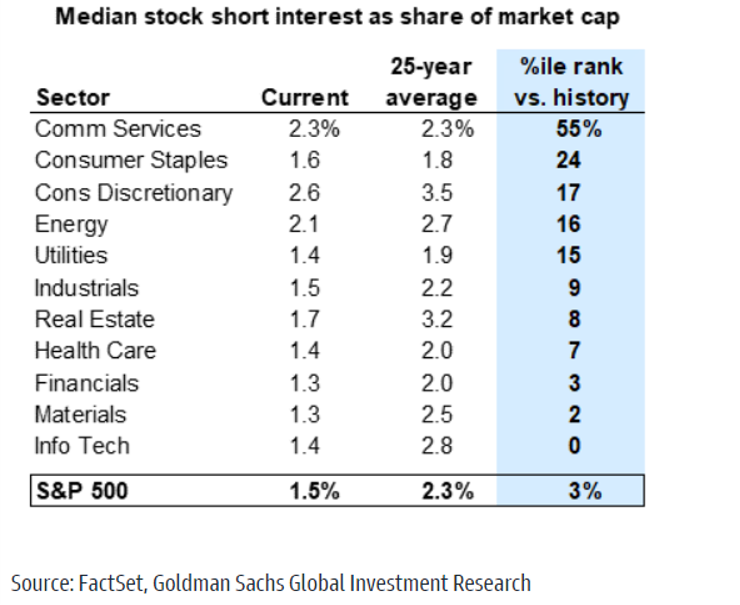
Breaking down current bearish wagers by sector is equally fascinating, with information technology at 0% quintile ranking versus history, despite elevated valuations.
Articles
Snap plunges 40%+ after CEO warning
This week Snap, the social media company behind SnapChat, warned that the macroeconomic environment has deteriorated "further and faster" than they expected when they issued their quarterly guidance just last month.
The CEO, Evan Spiegel, added “as a result, while our revenue continues to grow year-over-year, it is growing more slowly than we expected at this time” and as a result the company will slow its pace of hiring for the rest of the year.
India to limit sugar exports, adding to global food prices pressure
Bloomberg reported that India is set to restrict sugar exports as a precautionary measure to safeguard its own food supplies, another act of protectionism after banning wheat exports just over a week ago.
The move could be announced in the coming days, according to Bloomberg's sources. Critically, India was the world’s biggest sugar exporter after Brazil last year, and counts Bangladesh, Indonesia, Malaysia and U.A.E. among its top customers.
UK being warned of ‘apocalyptic’ food price rises
A quarter of Britons have resorted to skipping meals as inflationary pressures and a worsening food crisis combine in what the Bank of England recently dubbed an “apocalyptic” outlook for consumers.
A major British caterer commented that schools were now facing “difficult decisions” as to whether to reduce meal sizes or use lower quality ingredients amid surging prices.
Video
How to think about risk
Howard Marks' presentation on risk at Wharton is brilliant and thought provoking (full video at the bottom), addressing the most important question for all investors: how should we think about risk?
Marks makes a great point that many overlook: investor returns only tell you one part of the story. Performance has to be viewed in risk-adjusted terms. How much risk did the investor bare to get this return? What would returns have looked like if markets were hostile?
"Risk is the ultimate test of investment skill:
- It is not hard to achieve investment return
- That's especially true when the market rises, which it usually does
- The real achievement is achieving return with less-than-proportionate risk
Achieving an above average return with average risk is a significant accomplishment. Achieving an average return with below average risk is an equally significant accomplishment, albeit easily overlooked."
To demonstrate this Marks look at two scenarios:
A) the market generates returns of +10% and B) the market returns -10%. He then looks at the returns of several investors in both scenarios to figure out whether they are adding value or not.
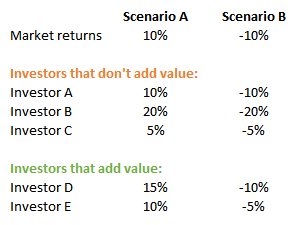
Investor A generates returns in line with the market, with market equivalent risk. Investor B meanwhile generates 2x market returns for 2x market equivalent risk (i.e. she is more aggressive). Investor C generates 0.5x market returns for 0.5x market risk (i.e. she is more conservative). Howard Marks points out that all three do not generate any real alpha (no skill) when taking into account their risk levels.
Now consider Investor D who adds value by generating asymmetry in returns: +15% in the first market scenario and -10% in the second. This suggests that she participates in the gains to a greater extent than the losses. Likewise, Investor E participates in the market returns in scenario A but loses less than the market in scenario B, highlighting that there are different ways skilful investors can add value.
Critically, Marks emphasises risk is not volatility although it can be an indicator of the presence of risk (a symptom). Otherwise, wouldn't venture capital and private equity be one of the least risky asset classes given they are not priced daily, weekly or even monthly and therefore appear to have less volatile returns? Of course, we know that is not the case.
So what is risk?
There are several types of risks to consider however, the most important one is the probability of permanent loss. This is followed by the risk of missing out on opportunities that drive a serious performance shortcoming, and the risk of being forced to sell at the market lows due to margin calls, loss of confidence or the need for cash. Unfortunately, risk cannot be quantified in advance or even in hindsight and is "a matter of opinion. A variety of experts will view it and quantify it differently".
Risk is largely a matter of price: "risk is not a function of asset quality: a high-quality asset can be priced so high that it's risky".
Consider this: most investors believe that to generate higher returns, you have to take higher risks. If high risk investments could be counted on to produce high returns, then they would not be risky. In reality, riskier investments have a wider range of outcomes, i.e. they are far from certain to deliver on their promise of high returns, as illustrated in the chart below:

Risk is something that should be dealt with constantly, not sporadically.
Highly skilled investors assemble portfolios that will produce "good returns if things go well and resist decline if things go poorly". Keep in mind: this is a hidden accomplishment most of the time as "risk only turns into loss occasionally... when the tide goes out".
“Only when the tide goes out do you discover who's been swimming naked.” — Warren Buffett
Ultimately, we should not expect to make money without bearing risk, but we also "should not expect to make money just for bearing risk".
Outstanding investors are "outstanding because they have a superior sense for the probability distribution that governs future events, and for whether the potential returns compensate for the risks that lurk in the distribution's negative left-hand tail. This enables them to achieve the asymmetry that characterizes them".
Until next time...
Thank you for reading this week’s issue. If you found it interesting, consider sharing it with someone like-minded.
Do you have any questions or thoughts? Please feel free to reach out.
Have a wonderful week.
Why ‘Buy the Umbrella’?
Individuals, many of whom also run businesses and governments, tend to not think of the downside when the present is stable, and the future is looking positive (usually when we feel most in control).
Just because it is currently sunny, does not mean it will never rain. If we are not prepared, once it does begin to rain, we will end up running around looking for an umbrella in the middle of a storm, when they tend to be in short supply. We therefore need to 'buy the umbrella' before it rains.
Simultaneously, we cannot allow our awareness of risk to make us fearful, pessimistic, or paranoid, as this too works against us over the long-term.
Having the right mindset in advance is critical. The challenge is getting the right balance between being optimistic about the future and being able to not only withstand future crises, but in fact grow stronger due to the opportunities they tend to present.
It is not enough just to be conservative. One needs to be willing to put our cash to work when others feel least comfortable doing it. To do that with confidence, we need to have a foundational understanding of history, business, markets and human psychology.
Our mission at BTU is to learn as much about the world as possible, and in doing so, to try to find investment opportunities with favourable risk/reward characteristics. These should, over the long term, help build sustainable wealth.