
Hi there!
Here is your latest dose of “Buy the Umbrella”, a short list of interesting things I’ve been reading and thinking about during the week.
Tweet
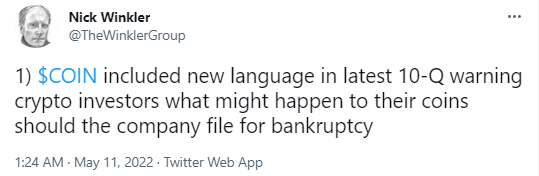
In Coinbase's most recent filing with the SEC, the company included new language warning crypto speculators that in the event of the company going through bankruptcy, users' coins "may be considered to be the property of a bankruptcy estate" and "could be subject to bankruptcy proceedings". As such, "customers could be treated as our general unsecured creditors".
In other words, if Coinbase were to go bankrupt, customers may lose control over their coins. What's particularly fascinating about this new warning is its timing given crypto's market value collapse from over $3 trillion in November 2021 to $1.2 trillion as of Thursday 19th May.
Quote
"A good mentor will teach you how to think, not what to think."
Charts
Global equity markets are quickly approaching, in some cases have already surpassed, bear market territory (defined as a >20% market decline from the prior peak).
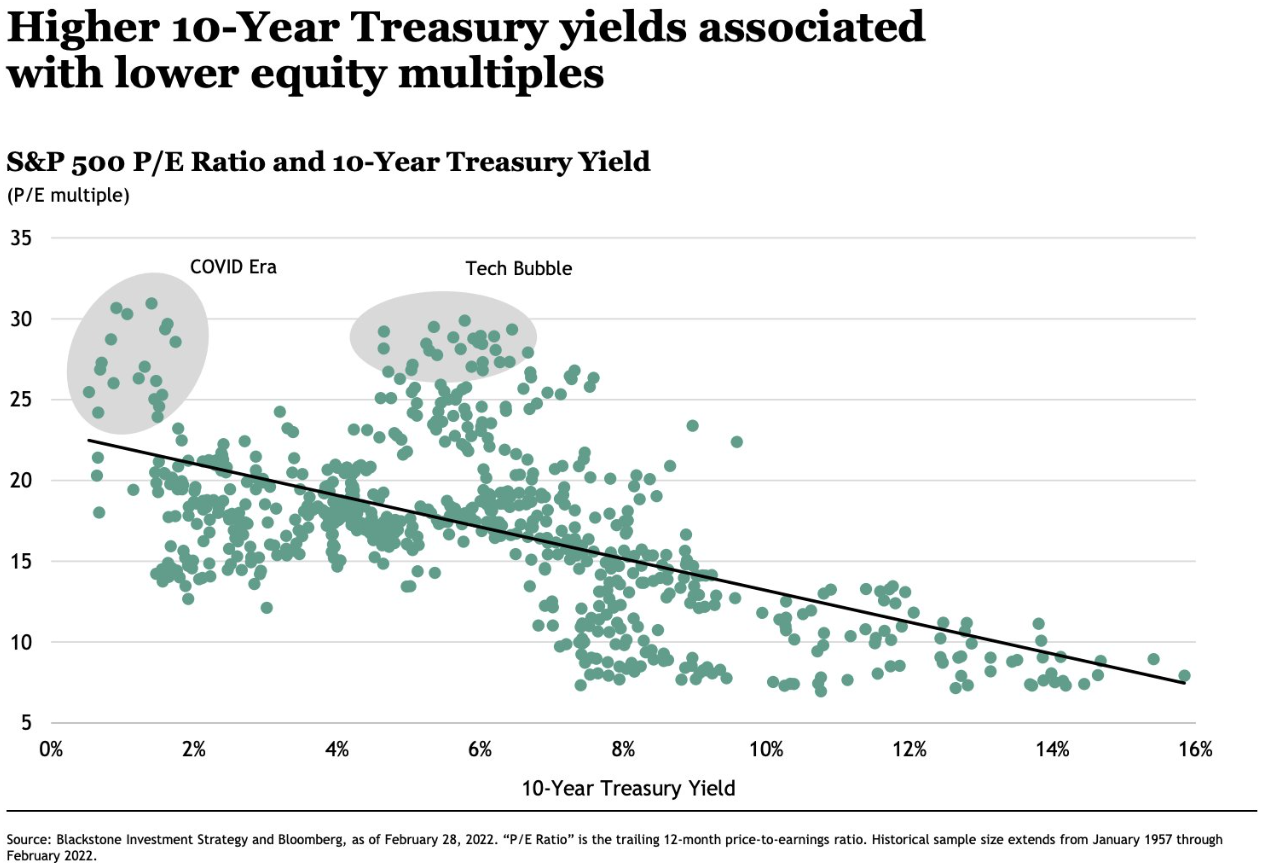
The S&P500, down almost 19% from its peak during the first week of January 2022, is trading at a price-to-earnings ratio of 19.6x. Meanwhile, the U.S. government's 10-year treasury yield is currently hovering around 3%. Based on Blackstone's analysis, if earnings hold up and yields stop their ascent, the S&P500 is at fair value, as shown in the chart below.
However, these assumptions are uncertain as earnings are likely to come under pressure due to rising costs that pressure operating margins. At the same time, yields may rise if inflationary pressures continue to concern investors.
Where inflation settles and how high yields are likely to rise is anyone's guess. Investors may want to see evidence of inflation cooling and/or valuations falling further before deploying built up cash reserves.
Side note: Nasdaq composite currently trades a price-to-earnings ratio of 37.4x.
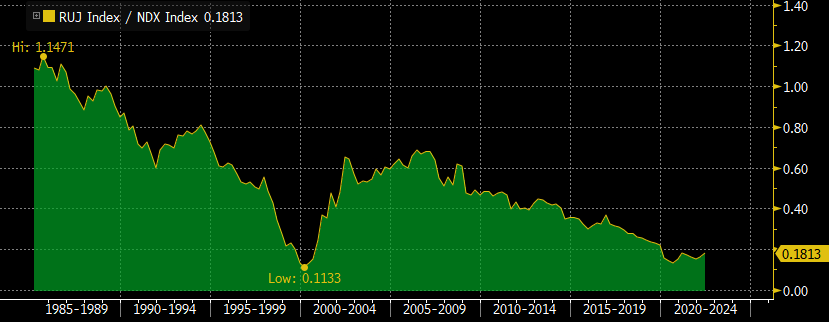
The Russell 2000 value index (made up of smaller "value" stocks) relative to the Nasdaq 100 (made up of larger mainly technology and "growth" stocks) could potentially be forming a bottom, as it did at the start of 2000. This marked the start of a 8+ year period where technology stocks underperformed.
Interestingly, many investors are currently overweight technology with the assumption that the sector will continue to outperform indefinitely. This seems unlikely especially when considering valuations relative to history.
To highlight the extreme weighting of technology, even within the S&P500, TMT currently makes up 36.5% of the S&P500, up from just 20-25% during the 2002-2017 period. Before the recent sell off, TMT was over 40% of the index, just below the 1999 peak of 45%. To us, it does not seem like a stretch to describe this as unsustainable. The odds favour a mean-reversion rather than further growth in the weighting of TMT.

When covering unsustainable valuations, we cannot forget the venture capital asset class which has enjoyed phenomenal returns since the global financial crisis, attracting large sums of inflows from institutions and interest from the public.
Using the Refinitiv VC Index, the asset class has returned almost 1,600% in just over 11 years (26.6% annualized). This has quickly unwound, with the index down over 53% since its peak. Even at current prices, it is tough to call the bottom given valuations are still elevated relative to historical metrics.
Start-ups may begin to tighten up their belts to reduce cash burn which is likely to decelerate revenue growth.

Articles
Softbank faces record loss as Masayoshi Son's bets tumble
The recent market correction has resulted in Softbank reporting incredible numbers. To start with, its Vision Fund, the largest technology fund in the world, has reported a loss of $18.6 billion on its public portfolio alone in the fourth quarter. This exceeds the $18.3 billion loss during its second quarter. Of course, Softbank is a huge technology investor in venture capital.
Accounting for Softbank's stake in the fund, the fourth quarter hit would account for a $10 billion loss. The rest of the losses are borne by other Vision Fund investors. To compound matters, the lack of transparency over how much of the funds’ assets are collateralized is fanning market concerns.
Investors' worries are highlighted by the stock's 53% decline and Softbank's credit default swap (i.e. the price at which investors are willing to insurance credit losses) rising to levels not seen since March 2020. That was when markets collapsed over worries due to the spread and consequences of covid-19.
Sri Lanka's PM says his country has ran out of petrol and will shortly run out of cash
Prime Minister Wickremesinghe said the economy is in an "extremely precarious" position as the country has ran out of petrol and will run out of cash to pay the 1.4 million civil servants their salaries in May. Adding to pressures, there is a possibility that the daily power outages will increase to 15 hours a day.
It appears the government will turn to money printing, with Wickremesinghe stating it is “against my own wishes, I am compelled to permit printing money in order to pay state-sector employees and to pay for essential goods and services". Printing money will likely add to inflationary pressures.
Things that make you go hmm...
Turbulence ahead for start-ups
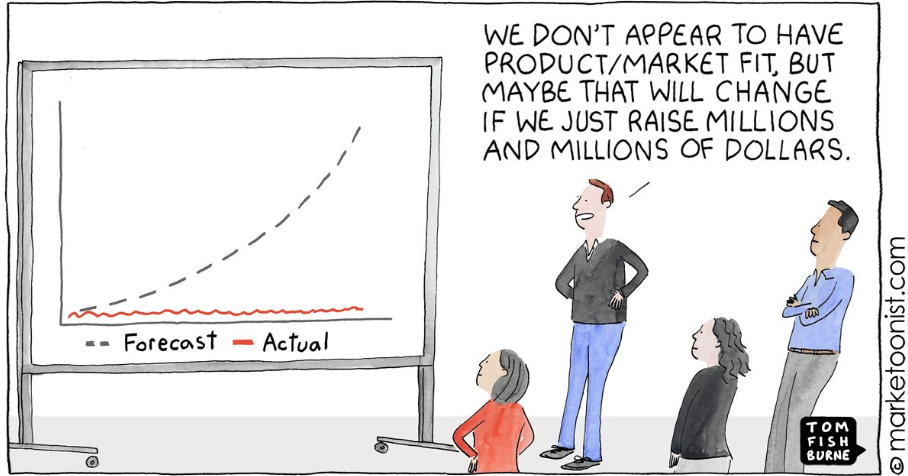
With public market valuations under pressure, how much longer will it take until we see a large number of start-ups run into speed bumps due to their inability to raise enough cash from investors?
Lockdown gains given back
According to an estimate by Morgan Stanley, amateur investors who jumped in when the lockdowns began have now lost all of their stock market gains. The calculation was based on trades placed by new investors since the start of 2020 and uses public data to tally cumulative profits and losses.
Until next time...
Thank you for reading this week’s issue. If you found it interesting, please consider sharing it with a like-minded friend or family member.
Do you have any questions or thoughts? Feel free to reach out.
Have a wonderful week.
Why ‘Buy the Umbrella’?
Individuals, many of whom also run businesses and governments, tend to not think of the downside when the present is stable, and the future is looking positive (usually when we feel most in control).
Just because it is currently sunny, does not mean it will never rain. If we are not prepared, once it does begin to rain, we will end up running around looking for an umbrella in the middle of a storm, when they tend to be in short supply. We therefore need to buy the umbrella before it rains.
At the same time, we cannot allow our awareness of risk to make us fearful, pessimistic, or paranoid, as this too works against us over the long-term.
Having the right mindset in advance is critical. The challenge is getting the right balance between being optimistic about the future and being able to not only withstand future crises, but in fact grow stronger due to the opportunities they tend to present. It is not enough just to be conservative. One needs to be willing to put our cash to work when others feel least comfortable doing it. To do that with confidence, we need to have a foundational understanding of history, business, markets and human psychology.
Our mission at BTU is to learn as much about the world as possible, and in doing so, to try to find investment opportunities with favourable risk/reward characteristics. These should, over the long term, help build sustainable wealth.