
Hi there!
Here is your latest dose of “Buy the Umbrella”, a short list of interesting things I’ve been reading and thinking about during the week.
Tweet
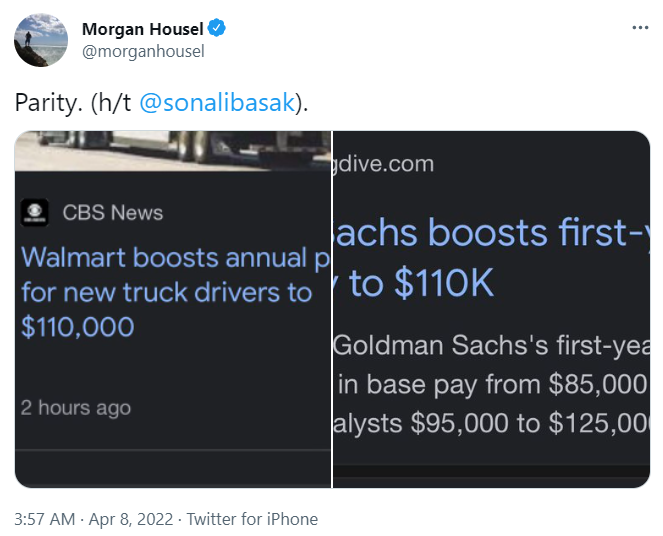
Morgan Housel's tweet highlighting the starting salary of $110,000 for Walmart's first year truckers and Goldman Sachs' first year analysts is pretty incredible.
Last year, trucking companies in the United States suffered a record deficit of 80,000 drivers, according to the American Trucking Associations (ATA). The ATA reported that the sector is heading towards a shortage of 160,000 drivers by 2030, and there is a need for one million new drivers over the next 10 years.
As a result, companies across the U.S. (and others, like the U.K., EU and Canada) are being forced to pay ever higher salaries to attract candidate drivers. Without more truck drivers, goods like fruits, vegetables, petrol and diesel are awaiting delivery and are exacerbating shortages.
Quote
"Writing makes you tighten up your thinking."
— Howard Marks
Charts
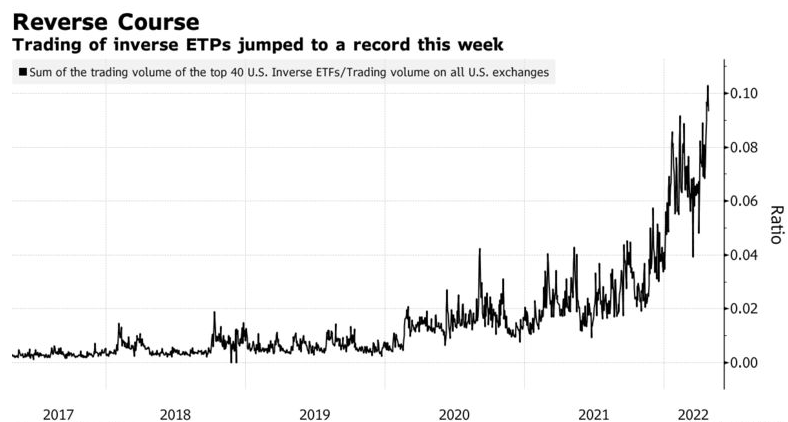
Bets on leveraged exchange-traded funds (ETFs)
Transaction volumes in leveraged ETFs hit an all-time high last week as investors struggled with the increased U.S. equity market volatility. The number of shares changing hands in the $17 billion world of inverse exchange-traded funds hit seven-times the average of the past five years on Wednesday, according to data compiled by Bloomberg.
Could this suggest that sentiment has tipped too far to the bearish side? If so, we may see equities move higher (at least in the near term) to shake investors out of these aggressive positions.
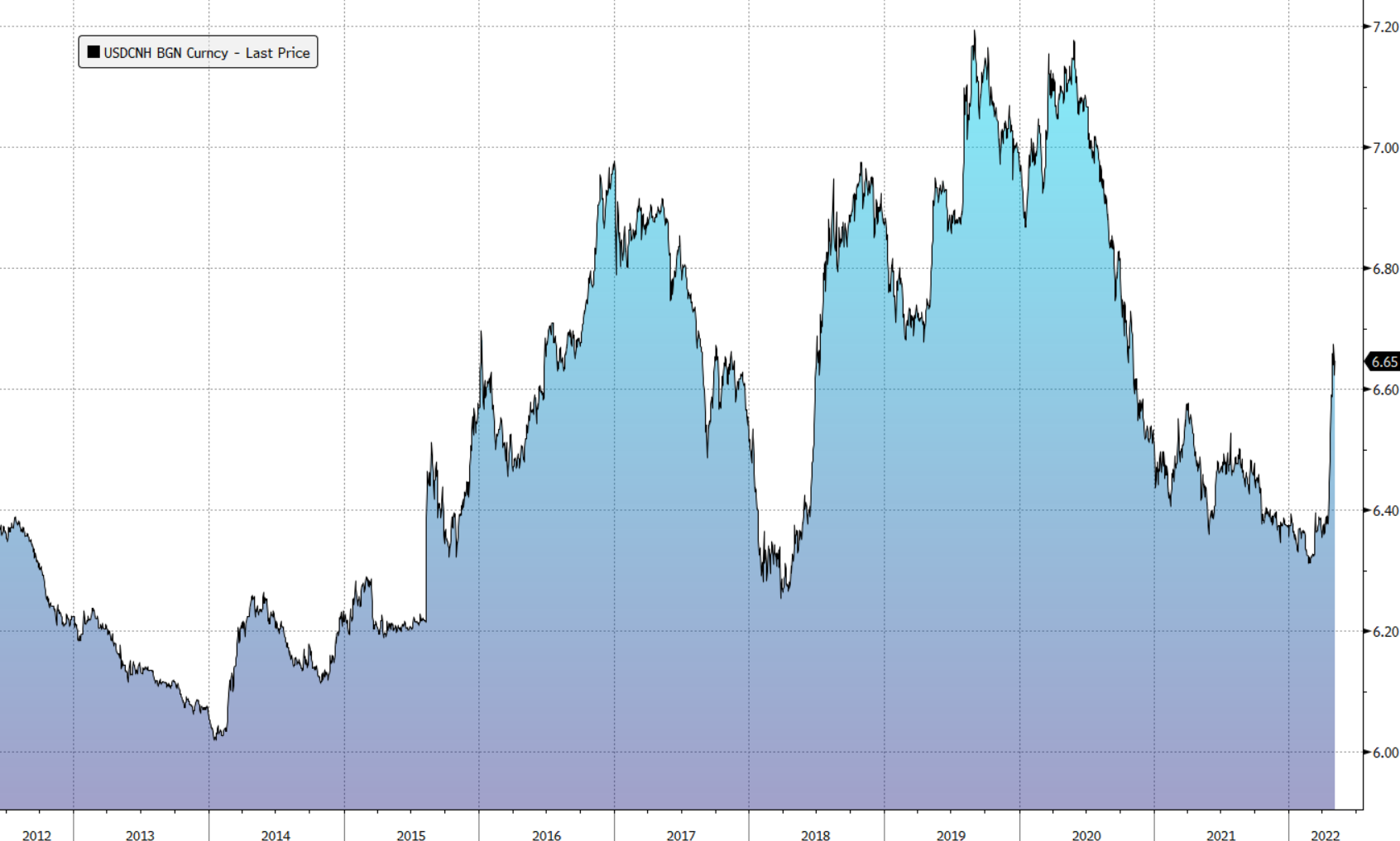
Chinese renminbi takes a tumble
China's currency took a record hit last month due to worries over the government's zero covid-19 policies which have resulted in major cities like Shanghai, and more recently Beijing undergoing strict lockdowns.

The currency has weakened to around 6.65 from 6.32 renminbi to the U.S. dollar. The weakest level of the last decade was set in 2019 at 7.19, around 8.6% away. Investors continue to expect the Chinese government to ease fiscal and/or monetary policy to support the economy and boost slowing economic growth.
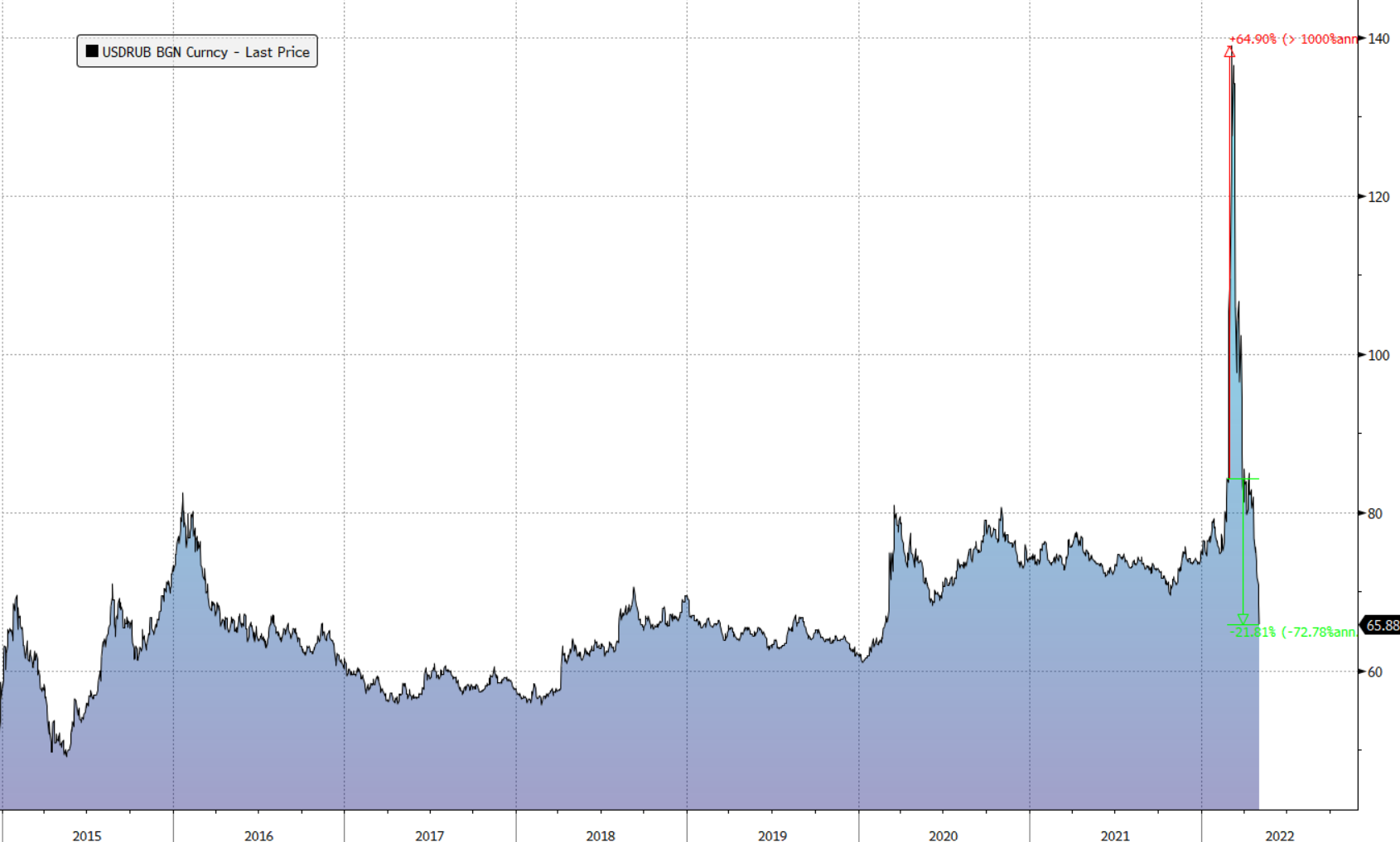
Russia's ruble continues to strengthen
Following the invasion of Ukraine and the subsequent western-led sanctions, the Russian currency collapsed to 140 rubles to the U.S. dollar. The country's central bank then took aggressive action to stop the bleeding by doubling short-term interest rates to 20% and applying capital controls. Since then, the ruble has reversed those declines and in fact hit the strongest levels since early 2020, currently trading around 66 rubles to the U.S. dollar.
Last week, rumours re-surfaced that the Kremlin was debating whether they should peg their currency to gold prices. The Bank of Russia's Governor Elvira Nabiullina has since dismissed the idea. These discussions were previously raised by a Russian security official back in August 2021 as policy makers believed linking the ruble to bullion could give Russia more sovereignty over its financial system.
Nasdaq declines during the bursting of the dotcom bubble
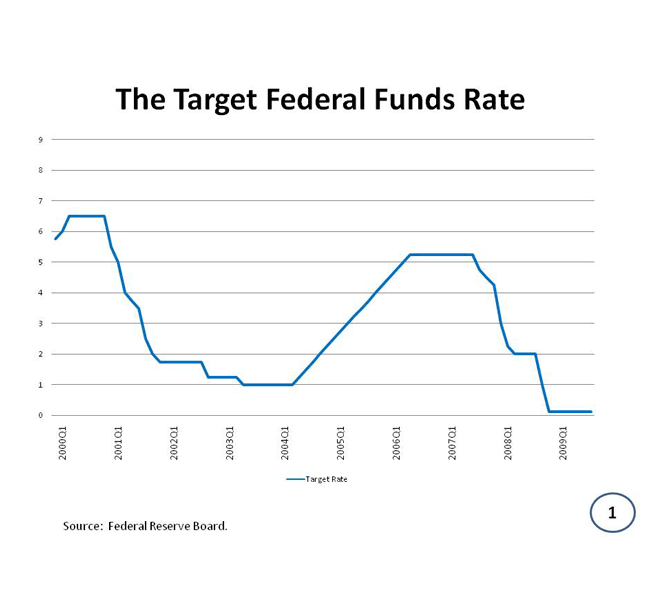
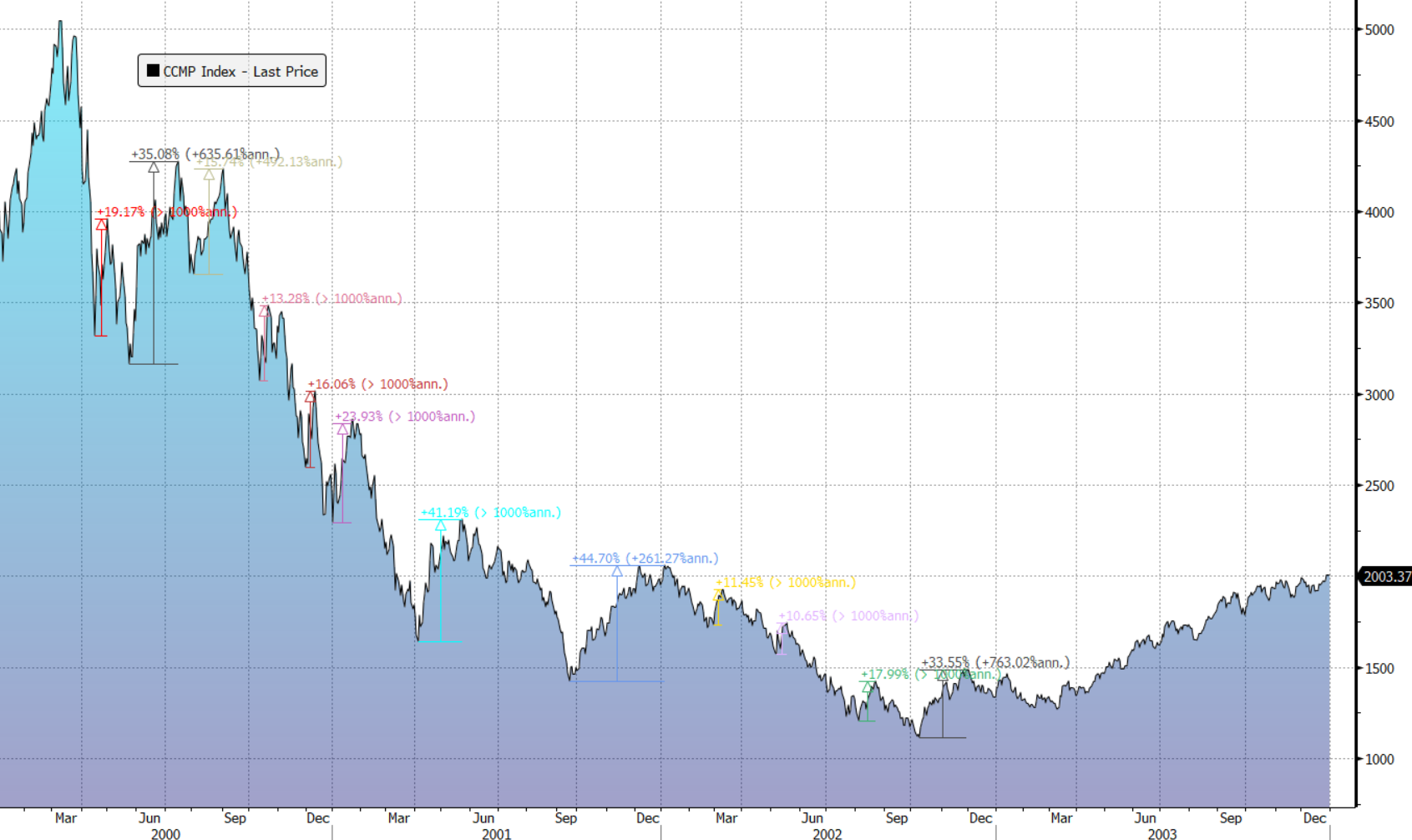
In the 2000 to 2002 slow-motion meltdown post the dotcom bubble, the Nasdaq Composite Index surged by 10% to 50% on at least 12 different occasions. Nevertheless, the Nasdaq tanked by almost 80% during that time, while the S&P 500 was cut in half. Incredibly, the steep losses occurred despite the Fed easing monetary policy throughout 2001-2003 (from 6.5% in late 2000 to 1.75% in December 2001 and to 1% in June 2003). In fact, Ben Bernanke labelled the easing as an "aggressive monetary policy response" in his 2010 speech.
Earnings Insights
Peabody Energy, a coal miner, reported earnings last week. The CEO indicated that he is seeing strong coal market backdrop, with "increased global demand and continued supply constraints".
Coal inventories have continued decline since December 2021, with a reduction of approximately 5% or 5 million tons. Russia accounts for 35% of global traded coal volumes.
The CEO expects that global thermal coal prices will remain "elevated" as "market indicators remain robust with global steel production, outside of China, at decade high levels".
Articles
U.S. federal reserve raises interest rates by 0.5%, the biggest increase in since 2000
On Wednesday, the federal reserve followed through on promises to turn more aggressive in tackling accelerating inflation in the U.S.. Powell has said he wants to quickly raise the fed’s rate to a level that neither stimulates nor restrains economic growth. Interestingly, the fed chair said a larger 75bps increase was not being “actively” considered.
In April, Powell told an IMF conference that he could see another 50 basis in June because demand for workers is "too hot – you know, it is unsustainably hot” creating the need to “front-load” rate hikes.
The popping of the bubble stocks: An update
Ray Dalio's latest piece discusses the "popping of bubble stocks" and as usual, backs up his views by historical data comparing today's environment to the 1920s and the 1990s bubbles.
Turkey's inflation rate accelerates to 70%
The country continues to struggle with hyperinflation, running at a 20-year high, and is a public reminder of what happens when rising inflation is not taken seriously by policymakers.
Until next time...
Thank you for reading this week’s issue. If you found it interesting, please consider sharing it with a like-minded friend or family member.
If you have any questions or feedback, please feel free to reach out!
Have a great week.
Why ‘Buy the Umbrella’?
Individuals, many of whom also run businesses and governments, tend to not think of the downside when the present is stable, and the future is looking positive (usually when we feel most in control).
Just because it is currently sunny, does not mean it will never rain. If we are not prepared, once it does begin to rain, we will end up running around looking for an umbrella in the middle of a storm, when they tend to be in short supply. We therefore need to buy the umbrella before it rains.
At the same time, we cannot allow our awareness of risk to make us fearful, pessimistic, or paranoid, as this too works against us over the long-term.
Having the right mindset in advance is critical. The challenge is getting the right balance between being optimistic about the future and being able to not only withstand future crises, but in fact grow stronger due to the opportunities they tend to present. It is not enough just to be conservative. One needs to be willing to put our cash to work when others feel least comfortable doing it. To do that with confidence, we need to have a foundational understanding of history, business, markets and human psychology.
Our mission at BTU is to learn as much about the world as possible, and in doing so, to try to find investment opportunities with favourable risk/reward characteristics. These should, over the long term, help build sustainable wealth.