
Hi there!
Here is your latest dose of “Buy the Umbrella”, a short list of interesting things I’ve been reading and thinking about during the week.
Quotes
“Education is a progressive discovery of our own ignorance.”
― Will Durant
"Wealth consists not in having great possessions, but in having few wants."
— Epictetus
Charts
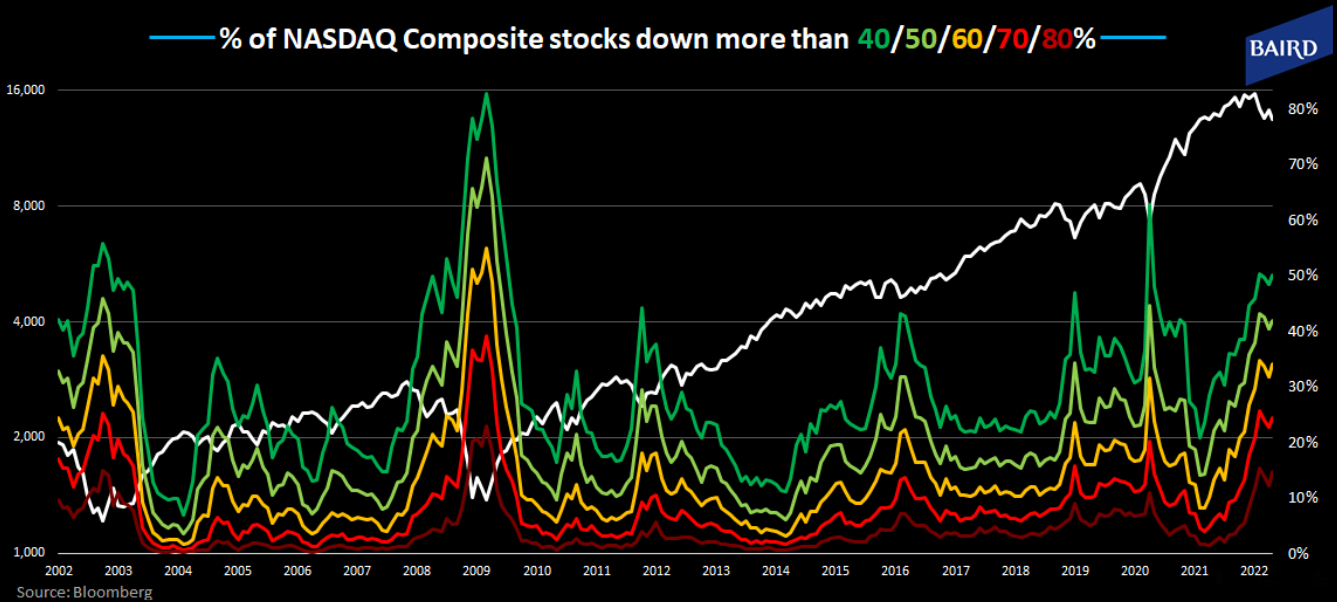
Nasdaq drawdown
The tech-heavy Nasdaq Composite Index is currently down ~23% since its peak in November 2021. The Nasdaq is comprised of 3,760 companies and incredibly, 50% of the stocks in the index are now down 40% from their peaks. Over a fifth of the constituents are down 70%.
U.S.' curious case of senior roles being filled by increasingly older individuals
Much of the focus and frustration today over rising inequality is centred around elevated asset prices such as housing. However, an interesting area that seems to be overlooked is job inequality, driven by the fact that those holding the top paying jobs are staying in positions significantly longer.
This seems to apply whether we are talking about faculty in schools, CEOs of Fortune 500 or S&P 500 companies or even the government.
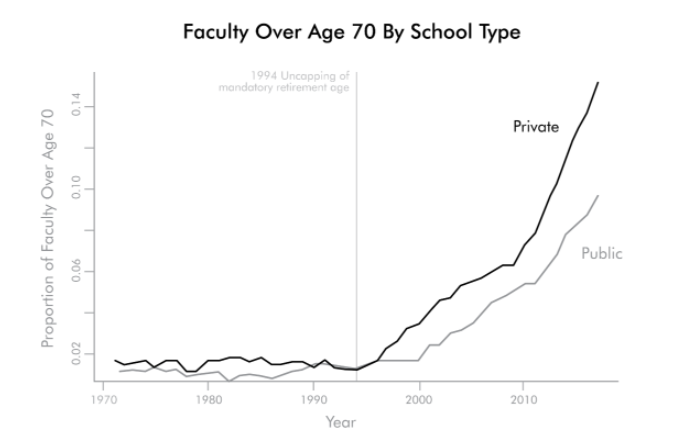
For example, the proportion of faculty over the age of 70 has increased meaningfully since the mid-1990s. This appears to have been driven by the implementation of peer review systems and extending teacher tenure (a permanent position of employment).
Data shows that most Nobel Laureates are recognized for work accomplished in their twenties to forties, however currently, all but two of the U.S.’ leading research institutions are run by individuals in this age bracket.
In corporates, from 1980 to 2001, the average age of a CEO at hire, got younger by four years. But since 2005 and through 2019, the average age of a CEO at hire increased by forteen years.

Most obviously, the public sector, specifically elected officials, are among the oldest workforces in the country. For example, President Biden and Donald Trump quickly come to mind given they are both in their mid-late 70s.
Compounding matters, the most represented age group in Congress is 60-69 years old. Half (!) of the U.S. Senate is over the age of 65. The 117th Congress is the oldest, on average, of any Congress in the past two decades. By comparison, only 19% of Americans eligible to run for Congress are 65 or older. Roughly one-third of the over-25 population is under 40, in recent years less than 5% of U.S. lawmakers are in this age group.
Unsurprisingly, research has found that older members of Congress are more attentive to issues of importance to older Americans, at the cost of attention paid to issues of importance to younger ones.
Article
Germany ready to back gradual EU ban on Russian oil
Germany appears ready to back a phased ban on Russian oil as EU countries figure out how to respond to a worsening energy crisis, according to Bloomberg. The EU took a similar, delayed approach when it banned coal earlier this month.
Germany’s new stance marks a significant shift. As recently as a few weeks ago, it was suggesting that any action on Russian energy supplies would hurt Europe more than Russia.
Things that make you go hmm...
In a 2018 speech, Federal Reserve Chairman Jerome Powell highlighted that “doing too little comes with higher costs than doing too much” when inflation expectations threaten to become unanchored.
If expectations "were to begin to drift, the reality or expectation of a weak initial response could exacerbate the problem. I am confident that the FOMC would resolutely ‘do whatever it takes’ should inflation expectations drift materially up or down or should crisis again threaten.”
Now that inflation appears to be a concern, is the Fed doing whatever it takes? Or is it just talking tough, while hoping to buy some time which could, in Powell's own words "exacerbate the problem"? Time will tell.
Until next time...
Thank you for reading this week’s issue. If you found it interesting, please consider sharing it with a like-minded friend or family member.
If you have any questions or feedback, please feel free to reach out!
Have a great week.
Why ‘Buy the Umbrella’?
Individuals, many of whom also run businesses and governments, tend to not think of the downside when the present is stable, and the future is looking positive (usually when we feel most in control).
Just because it is currently sunny, does not mean it will never rain. If we are not prepared, once it does begin to rain, we will end up running around looking for an umbrella in the middle of a storm, when they tend to be in short supply. We therefore need to buy the umbrella before it rains.
At the same time, we cannot allow our awareness of risk to make us fearful, pessimistic, or paranoid, as this too works against us over the long-term.
Having the right mindset in advance is critical. The challenge is getting the right balance between being optimistic about the future and being able to not only withstand future crises, but in fact grow stronger due to the opportunities they tend to present. It is not enough just to be conservative. One needs to be willing to put our cash to work when others feel least comfortable doing it. To do that with confidence, we need to have a foundational understanding of history, business, markets and human psychology.
Our mission at BTU is to learn as much about the world as possible, and in doing so, to try to find investment opportunities with favourable risk/reward characteristics. These should, over the long term, help build sustainable wealth.