
Hi there!
Here is your latest dose of “Buy the Umbrella”, a short list of interesting things I’ve been reading and thinking about during the week.
Tweet
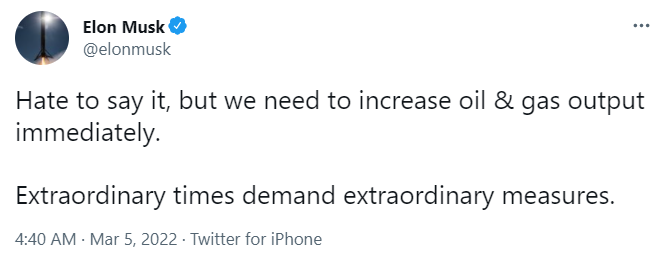
The Tesla CEO's tweet on the need to ramp up oil and gas production was considered surprising by some people given Musk's focus on sustainable energy and electric vehicles.
The reality is oil and gas are still essential ingredients today, especially considering the commodities' dominance in energy generation and turning raw materials into valuable goods. This includes the manufacturing of electric vehicles, battery packs and solar panels. We covered this topic in more detail during last week's BTU issue #18.
It's great to see someone with Musk's influence and follower base acknowledge the importance of maintaining an appropriate level of investment within oil and gas to safe guard output levels. Otherwise, we run the risk of a global energy and food crisis, in turn risking unrest and conflict.
The EIA reported U.S. crude and product inventories fell again last week and are now a record 10.95% or 212 million barrels below their 5-year average. This was before the impact of reduced Russian supply. U.S. oil production remained unchanged and still below the March 2020 peak. Notably, it needs to rise by 1 million barrels per day just to stop the draw on U.S. inventories.
The big question: Is there sufficient global spare capacity to quickly offset the potential loss of oil and gas output from Russia and Ukraine?
Quotes
"If I had an hour to solve a problem, I’d spend 55 minutes thinking about the problem and five minutes thinking about solutions".
— Albert Einstein
"Action may not always bring happiness, but there is no happiness without action".
— Benjamin Disraeli
Charts
Technology, IPOs and crypto
Non-profitable technology firms and companies that have recently listed on the stock exchanges have lost almost all their out-performance relative to the S&P500 over the last 4-5 months.
Notably, crypto (shown as "bitcoin sensitive" in the chart below) has been trading in lockstep with these more speculative names, suggesting the so-called new asset class is correlated with highly speculative backdrops.

Commodities sky-rocket amidst Russia/Ukraine supply concerns
The two most talked commodities as a result of the Russian invasion of Ukraine are typically oil and gas. The invasion pushed oil prices to over $130 per barrel and European gas prices to record highs. Strikingly, other critical commodities have seen their prices rise significantly too.
For example, wheat prices are up more than 60% so far this year. Russia and Ukraine are the largest and fifth largest exporters of wheat respectively.
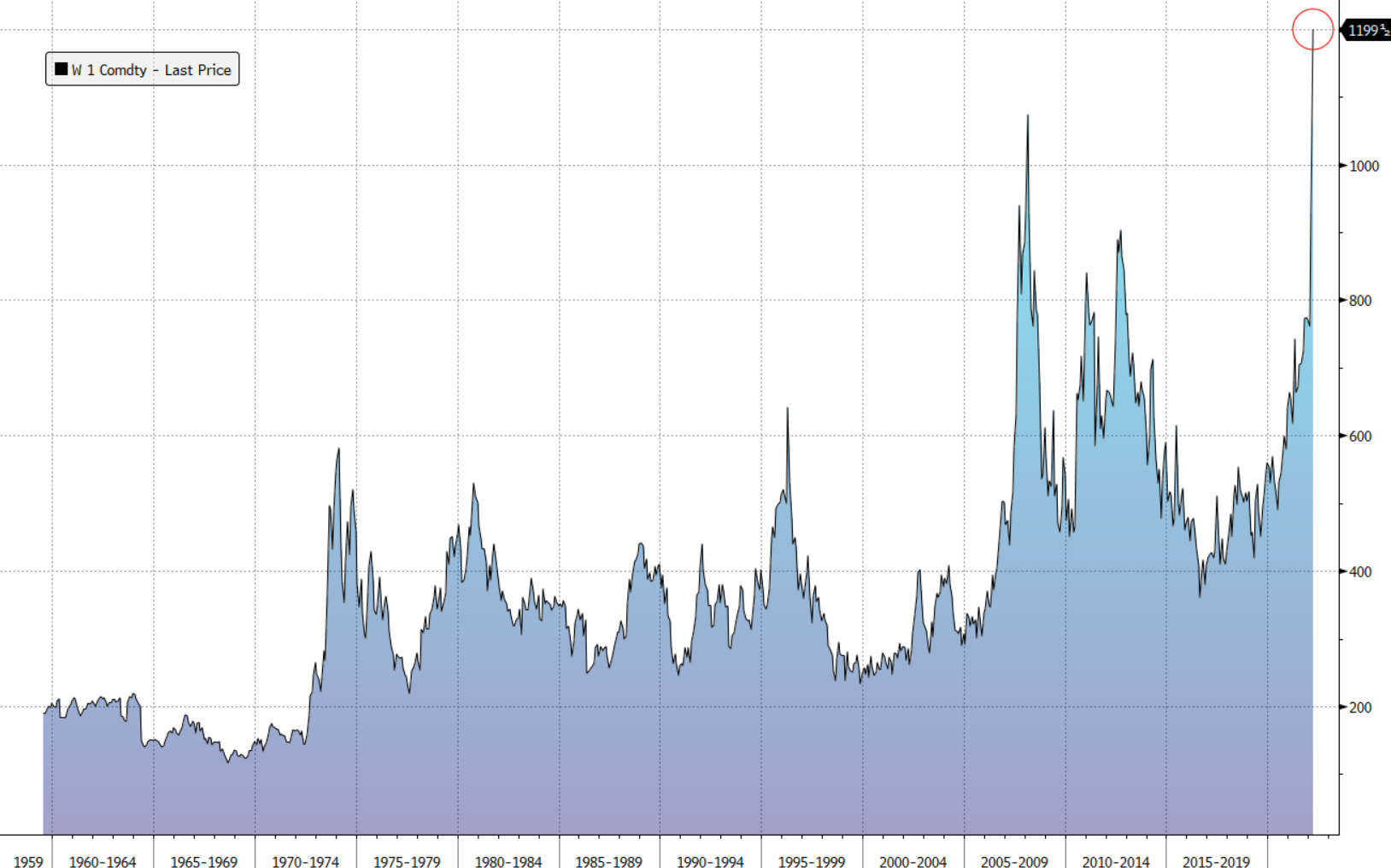
In addition, corn and soybean futures have each surged 26% so far this year. Increases of this magnitude in food-staple commodities have been associated with civil unrest throughout history, especially in countries where governments cannot afford to further subsidize the costs of food and energy.
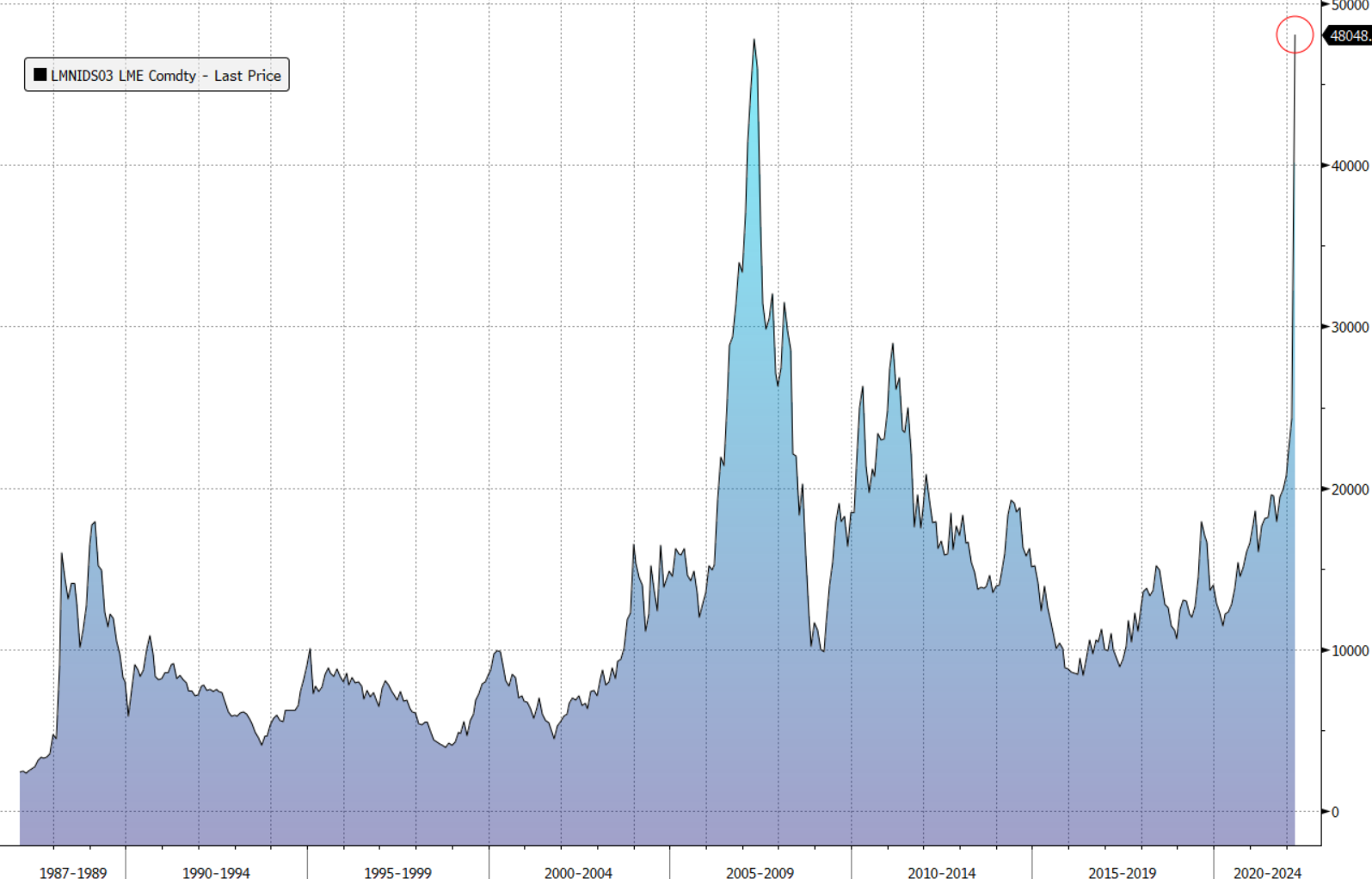
In similar vain, Nickel sky-rocketed to a record high earlier this week. Russia is the largest exporter of this strategic commodity, which is essential in battery technologies and due to its resistance to corrosion, is used in a variety of products such as wires, nails, pipes and gas turbines.
Russia produces more than 28% of the world’s raw nickel exports, followed by Australia and Canada, which account for 15% and 11% of global exports respectively.
For a more extensive overview of the commodities Russia exports click here.
Things that make you go hmm...
82% of new-car buyers are currently paying above sticker price
Pandemic-related supply chain problems have stretched the new-vehicle shortage into a second year, with near-empty dealer lots, high prices and multi-month long waits for a new car.
Car dealers in some cases are charging $35,000 to $40,000 above the manufacturer’s suggested retail price on luxury cars that normally sell for $80,000 or more.
Incredibly, before the pandemic, very few paid above the sticker price for a new car. In January, an unprecedented 82% of buyers did, according to consumer research site Edmunds.com.
Middle East
Sequoia Capital India, Saudi VC STV lead $54 million funding for Gulf fintech Tabby
Tabby, the Middle East’s largest 'buy-now pay-later' provider raised its latest round, taking the firm's total fundraising to $180 million in debt and equity to-date. This investment follows Sequoia's foray into the Middle East, with a $33 million series A investment in Saudi fintech start-up Lean Technologies.
Tabby is among companies that are gaining attention in the fintech sector due to the pandemic-accelerated shift toward online retail and digital payments. Buy-now pay-later services allow customers to purchase goods and then pay for them in instalments, or after a certain period of time, free of interest. It will be fascinating to see how borrower quality will be maintained given the highly competitive dynamics in the industry, especially as consumers' wallets feel the pinch of inflationary pressures.
Video
Changing borders of Europe
We often forget that maps have changed throughout human history. Europe's is no different. With the ongoing war in Ukraine, this video is a timely reminder of how drastically Europe's borders has changed over time. We recommend watching it on an accelerated playback speed or starting it from the 1900s at 9:38.
Until next time...
Thank you for reading this week’s issue. If you found it interesting, please consider sharing it with a like-minded friend or family member.
If you have any questions or feedback, please reach out!
Have a great week.
Why ‘Buy the Umbrella’?
Individuals, many of whom also run businesses and governments, tend to not think of the downside when the present is stable, and the future is looking positive (usually when we feel most in control).
Just because it is currently sunny, does not mean it will never rain. If we are not prepared, once it does begin to rain, we will end up running around looking for an umbrella in the middle of a storm, when they tend to be in short supply. We therefore need to buy the umbrella before it rains.
At the same time, we cannot allow our awareness of risk to make us fearful, pessimistic, or paranoid, as this too works against us over the long-term.
Having the right mindset in advance is critical. The challenge is getting the right balance between being optimistic about the future and being able to not only withstand future crises, but in fact grow stronger due to the opportunities they tend to present. It is not enough just to be conservative. One needs to be willing to put our cash to work when others feel least comfortable doing it. To do that with confidence, we need to have a foundational understanding of history, business, markets and human psychology.
Our mission at BTU is to learn as much about the world as possible, and in doing so, to try to find investment opportunities with favourable risk/reward characteristics. These should, over the long term, help build sustainable wealth.