
Hi there!
Here is your latest dose of “Buy the Umbrella”, a short list of interesting things I’ve been reading and thinking about during the week.
Book of the month
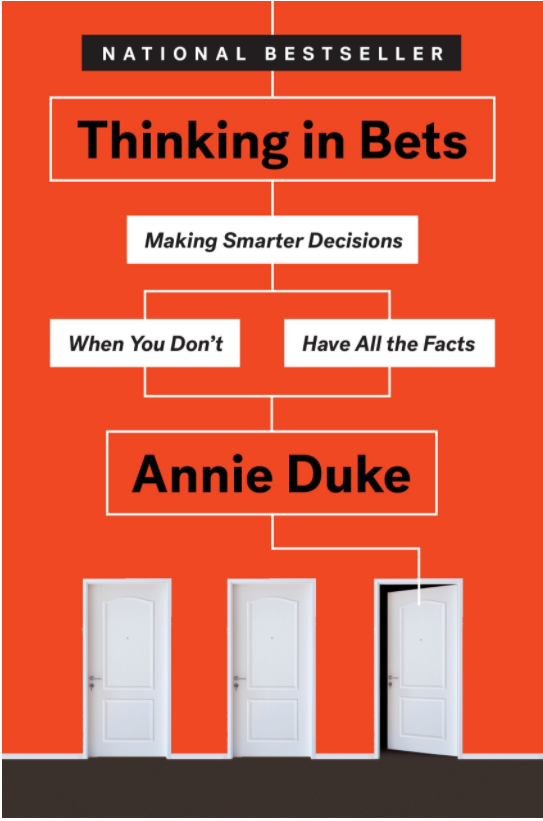
Thinking in Bets by Annie Duke, a former World Series of Poker champion and now business consultant, is a great book on decision making and an easy read. Applicable to business strategy as well as investing, Duke highlights the importance of shifting our thinking away from a need for certainty and towards a goal of accurately assessing what you know and what you don't. This results in less vulnerability to reactive emotions, biases and bad habits in decision making.
Duke writes:
In chess, outcomes correlate more tightly with decision quality. In poker, it is much easier to get lucky and win, or get unlucky and lose. If life were like chess, nearly every time you ran a red light, you would get in an accident (or at least receive a ticket).
Life however, is not like chess but more like poker:
You could run a red light and get through the intersection safely - or follow all the traffic rules and signals and end up in an accident. You could teach someone the rules of poker in five minutes, put them at a table with a world champion player, deal a hand (or several), and the novice could beat the champion. That could never happen in chess.
What good poker players and good decision-makers have in common is their comfort with the world being an uncertain and unpredictable place. What makes a great decision is not that it has a great outcome, it is "the result of a good process". That process must include an attempt to accurately represent our own state of knowledge.
Good process is critical to successful investing over the long-term.
Tweet
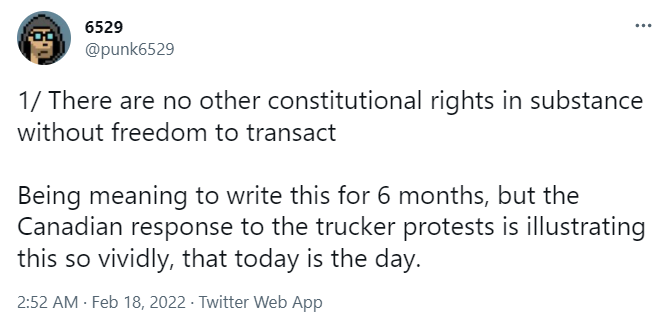
This twitter thread by an anonymous account is a fascinating view on the importance of having the freedom to transact. The author believes that without this freedom, one would struggle to exercise their other constitutional rights.
The author explains that until around 2001, the risk of financial censorship had been much lower, as people could have decentralized non-custodial mediums of exchange (i.e. cash). Over the last 20-years however, this risk has changed significantly with the introduction of the Patriot Act in the U.S. and other derivatives of it.
While the primary goals of these regulations are to stop money laundering, terrorism and tax evasion, the U.S. and EU have used these regulations to pressure banks and payment processors to cut off accounts to activities they view negatively, without having to pass laws to make those specific activities illegal. This allows them to avoid potentially alienating their electorate.
What makes the tweet so timely is that Canada, a constitutional democracy, recently invoked its Emergencies Act for the first time in its history due to the protests in Ottawa. This was then followed by the government asking every financial system provider (banks, credit card companies, investment and insurance firms, crowdfunding platforms and crypto companies) to freeze the accounts of anyone directly or indirectly supporting the protests. The Emergencies Act ensured there was no civil liability for this freezing - skipping the usual process of having to prove one guilty via court.
Now that the streets of Ottawa are cleared after three weeks of protests, Canadian authorities have said that they would start to lift the freezing of bank accounts associated with organizers, including Canadians who had blocked the streets with their personal vehicles.
Political views aside, some may view the Canadian government's actions as appropriate, given the importance of the international trade route (the route handles about a quarter of all cross-border trade between the U.S. and Canada). The question the tweet author asks is: what if Donald Trump used similar means in the U.S. to suppress 'Black Lives Matter' protests and all their "indirect" supporters? Another question is: will this precedent set by Canada be considered by other democratic leaders when future protests erupt in their own backyards?
Quotes
"What do you want to be remembered for?"
“Do not spoil what you have by desiring what you have not; remember that what you now have was once among the things you only hoped for.”
― Epicurus
Charts
With ongoing media attention focused on the escalating Russia/Ukraine conflict, some investors have accelerated their disposal of risk assets (Russia's stock market index for example was down ~40% earlier today). Meanwhile, Brent crude oil hit the highest level since 2014, exceeding $105 a barrel and precious metals, like gold and silver have been bid up (gold is up ~7% year-to-date, silver up ~9%).
Given the backdrop, it is worth taking a step back and looking at prior geopolitical conflicts to help gauge the possibilities going forward. Of course, no two conflicts are identical.
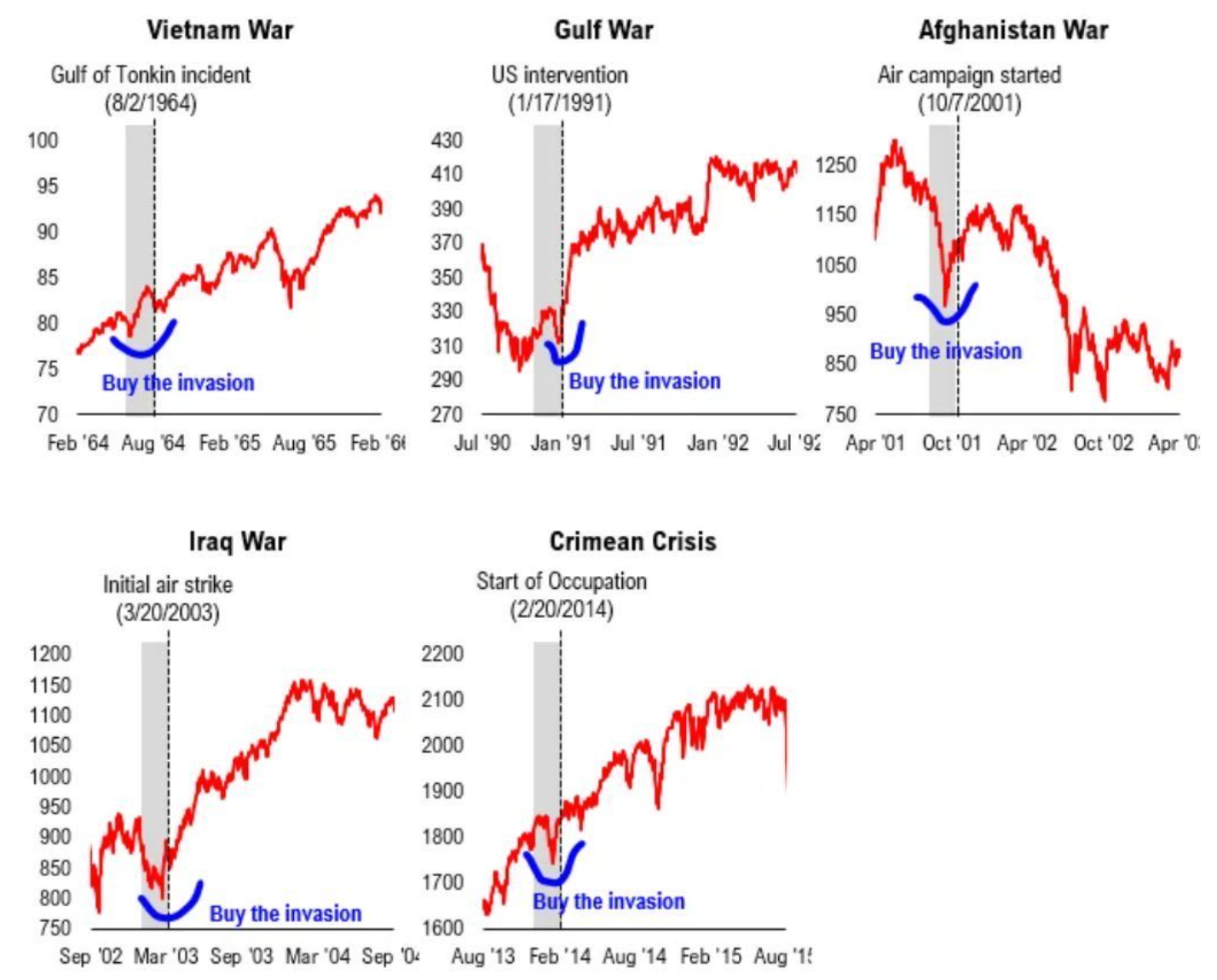
Typically, when investors and the media are heavily focused on a specific concern, it is highly likely that investors have priced in the most probable outcomes and therefore, any slight improvement in the outlook results in investor relief, pushing markets back up.
The charts below illustrate this for five prior conflicts, whereby in the run-up to each invasion markets sold off, but once the invasion took place, markets rallied:
Things that make you go hmm...
According to data compiled by Statista, there are an estimated 725 million Visa, Mastercard, and American Express cards in circulation today in the US alone – almost four for every adult.
Until next time...
Thank you for reading this week’s issue. If you found it interesting, please consider sharing it with a like-minded friend or family member.
If you have any questions or feedback, please reach out!
Have a great week.
Why ‘Buy the Umbrella’?
Individuals, many of whom also run businesses and governments, tend to not think of the downside when the present is stable, and the future is looking positive (usually when we feel most in control).
Just because it is currently sunny, does not mean it will never rain. If we are not prepared, once it does begin to rain, we will end up running around looking for an umbrella in the middle of a storm, when they tend to be in short supply. We therefore need to buy the umbrella before it rains.
At the same time, we cannot allow our awareness of risk to make us fearful, pessimistic, or paranoid, as this too works against us over the long-term.
Having the right mindset in advance is critical. The challenge is getting the right balance between being optimistic about the future and being able to not only withstand future crises, but in fact grow stronger due to the opportunities they tend to present. It is not enough just to be conservative. One needs to be willing to put our cash to work when others feel least comfortable doing it. To do that with confidence, we need to have a foundational understanding of history, business, markets and human psychology.
Our mission at BTU is to learn as much about the world as possible, and in doing so, to try to find investment opportunities with favourable risk/reward characteristics. These should, over the long term, help build sustainable wealth.