
Hi there!
Here is your latest dose of “Buy the Umbrella”, a short list of interesting things I’ve been reading and thinking about during the week.
Tweet
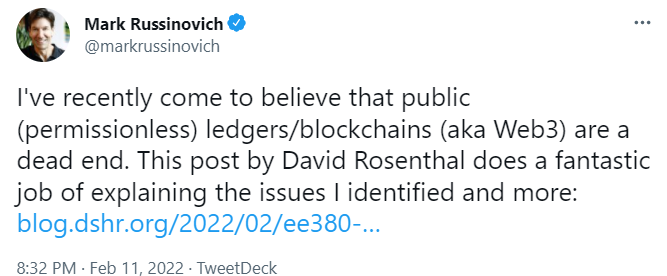
Earlier this week, Mark Russinovich, Microsoft Azure's Chief Technology Officer tweeted a link to David Rosenthal's 'Computer Systems' lecture at Stanford. Rosenthal was Chief Scientist and employee number four at Nvidia.
Rosenthal shares his detailed analysis of the major shortcomings of public decentralised ledgers/blockchains, known as Web3. Both Russinovich and Rosenthal go as far as labelling the technology a dead end, backed extensively by data points.
The entire post is a worthwhile read given his technical understanding of the space. Below are some fascinating points grouped into four key takeaways:
1. Why are cryptocurrencies key to permissionless (decentralised) blockchains?
In permissionless blockchains, cryptocurrencies must be generated organically by the blockchain itself in order to reimburse miners for their costly effort in defending the consensus systems from Sybil attacks.
Miners' operating expenses and capital investments cannot be paid in the blockchain's cryptocurrency, therefore exchanges are required to enable the rewards for mining to be converted into fiat currency (like the U.S. Dollar) to pay for these costs. To convert them, someone needs to be on the other side of these sell orders. The only reason to be on the buy side of these orders is the belief that the price will go up. Thus the exchanges need to attract speculators in order to perform their function.
A permissionless blockchain requires a cryptocurrency to function, and this cryptocurrency requires speculation to function.
2. Given Bitcoin's popularity, is it used as a currency?
90% of transaction volume on the Bitcoin blockchain is not tied to economically meaningful activities (such as purchasing a good or service), suggesting that the majority of transactions are linked to speculation. Less than five transactions per minute are economically meaningful.
3. Are the blockchains truly decentralised?
"As has been true for the last seven years, no more than five mining pools control the majority of the Bitcoin mining power and last November two pools controlled the majority of Ethereum mining."
"Most activity in 'trustless' cryptocurrencies actually uses trusted third parties, exchanges, that are layered above the blockchain itself. These use conventional Web-based identities and provide another layer of centralization. Binance, the dominant exchange, does two out of three derivative transactions and half of all spot transactions."
"The entire cryptocurrency ecosystem depends upon a trusted third party, Tether, which acts as a central bank issuing the "stablecoins" that cryptocurrencies are priced against and traded in. This is despite the fact that Tether is known to be untrustworthy, having consistently lied about its reserves." [We discussed Tether in more detail in BTU Issue 8]
"The only reason for the massive carbon footprint of Proof-of-Work and the complexity and risk of the alternatives is to maintain the illusion of decentralization."
4. Are blockchains secure and do they have controls to stop criminal activity?
"Because Ethereum and similar cryptocurrencies are programming environments, their attack surface is much larger than Bitcoin's. Now that DeFi and NFT protocols are implemented as 'smart contracts' in these environments, the attack surface has expanded much further."
"Immutability is one of the two things that make the cryptocurrency crime wave so effective. These systems are brittle, make a single momentary mistake and your assets are irretrievable."
Vulnerabilities are equally inevitable with a long list of recent examples: the $38M, $19M and $130M hacks of Cream Finance last year, the $115M hack of BadgerDAO, the $196M hack of BitMart, the recent $323M hack of Wormhole, and the $600M hack of Poly Network.
"The other main enabler of the cryptocurrency crime spree is the prospect of transactions that aren't merely immutable but are also anonymous. Anonymity for small transactions is important, but for large transactions, it provides the infrastructure for major crime. In the physical world cash is anonymous, but it has the valuable property that the cost and difficulty of transacting increase strongly with size. KYC/AML and other regulations leverage this. Cryptocurrencies lack this property."
Putting the crypto hype to one side, Rosenthal's well-informed view, backed by convincing arguments, suggests the current technology isn't that great after all. Even the excitement around NFTs appears to be misplaced, as they are simply a "link to a file of metadata that links to the image" it appears to represent, therefore it is neither guaranteed to exist or be valid.
Quotes
“Wind, then rain, and then the blue sky.”
— Mo Yan
"It always seems impossible until it is done."
Charts
U.S. Housing Boom
The S&P National Home Price Index rose 18.8% year-on-year in November 2021, outpacing 2005’s peak annual gain. Commentators believe that the current U.S. housing boom is sure to end in disaster, a throwback to what some see as the cause of the global financial crisis in 2007-2009.
In reality, the housing picture today looks very different to that period. Today's spiking prices stem from tight housing supply and strong demand, accelerated by the pandemic as remote working has spurred people with the means to do so to upgrade and/or to relocate.
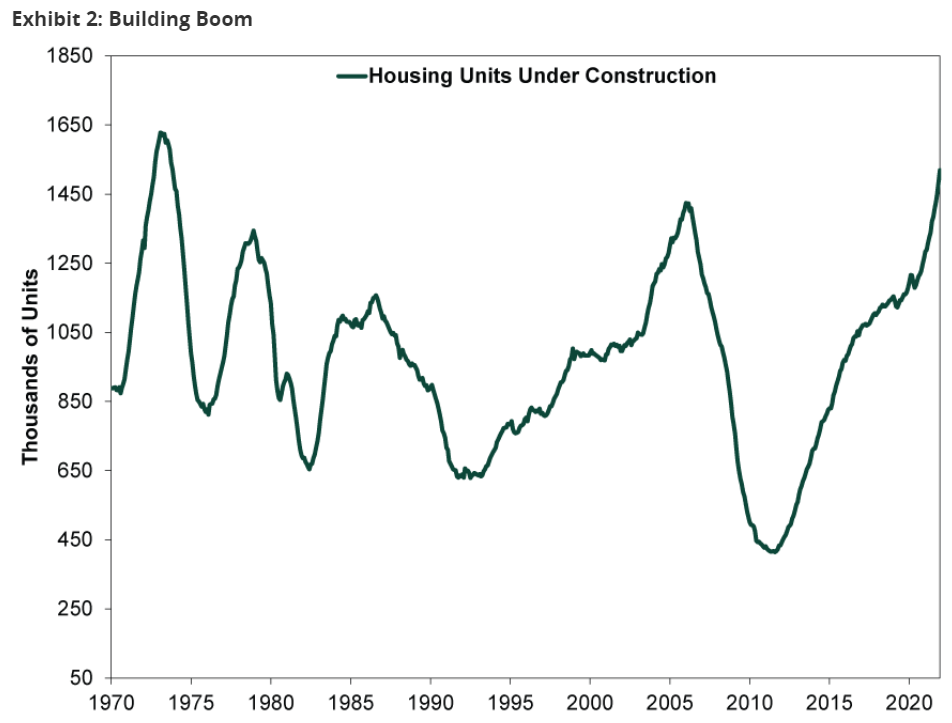
While existing home inventory was down 14.2% year-on-year in December 2021, the good news is that housing construction is rebounding (chart below), which should ease the pressure of rapidly rising home prices.
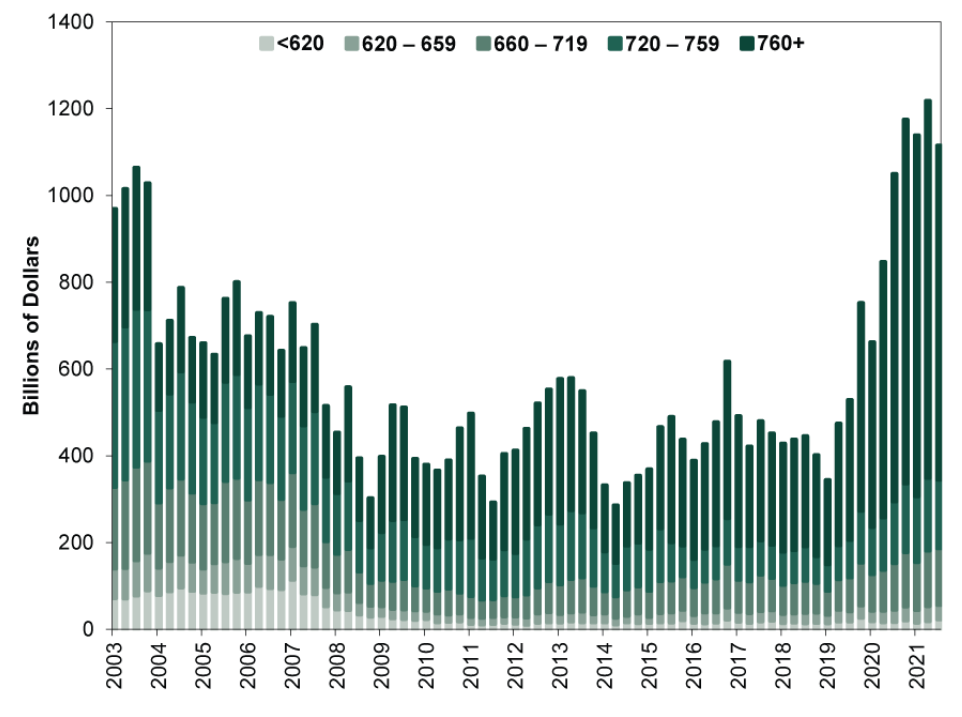
Critically, unlike during the housing Mania of the mid-2000s, mortgage originations standards appear to be more stringent now. While credit scores are not a perfect metric, they help to reflect a borrower's ability to service debt to a degree. Based on the chart below, it suggests that the vast majority of mortgages taken out over the last few years are from creditworthy buyers, which should cushion the blow from rising interest rates and/or a contraction in housing prices.
US shale companies' restraint is being tested as oil climbs towards $100 a barrel
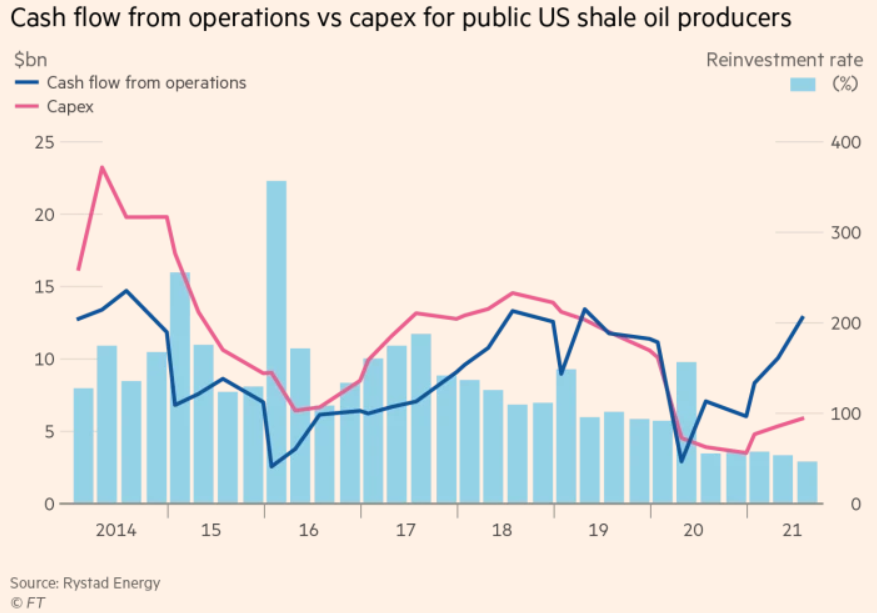
Oil companies are having their capital discipline tested as oil approaches $100 a barrel. Despite this, some of the big public independent companies, such as Pioneer Natural Resources, EOG Resources, Diamondback Energy and Devon, have suggested they will keep a lid on capital spending.
Diamondback's CEO Travis Stice went a step further, stating that the capital that they would have historically spent on growing the company, will now instead be deployed in the form of share repurchases.
Investors have rewarded companies that have committed to remaining disciplined. For example, investors bid up Devon's stock, making it the S&P500's best performer in 2021. The company announced a variable dividend and share buybacks in November last year.
This discipline is illustrated by the chart below, produced by Rystad Energy, a research company:
Things that make you go hmm...
The International Energy Agency (IEA) admitted that it had been incorrectly calculating oil demand over the last 15-years. Bloomberg reported that the IEA has revised its historical oil demand numbers since 2007. The changes aren't small at 2.9 billion barrels.
The result is that the 660 million barrels of surplus stockpiles that the IEA saw a month ago have evaporated. The demand revisions mean that the agency now estimates that global oil stockpiles have fallen below the level which they were at in the fourth quarter of 2019.
Commercial oil inventories among the developed economies fell by 60 million barrels in December and are thought to have dropped further this month. This is in stark contrast to Saudi Arabia’s expectation that the market would swing to a surplus.
With OPEC struggling to raise production, the Bloomberg article suggests the oil market will need to see either an increase in shale production or the return of Iranian production to meet demand.
Article
Ray Dalio: All currencies are devalued or die
Dalio's latest macroeconomic piece is, as always, a worthwhile read. He attempts to answer the question of where we are in the big cycle of money, credit and economic activity.
The following snippet on currencies is particularly interesting, given how far back Dalio's research goes:
"Of the roughly 750 currencies that have existed since 1700, only about 20 percent remain, and all of them have been devalued. If you went back to 1850, as an example, the world’s major currencies wouldn’t look anything like the ones today.
While the dollar, pound, and Swiss franc existed in 1850, the most important currencies of that era have died. In what is now Germany, you would have used the gulden or the thaler. There was no yen, so in Japan you might have used the koban or the ryo instead. In Italy you would have used one or more of six currencies. You would have used different currencies in Spain, China, and most other countries as well.
Some were completely wiped out (in most cases they were in countries that had hyperinflation and/or lost wars and had large war debts) and replaced by entirely new currencies. Some were merged into currencies that replaced them (e.g., the individual European currencies were merged into the euro). And some remain in existence but were devalued, like the British pound and the US dollar."
Until next time...
Thank you for reading this week’s issue. If you found it interesting, please consider sharing it with a like-minded friend or family member.
If you have any questions or feedback, please reach out!
Have a great week.