
Hi there!
Here is your latest dose of “Buy the Umbrella”, a short list of interesting things I’ve been reading and thinking about during the week.
Tweet
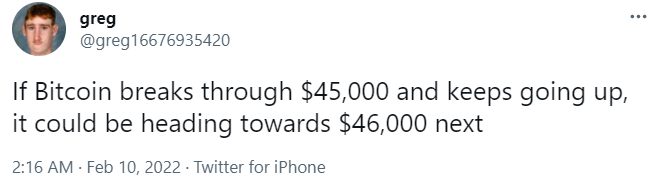
The tongue-in-cheek tweet above is a good way to remind us that most forecasts, especially in crypto-land, tend to be guesses at best.
Surprising to many, this also applies to macroeconomic forecasts, which attempt to model how millions (or billions) of people, including businesses and governments, will behave over the next quarter or the next year. For example, the number of variables involved in forecasting the magnitude of economic growth or the inflation rate are practically impossible to model accurately, resulting in best guesses based on historical data.
It is also important to remember that trends can change rapidly and no-one can predict these consistently, which was clearly highlighted during the start of the pandemic in 2020.
Quote
“To be interesting, be interested.”
— Dale Carnegie
"When the facts change, I change my mind. What do you do, sir?"
— John Maynard Keynes
Charts
Asset bubbles
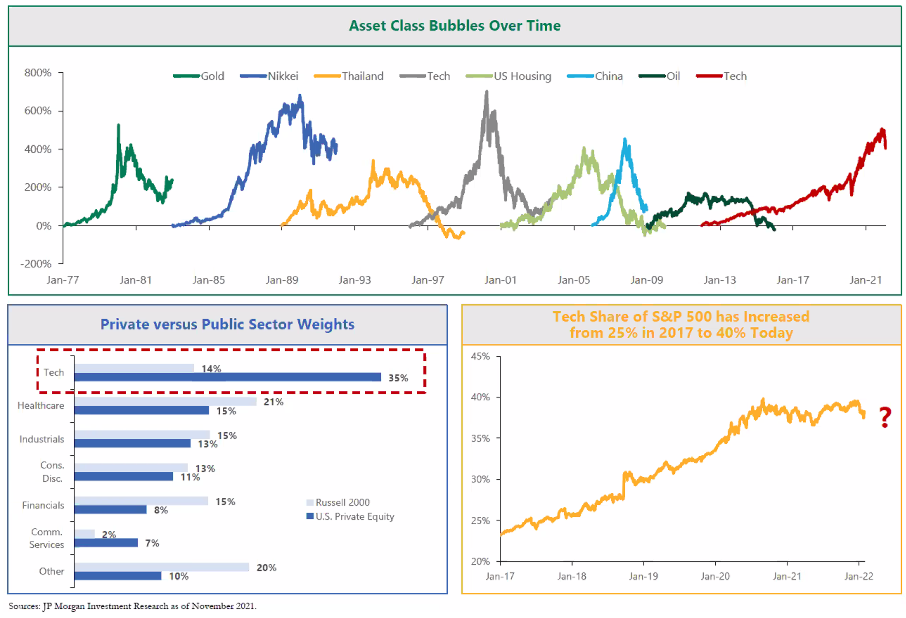
Asset bubbles are a fascinating topic. Bubbles, including their magnitude and duration, are so difficult to predict, or recognize, even when we are in the middle of one. The chart below shows the asset bubbles since 1977 and their respective percentage gains (and their subsequent wipe out).
The chart also highlights technologies' current weighting within the private and public markets, and specifically the S&P500. Could this potentially be signalling that we are in the midst of a technology bubble?
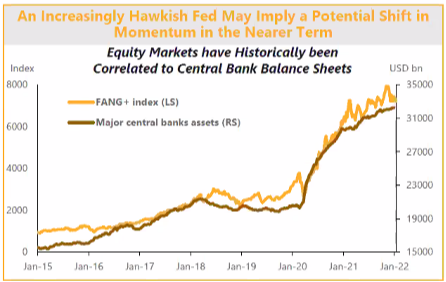
Equity markets have been historically correlated to central bank balance sheets
The correlation between central bank balance sheets growth, via quantitative easing, is highly evident in the chart below. Expectations are growing that central bankers will soon start to shrink their balance sheets.
Morgan Stanley (MS) believe G4 central bank balance sheets will peak in May this year. From May 2022 to May 2023, MS' Andrew Sheets expects their balance sheets to shrink by $2 trillion, four times the largest 12-month decline in history, from 2018-19.
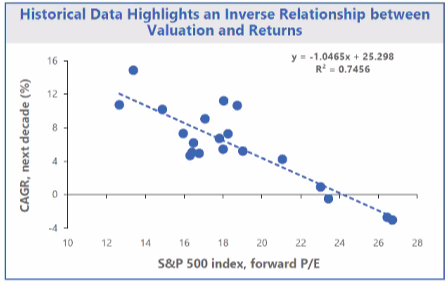
Inverse relationship between high valuations and future returns
Given current elevated valuations, the next chart is highly relevant, illustrating the correlation (R^2 of 0.75) between valuations and returns over the subsequent decade. As one would expect, the relationship is negative, i.e. the higher valuations are today, the lower future returns are likely to be.
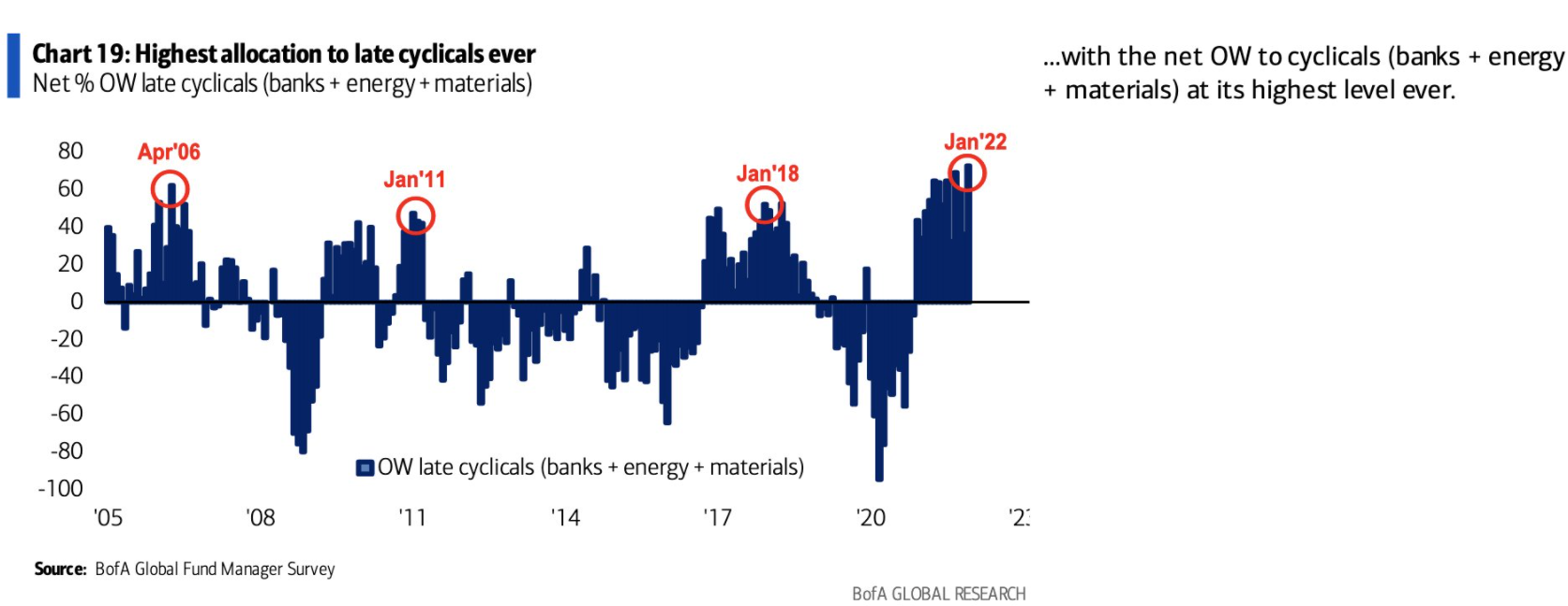
High allocations to late cyclicals
Bank of America are seeing the highest allocations to late cyclicals ever. Cyclical sectors include banks, energy and material companies. This is not a good sign if you believe you are making a contrarian bet by overweighting these sectors today.
Articles
Bank of England tightens monetary policy
The Bank of England raised rates last week up from 0.25% to 0.50%, in the first back-to-back hike since 2004. Four of the nine MPC members had called for a larger 0.50% hike. Off the back of this, investors continue to price in a further 0.25% increase in both March and May this year. The central bank said the Consumer Price Index, which stood at 5.4% in December, now looks set to peak at around 7.25% in April.
The central bank added that it will start to unwind its balance sheet by allowing its holdings of government bonds to roll off as they mature. It will also sell its much smaller holding of corporate bonds.
Ofgem increased the price cap on gas bills by 54%
The UK's power regulator Ofgem increased the price cap on gas bills after the government announced it will be providing subsidies to the tune of £9 billion.
To ease the impact, the government will provide state backed loans to energy providers to spread their higher costs over five years, worth £200 per consumer. It will also provide a £150 rebate on local taxes to around 80% of households in England.
As expected, Cornwall Insight said the government’s move was not a viable long term solution. “Without changes, we predict the winter cap will see payments rise to over £2000 a year for the average customer. Any tools intended to reduce the immediate impact of these record high prices will mean that they are ultimately borne over a longer period”.
Financial Tip of the Month
Morgan Stanley put together a short article explaining why having a goal is key to investing one's personal wealth. It's worth a read. Here's a brief snippet:
"One of the biggest mistakes I see investors make is confusing investing with stock picking. Ask many people how their money is invested and they might quickly jump to tell you the latest hot stock they’ve purchased and the investment thesis that explains why they think it’s going to take off.
What is their investing goal? Probably just to make some quick, easy money, which neuroscience has shown makes us feel good."
Until next time...
Thank you for reading this week’s issue. If you found it interesting, please consider sharing it with a like-minded friend or family member.
If you have any questions or feedback, please reach out!
Have a great week.
Why ‘Buy the Umbrella’?
Individuals, many of whom also run businesses and governments, tend to not think of the downside when the present is stable, and the future is looking positive (usually when we feel most in control).
Just because it is currently sunny, does not mean it will never rain. If we are not prepared, once it does begin to rain, we will end up running around looking for an umbrella in the middle of a storm, when they tend to be in short supply. We therefore need to buy the umbrella before it rains.
At the same time, we cannot allow our awareness of risk to make us fearful, pessimistic, or paranoid, as this too works against us over the long-term.
Having the right mindset in advance is critical. The challenge is getting the right balance between being optimistic about the future and being able to not only withstand future crises, but in fact grow stronger due to the opportunities they tend to present. It is not enough just to be conservative. One needs to be willing to put our cash to work when others feel least comfortable doing it. To do that with confidence, we need to have a foundational understanding of history, business, markets and human psychology.
Our mission at BTU is to learn as much about the world as possible, and in doing so, to try to find investment opportunities with favourable risk/reward characteristics. These should, over the long term, help build sustainable wealth.