
Hi there!
Here is your latest dose of “Buy the Umbrella”, a short list of interesting things I’ve been reading and thinking about during the week.
Tweet
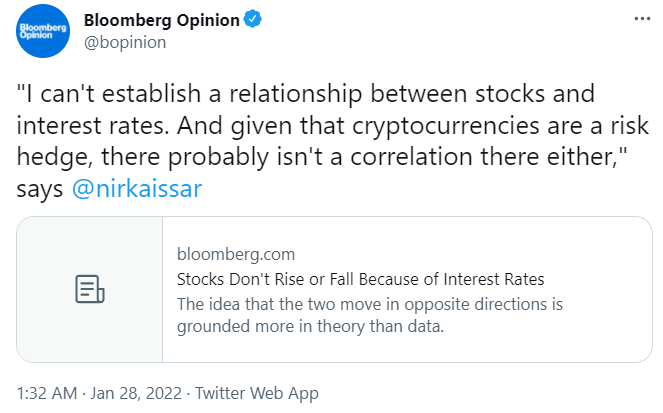
Equity markets have started the year on a sour note, with investors worried about further declines due to elevated inflation and the Federal Reserve's policy decisions going forward. Bloomberg's Nir Kaissar argues that data suggests the opposite is more likely to happen; whereby interest rates rise alongside stocks.
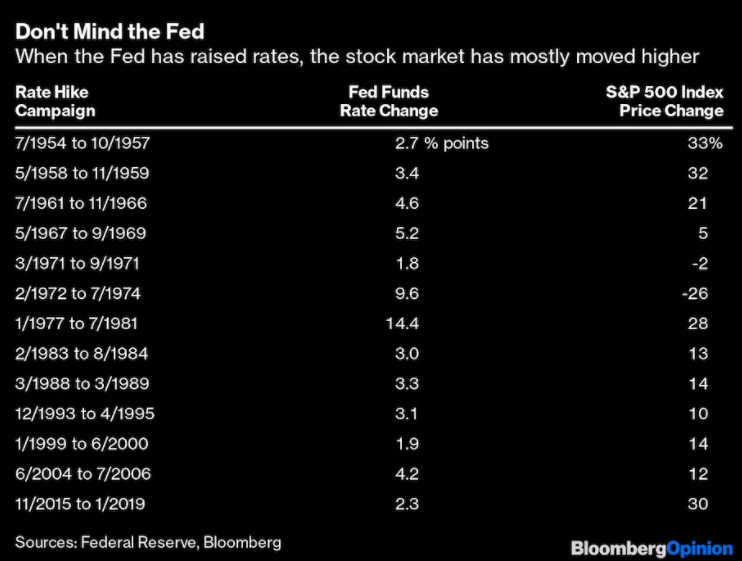
By his count, the Fed has embarked on 13 rate-raising campaigns since 1954. Rather than hurting the market, the S&P 500 Index moved higher during 11 of them, with a median gain of 14%, excluding dividends.
Of course, there were two exceptions. A brief rate hiking campaign in 1971 resulted in the market declining by 2%, and a longer one shortly after from 1972 to 1974, in which the market declined 26%. The latter episode coincided with an oil embargo that tipped the economy into a long recession, therefore it is not clear rising interest rates alone triggered the selloff.
Kaissar highlights that the correlation between 10-year treasury yields and the cyclically adjusted price-earnings (CAPE) ratio for the U.S. stock market is "only slightly negative (-0.21) over the past 140 years, meaning very weak negative correlation, if any".
Stocks typically rise following the start of tightening cycles. Recent examples include: two separate tightening cycles in the 1990s bull market, another in 2002-2007’s cycle and one in 2009-2020’s cycle. Importantly, the first hike in each came long before stocks peaked.
Quotes
“Integrity is the only path where you will never get lost”.
“I learned that courage was not the absence of fear, but the triumph over it. The brave man is not he who does not feel afraid, but he who conquers that fear.”
Charts
Drivers of stock market performance
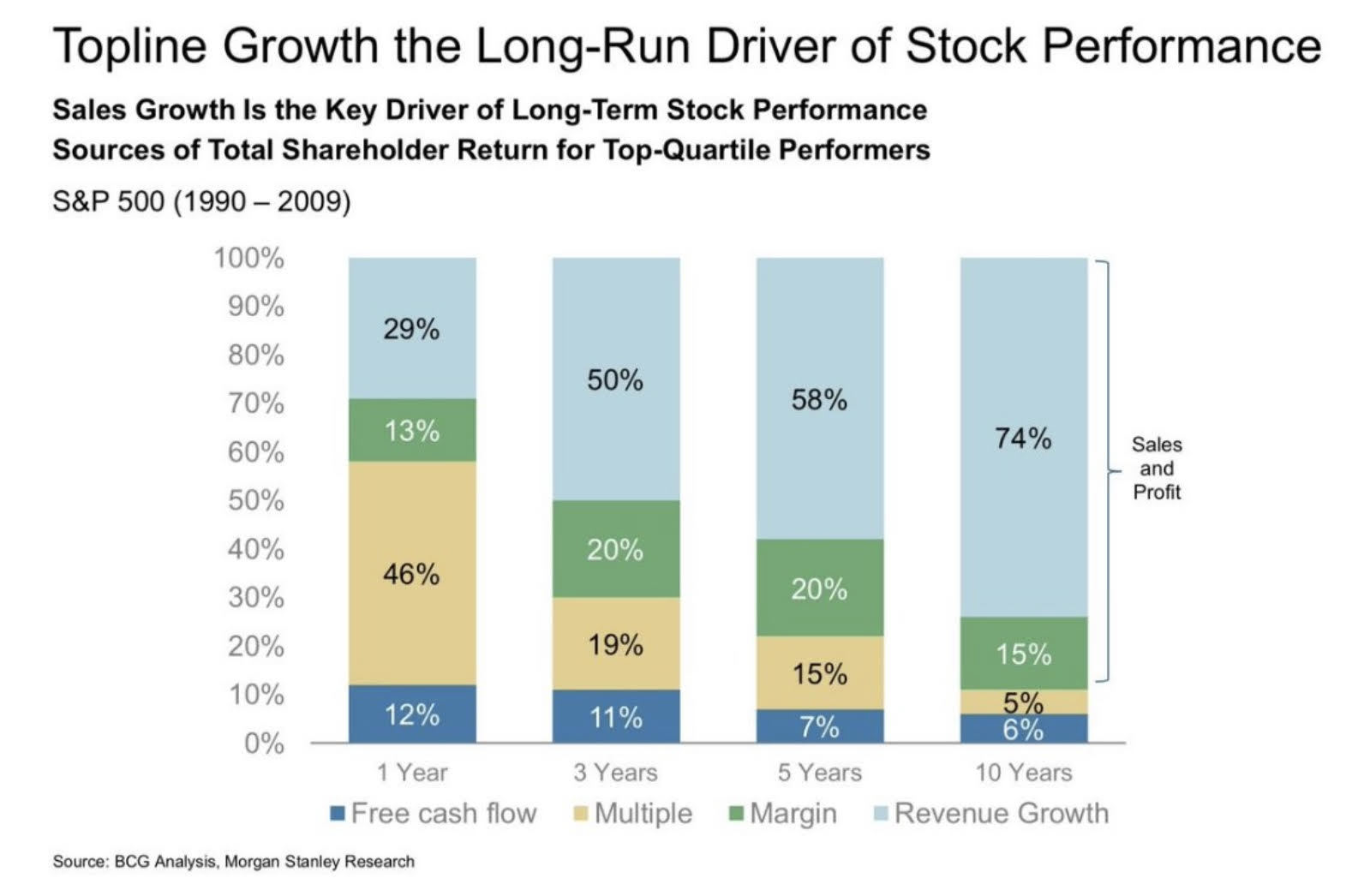
With so much attention being placed on central banks raising interest rates, the below chart highlights that the key variable behind positive market performance, even during hiking cycles, is corporate earnings.

This can be broken down further by looking at what ultimately feeds earnings growth. Given earnings growth is driven by a combination of sales growth and margin expansion, research shows that up to 89% of total shareholder return, over the long-term, is driven by these two factors.
Over shorter periods of 1-3 years, multiple expansion (i.e. the multiple attributed to a company's existing financial metrics) has a larger influence, accounting for up to 46% of a stock's return. Given where stock market valuations currently stand, it is unwise to assume further multiple expansion. In fact, we are more likely to experience multiple contraction.
S&P500 Weightings
The S&P500 is a market-capitalization-weighted index of 505 (yes, 505..) U.S. stocks. It has seen wide gyrations in the weightings of each sector.
Since 1975, we have seen three major sector bubbles within energy, information technology (IT) and financials. Interestingly, the IT sector currently weighs 29%, which is more than the financials and energy sectors during their respective bubbles. Albeit, this is less than its 33% weighting the IT sector experienced during the dotcom bubble in the late 1990s.

Incredibly, the chart below shows that 23% of the S&P500 is currently attributable to five stocks: Apple, Amazon, Microsoft, Alphabet (formerly Google) and Meta (formerly Facebook). This is higher than the concentration of the largest five stocks during the dotcom bubble, which summed up to 18% of the S&P500 at the peak in 2000.
The largest five stocks from the year 2000 now only comprise 8% of the S&P500. Microsoft is currently the stand-out exception, given it continues to rank in the top 5.
Astonishingly, if we review today's weighting of the former leaders from 2000, excluding Microsoft given it continues to be in the top 5, the total weighting today of the four other stocks is only 2%.
Clearly, maintaining equity leadership is difficult.

Technology Corner
Fever
Live-entertainment discovery platform Fever has raised over $227 million, in a new funding round led by the growth equity arm of Goldman Sachs, valuing the company at over $1 billion.
Despite so much attention currently placed on the digital world and the promise of the metaverse, it seems physical real-world interactions are still high in demand.
Sony to Buy Videogame Maker Bungie in $3.6 Billion Deal
After Microsoft's decision to acquire Activision Blizzard for $75 billion, Sony was feeling the pressure to bolster its own videogame operations. Sony announced it intends to purchase Bungie for $3.6 billion, which will bring the studio that created the Halo and Destiny franchises under its roof.
Interestingly, back in 2000, Microsoft acquired Bungie to develop games for its then-forthcoming Xbox console. The studio found success in the early 2000s before it was split off from Microsoft in 2007. Microsoft’s Xbox Game Studios has continued to produce new Halo games since then and the company owns the intellectual property behind the franchise. In 2010, Bungie signed a 10-year exclusive publishing deal for its Destiny franchise with Activision, which ended a year early in 2019, with Activision saying the shooter series didn't meet its financial expectations.
The recent deal activity gives the console makers additional ways to compete against each other, by acquiring content they could offer exclusively to their customers at launch, through subscription services and other means.
The activity comes after mergers-and-acquisitions (M&A) deals within the game industry have nearly tripled to $26.2 billion in 2021, up from $8.9 billion in 2020, according to data from PitchBook.
Things that make you go hmm...
US Consumer Price Index (CPI) is expected to accelerate to 7.3% in January, up from 7.0% in December. Excluding food and energy, consensus believe CPI will accelerate to 5.9%, up from 5.5%.
The big question: what if the data for January and subsequent months comes in below currently-elevated inflation expectations? This would suggest that the now priced-in four to five fed interest rate hikes in 2022 are too aggressive, and would in turn likely be bullish for bonds and potentially for stocks too.
Until next time...
Thank you for reading this week’s issue. If you found it interesting, please consider sharing it with a like-minded friend or family member.
If you have any questions or feedback, please reach out!
Have a great week.
Why ‘Buy the Umbrella’?
Individuals, many of whom also run businesses and governments, tend to not think of the downside when the present is stable, and the future is looking positive (usually when we feel most in control).
Just because it is currently sunny, does not mean it will never rain. If we are not prepared, once it does begin to rain, we will end up running around looking for an umbrella in the middle of a storm, when they tend to be in short supply. We therefore need to buy the umbrella before it rains.
At the same time, we cannot allow our awareness of risk to make us fearful, pessimistic, or paranoid, as this too works against us over the long-term.
Having the right mindset in advance is critical. The challenge is getting the right balance between being optimistic about the future and being able to not only withstand future crises, but in fact grow stronger due to the opportunities they tend to present. It is not enough just to be conservative. One needs to be willing to put our cash to work when others feel least comfortable doing it. To do that with confidence, we need to have a foundational understanding of history, business, markets and human psychology.
Our mission at BTU is to learn as much about the world as possible, and in doing so, to try to find investment opportunities with favourable risk/reward characteristics. These should, over the long term, help build sustainable wealth.