
Hi there!
Here is your latest dose of “Buy the Umbrella”, a short list of interesting things I’ve been reading and thinking about during the week.
Tweet
At BTU, we have been the raising alarm bells since November over the froth in asset prices, especially in companies where strong profitability and free cash flow generation were far from certain. For many investors however, valuations were an afterthought, as they believed central banks would remain highly accommodative for years to come.
Over the last few weeks, the market's tone has changed on the back of higher inflation data, and the realisation that central banks will want to act to tame inflation expectations. Investors have now been pricing in the likelihood of less supportive central banks and therefore higher interest rates.
As a result, the highly valued stocks, such as many of those listed on the Nasdaq, have corrected. The Nasdaq has declined just under 20% since its peak on 22nd November 2021. Since then, many technology names are down over 35%, including the likes of Shopify, DocuSign and Coinbase. This has resulted in more muted sentiment, far from the excessive, and at times euphoric, optimism of 2021.
Notably, the S&P 500 index, which is more diversified than the tech-heavy Nasdaq, has seen a smaller drawdown from its peak, down just over 12%. The index has been held up by sectors such as energy, industrials, materials and financials. For example, oil & gas exploration stocks are up around 27% year-to-date, driven by higher oil prices (Brent is now at ~$90/barrel).
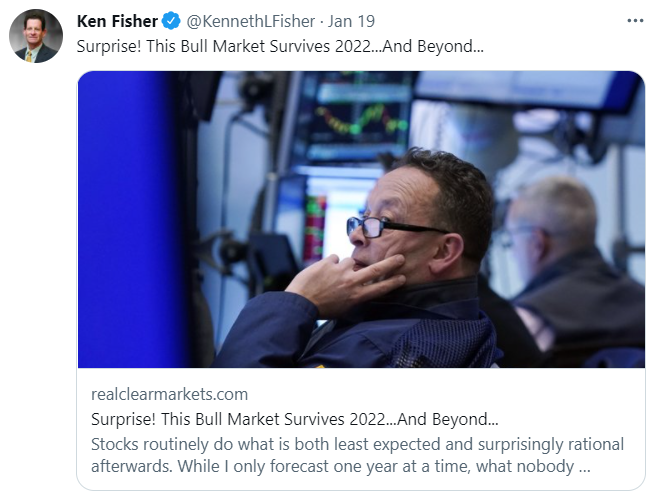
Following the recent market declines, we now see attractive opportunities within specific segments of the market and agree with some of Ken Fisher's views.
Fisher believes that markets have now pre-priced central banks' 2022 interest rate moves, and that declining inflation pressures should render long-term interest rates benign. He concludes that "investment success comes from fathoming the unfathomable. In 2022, that means seeing this bull market has room to run—before others do".
Quotes
"A problem well put is half-solved."
“I would rather have questions that can’t be answered than answers that can’t be questioned.”
Charts
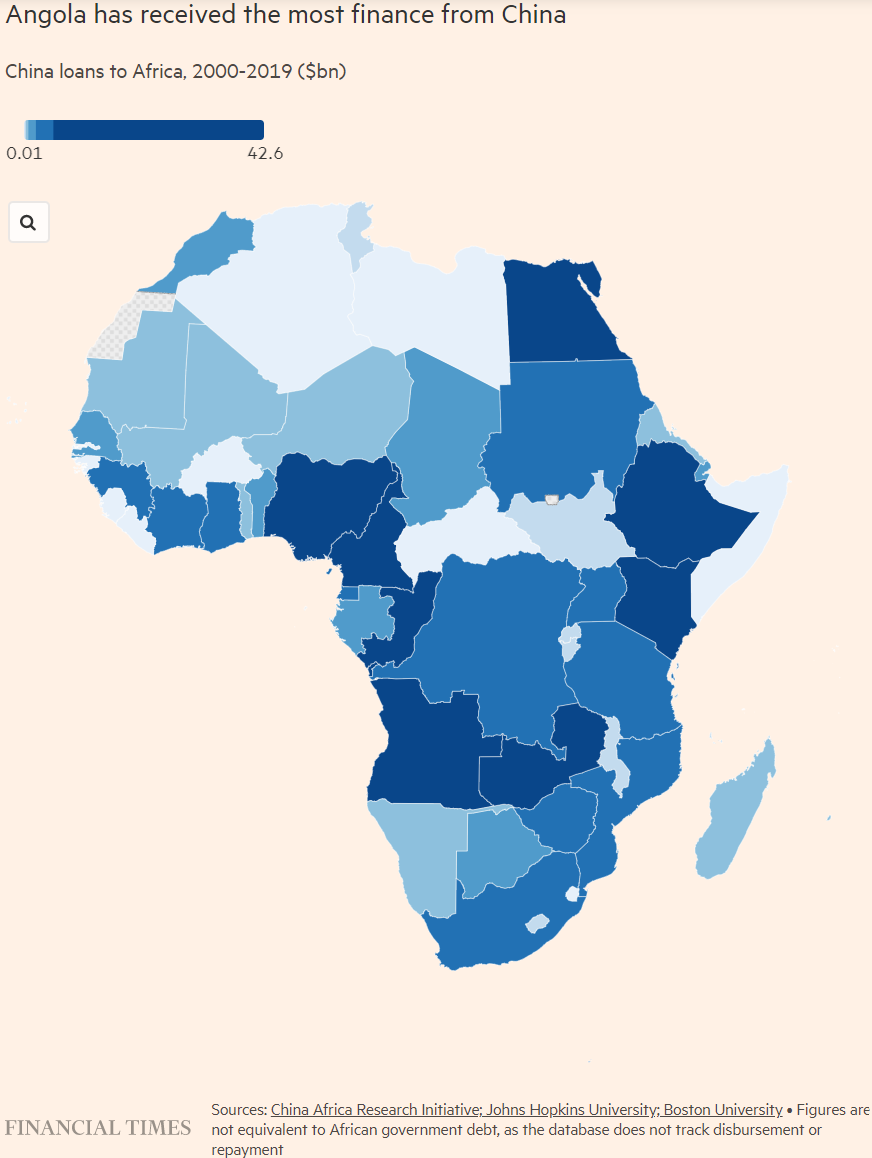
China applies brakes to Africa lending
Incredibly, Chinese banks now make up about one-fifth of all lending to Africa, focused on strategic and usually resource-rich countries, such as Angola, Djibouti, Ethiopia, Kenya and Zambia.
Chinese lenders have grown more cautious about deploying further capital into the world’s poorest continent, as some African nations have reached the limit of their borrowing capacity and the prospect of default looms. In fact, the IMF now lists more than 20 African countries as being in, or at high risk of, debt distress.
Venture capitalists continue to strike new deals
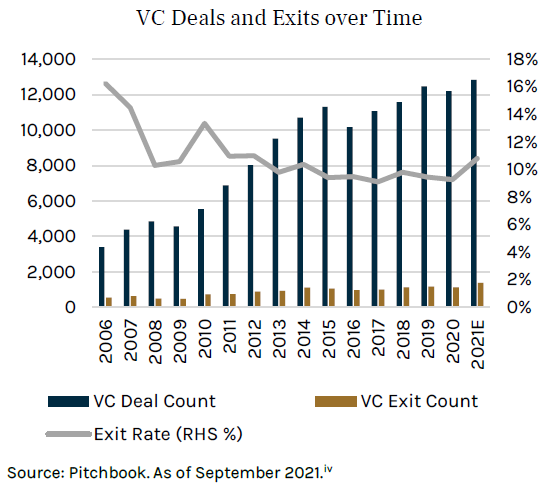
Venture capitalists continue to deploy funding rapidly, financing a record number of deals, totalling over 13,000 in 2021. The allure for spectacular returns appears to be hard to resist in our current low-yield world. Extraordinarily, despite the amount of liquidity in the system, exits remain a small fraction of deal count.
During the global financial crisis in 2007/08, the exit rate fell from over 16% to 10%. The big question for today is, what would happen to the exit rate if valuations take a hit, given it continues to hover around the 10% mark?
Technology Corner
Web3: Decentralisation, Crypto and NFTs
Moxie Marlinspike, the founder of instant messaging app Signal, is not drawn to the excitement around the potential of web3, despite considering himself a cryptographer.
In his detailed blog, he compares web1 and web2 and why the current concept of web3 will struggle, as no-one wants to run their own servers. He puts the current idea of decentralisation to bed by showing concrete examples of how decentralisation is very difficult to change and "often remains stuck in time".
As Marlinspike points out, many of the companies at the forefront of web3 have realised this, and have therefore skipped the decentralisation verifications. He believes this has made privacy a bigger problem than existing solutions:
"Imagine if every time you interacted with a website in Chrome, your request first went to Google before being routed to the destination and back. That’s the situation with Ethereum today. All write traffic is obviously already public on the blockchain, but these companies also have visibility into almost all read requests from almost all users in almost all dApps."
Article
SpaceX wins $102 million Air Force earth-to-earth cargo transport
The contract, worth more than $102 million, is part of the US Air Force's Rocket Cargo program looking to deploy commercial rockets to transport military cargo and humanitarian aid around the world.
Europe's governments face tough choices as energy prices spike
At BTU, we have been regularly discussing energy commodities' supply/demand imbalance. Unfortunately, this continues to be largely under the radar however, Bloomberg wrote a good piece about it earlier this week. Did you know that gas prices tripled last year? Did you know that oil is now trading at the highest level since 2014 at around $90/barrel (Brent)?
Bank of America analysts estimate that European households will pay an average of 54% more for energy this year than in 2020, with the largest increases in the U.K. and Italy, where average yearly bills are set to jump by the equivalent of more than $1,000.
The Bloomberg article highlights that Europe is currently gripped by one of the worst energy crunches in history, which has now forced politicians to step in via subsidies, to help millions of households who are unable to pay their bills. These measures are unlikely to be enough, as they do not address the root of the problem, which is largely centred around insufficient investment in critical commodities that satisfy our global energy needs.
Of course, rising energy costs do not only impact households. Businesses are also set to be hit hard, with industrial companies seeing an increase of as much as 70% in their electricity costs and 100% in their gas costs this year, according to Bank of America analysts.
In Larry Fink's 2022 annual letter, the Blackrock CEO spoke about the importance of not divesting from the oil and gas sector, as it will not get us to a world of net zero, given this ambitious goal will take time. His rational thoughts have attracted wide spread criticism from politicians and climate activists.
Germany is looking for skilled workers from abroad
Germany’s new coalition government wants to attract 400,000 skilled workers from abroad, each year, to tackle the demographic and labour shortage in key sectors, which risk undermining the economic recovery.
“The shortage of workers has become so serious by now that it is dramatically slowing down our economy”, FDP parliamentary leader Christian Duerr said.
Things that make you go hmm...
Morgan Housel has put together a thought provoking list of short stories that you can quickly flick through.
Here are three of my favourites:
Franklin Roosevelt looked around the room and chuckled when his presidential library opened in 1941. A reporter asked why he was so cheerful. “I’m thinking of all the historians who will come here thinking they’ll find the answers to their questions,” he said.
Everything we know about history is limited to what’s been written down, shared publicly, or spoken into a camera. The stuff that’s been kept secret, in someone’s head, taken to the grave, must be – I don’t know – 1,000 times as large and more interesting.
--
BlackRock CEO Larry Fink once told a story about having dinner with the manager of one of the world’s largest sovereign wealth funds.
The fund’s objectives, the manager said, were generational.
“So how do you measure performance?” Fink asked.
“Quarterly,” said the manager.
The gap between ideals and reality.
--
Gallup has been asking Americans for more than four decades, “Are you satisfied with the way things are going in the U.S. right now?”
The average percent of Americans answering “no” since 1969 is 63%.
What’s interesting is that Gallup asks a follow-up question: “Are you satisfied with the way things are going in your own life right now?”
There, the average “no” response is just 15.8%.
People tend to be optimistic about themselves but pessimistic about others. Social media probably supercharges that. Benedict Evans says, “The more the Internet exposes people to new points of view, the angrier people get that different views exist.”
Until next time...
Thank you for reading this week’s issue. If you found it interesting, please consider sharing it with a like-minded friend or family member.
If you have any questions or feedback, please reach out!
Have a great week.
Why ‘Buy the Umbrella’?
Individuals, many of whom also run businesses and governments, tend to not think of the downside when the present is stable, and the future is looking positive (usually when we feel most in control).
Just because it is currently sunny, does not mean it will never rain. If we are not prepared, once it does begin to rain, we will end up running around looking for an umbrella in the middle of a storm, when they tend to be in short supply. We therefore need to buy the umbrella before it rains.
At the same time, we cannot allow our awareness of risk to make us fearful, pessimistic, or paranoid, as this too works against us over the long-term.
Having the right mindset in advance is critical. The challenge is getting the right balance between being optimistic about the future and being able to not only withstand future crises, but in fact grow stronger due to the opportunities they tend to present. It is not enough just to be conservative. One needs to be willing to put our cash to work when others feel least comfortable doing it. To do that with confidence, we need to have a foundational understanding of history, business, markets and human psychology.
Our mission at BTU is to learn as much about the world as possible, and in doing so, to try to find investment opportunities with favourable risk/reward characteristics. These should, over the long term, help build sustainable wealth.