
Hi there!
Here is your latest dose of “Buy the Umbrella”, a short list of interesting things I’ve been reading and thinking about during the week.
Tweet
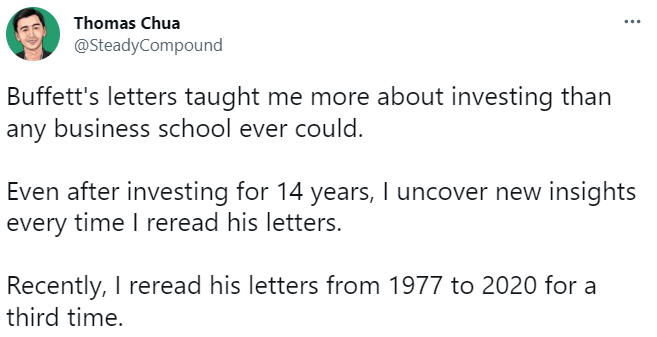
Warren Buffet, the Chairman and CEO of Berkshire Hathaway, has written an annual letter to shareholders since 1977. His letters (found here) continue to be an incredible educational resource for learning how to become a better long-term investor.
Thomas Chua's Twitter Thread, does a good job highlighting some of the key teachings of the 'Oracle of Omaha' and is worth a read.
I find the part on "Mr. Market" in Buffet's 1987 letter a particularly powerful reminder that the market is there to serve us, not to guide us. Buffett states, "if he [Mr. Market] shows up some day in a particularly foolish mood, you are free to either ignore him or to take advantage of him, but it will be disastrous if you fall under his influence".
Quotes
“'Emergencies’ have always been the pretext on which the safeguards of individual liberty have been eroded – and once they are suspended it is not difficult for anyone who has assumed such emergency powers to see to it that the emergency persists.“
"There are more tears shed over answered prayers than over unanswered prayers."
“Inflation is always and everywhere a monetary phenomenon in the sense that it is and can be produced only by a more rapid increase in the quantity of money than in output.”
Charts
Covid-19: Rising global case counts
Mainstream media continues to focus heavily on rising covid-19 case counts, in many cases without emphasizing the impact of the reduced severity of the Omicron variant, benefit of vaccines and improving treatments at hospitals. Interestingly, The Associated Press has recently told its editors and reporters to "avoid emphasizing case counts in stories about the disease".
An alternative metric to understanding the health impact of covid-19 is by looking at the case fatality rate (the ratio of confirmed deaths to confirmed cases):
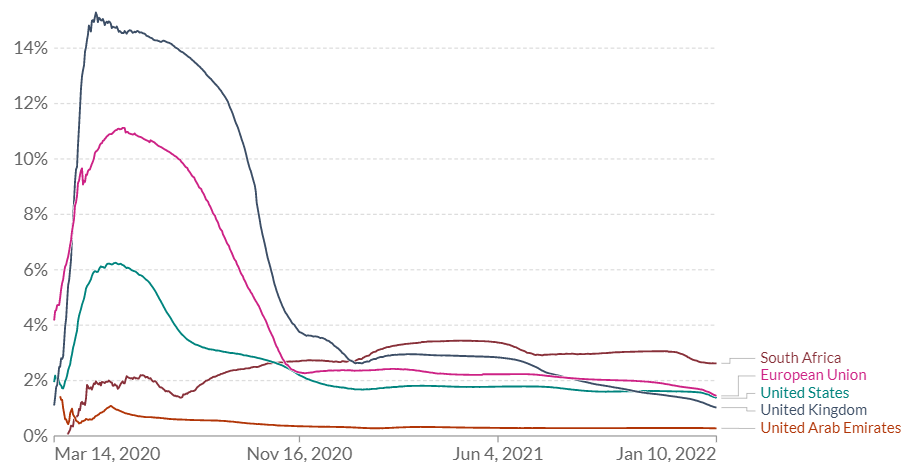
Confirmed cases are likely to be under reported in many countries, as The Associate Press points out in the same article, and therefore the fatality rate is likely to be even lower than shown in the chart above (likely to be closer to the UAE's, where public testing is known to be very high).
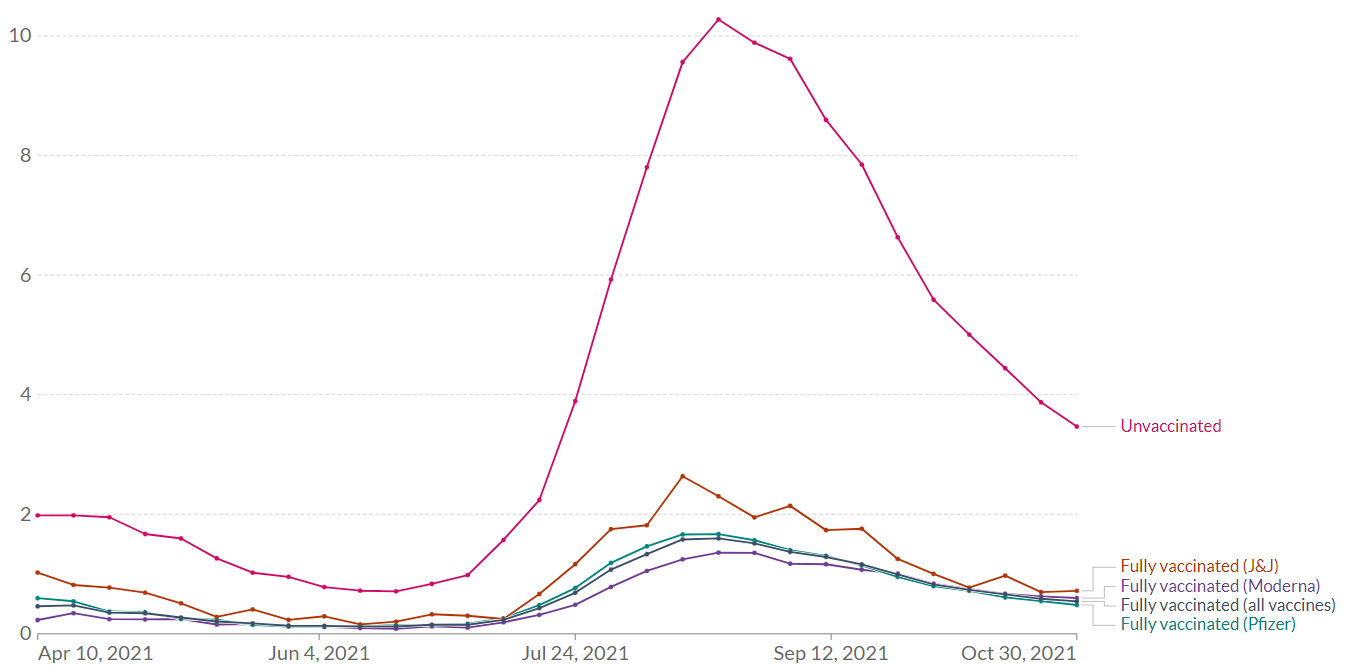
Importantly, the data highlights that vaccines are having a significant positive impact, as countries with higher vaccination rates are showing lower fatality rates. This can be illustrated by looking at the covid-19 deaths in the U.S., split between those who were vaccinated and unvaccinated during the summer 'delta' wave:
Will the U.S. federal reserve hesitate or u-turn if markets tumble?
Investors and market commentators over the last 10+ years have been accustomed to seeing the federal reserve and other central banks step in (i.e. walk back monetary policy tightening by either slowing/stopping rates increases and/or their balance sheet run-off) whenever markets have had meaningful drawdowns.
Looking back further to the dot-com bubble during the late 1990s, the fed continued to tighten monetary policy, increasing interest rates by 50bps in May 2000, despite the Nasdaq declining 30%+ from its March peak. Following that hike, the fed kept rates steady at 6.50%.
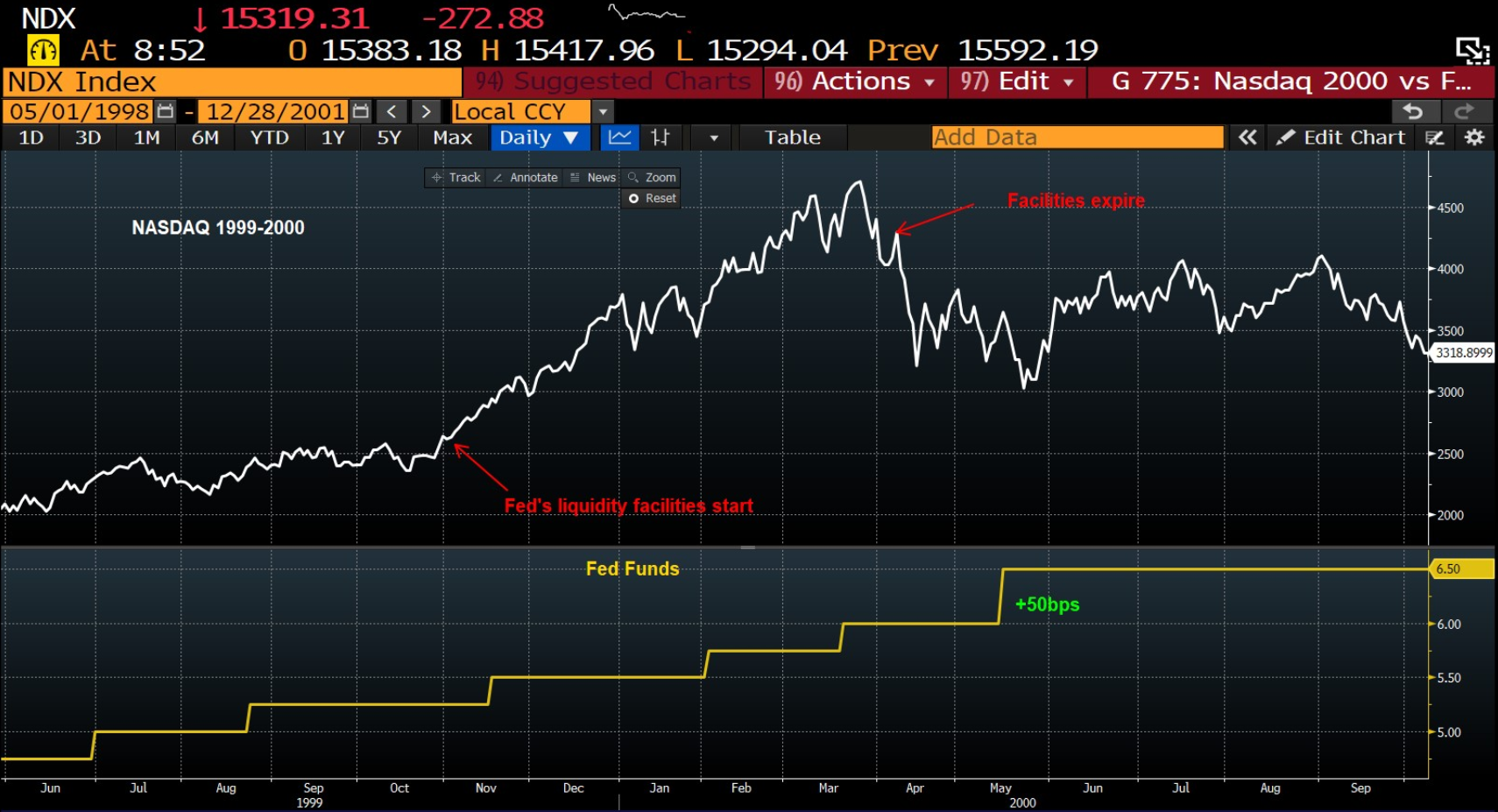
The phrase "fed put" is often mentioned in market commentary, referring to the idea that the fed has investors' backs. Investors believe that the fed will step in and protect investors, if markets were to experience a painful decline.
The fed put is not a quantitively defined notion per se, however the interesting consideration that the above chart highlights is that the level at which the fed steps in is probably much lower than investors currently believe. This could be important, especially when considering that the fed's official dual mandate, maximum employment and stable prices, has now been largely met.
One final noteworthy development that will likely complicate matters for the central bankers: the politicians are starting to feel the heat from rising frustration amongst U.S. voters, due to the currently elevated inflationary pressures.
Articles
GoPuff's successful 2021 and what's ahead for 2022
GoPuff, a fast-growing delivery start-up, recently raised a $1.5 billion convertible note, tied to a public offering and a valuation that could go as high as $40 billion.
In a wide ranging interview, GoPuff's Senior Vice President recaps the company's accomplishments in 2021 and the company's goals for 2022.
GoPuff has managed to expand its platform significantly in terms of the assortment it offers customers and saw strong demand within grocery, pet, baby and over-the-counter medicine. In addition, the company started rolling out GoPuff Kitchens, offering fresh meals.
The start-up has begun its expansion into Europe, with an initial focus on London and Paris, with the ultimate goal of being the number one player in every market they operate in.
The interview covers its surprising partnership with Uber Eats and shares insights into its strategic rationale behind acquiring two alcohol retailers in the U.S.
'Artificial Sun' activated in China
A nuclear fusion reactor in China has set a new record for sustained high temperatures, after running 5 times hotter than the sun for more than 17 minutes.
According to state media, the so called "Experimental Advanced Superconducting Tokamak" (EAST), known as an 'artificial Sun', achieved temperatures of 70,000,000 degrees Celsius during testing.
The aim of the development is to deliver large quantities of clean energy by replicating the natural reactions that occur within stars like our Sun.
As previously discussed in BTU issue #4, nuclear fusion reactors merge atomic nuclei in order to generate massive amounts of energy that can be turned into electricity. Unlike nuclear fission, the process leaves behind no hazardous waste materials. Physicists also claim that there is far less risk of an environmental disaster.
Reflection of the Month
The start of a new year for many is a time to reflect on goals for the coming year and beyond. This Twitter thread is a timely read, where Sahil Bloom shares a system that should help increase the probability of meeting our desired goals.
When it comes to setting medium/long term goals, the most common mistakes appear to be:
Setting too many goals
Loose goals
Not tied to actions
Unclear time bounds
Bloom's simple 5-step framework over comes these weaknesses and is worth a quick read for those looking for some guidance.
Until next time...
Thank you for reading this week’s issue. If you found it interesting, please consider sharing it with a like-minded friend or family member.
If you have any questions or feedback, please reach out!
Have a great week.
Why ‘Buy the Umbrella’?
Individuals, many of whom also run businesses and governments, tend to not think of the downside when the present is stable, and the future is looking positive (usually when we feel most in control).
Just because it is currently sunny, does not mean it will never rain. We therefore need to buy the umbrella before it rains. Otherwise, by the time we are running around looking for an umbrella in the middle of a storm, they tend to be in short supply.
At the same time, we cannot allow our awareness of risk to make us fearful, pessimistic, or paranoid, as this too works against us over the long-term.
Having the right mindset in advance is critical. The challenge is getting the right balance between being optimistic about the future and being able to not only withstand future crisis, but in fact grow stronger due to the opportunities they tend to present. It is not enough just to be conservative. One needs to be willing to put cash to work when others feel least comfortable doing it. To do that with confidence, we need to have a foundational understanding of history, business, markets and human psychology.
Our mission at BTU is to learn as much about the world as possible, and in doing so, to try to find investment opportunities with favourable risk/reward characteristics. These should, over the long term, help build sustainable wealth.