
Hi there!
Happy and healthy new year to you and your loved ones.
Here is your latest dose of “Buy the Umbrella”, a short list of interesting things I’ve been reading and thinking about during the week.
Book of the Month
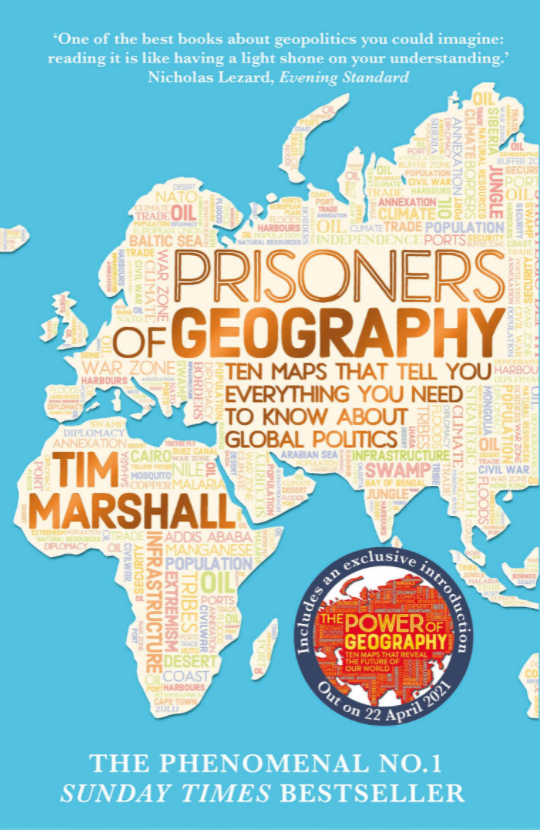
With all the media attention on rising geopolitical instability in Eastern Europe and South East Asia, the Prisoners of Geography is a timely read.
The book is a fascinating and engaging insight into the complex geopolitical strategies of world leaders, answering questions such as:
Why does Russia's lack of a warm-water port, with direct access to the oceans, affect Putin’s positioning on Ukraine? Why is Russia's Far East likely to come under greater Chinese cultural and eventually political control? How is China’s future constrained by its geography and why is it's ability to feed its population a growing problem? Why will Europe never be united? Why will America never be invaded?
Each of the 10 geographies discussed in the book are approximately 30 pages long, making this a digestible and highly informative read.
Quotes
“We are choked with news and starved of history.”
"Faced with the choice between changing one's mind and proving there is no need to do so, almost everyone gets busy on the proof."
Charts
Food price index hits 10-year high in 2021
The United Nations Food & Agriculture Organization's (FAO) Food Price Index ended 2021 up 28.1%, with all sub-indices averaging sharply higher than in the previous year. For example, Cereals increased 27.2%, driven by increases in maize and wheat prices, which were up 44.1% and 31.3% respectively. Dairy prices rose 16.9% for the year, while sugar prices rose by 37.5%.
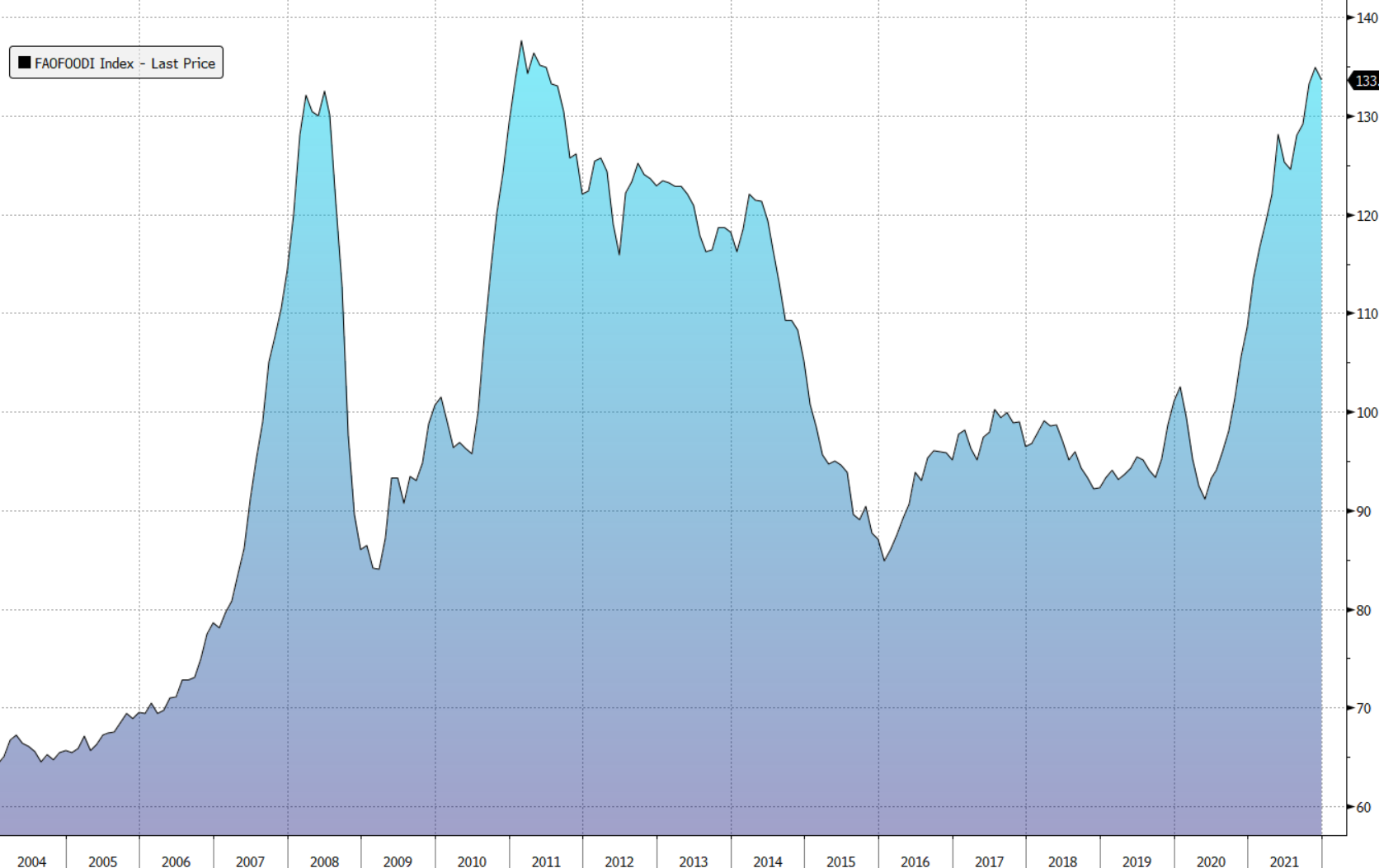
This is especially problematic for developing countries, given lower income households are hit hard by rapidly rising food prices. For example, increasingly unaffordable food prices are believed to have played an important role in driving unrest during the 2011 Arab spring, according to some analysts.
In response to higher food prices, Argentina, the third-largest corn exporter and a top exporter of wheat, recently put a limit on its grain exports to fight against local food inflation, which is currently running at 51%.
Meanwhile, the two leading fertilizer exporters, China and Russia, recently announced curbs/bans on exports in an attempt to keep local agricultural prices in check.
Fertilizer and other nutrient prices have surged globally as soaring gas prices have increased production costs and forced some plants to cut production. European farmers have already voiced concern about securing fertilizer supplies for the spring, which risks lower potential harvests for the year ahead.
If other countries follow suit with export limits, this will exacerbate food inflation in places that rely on imported food.
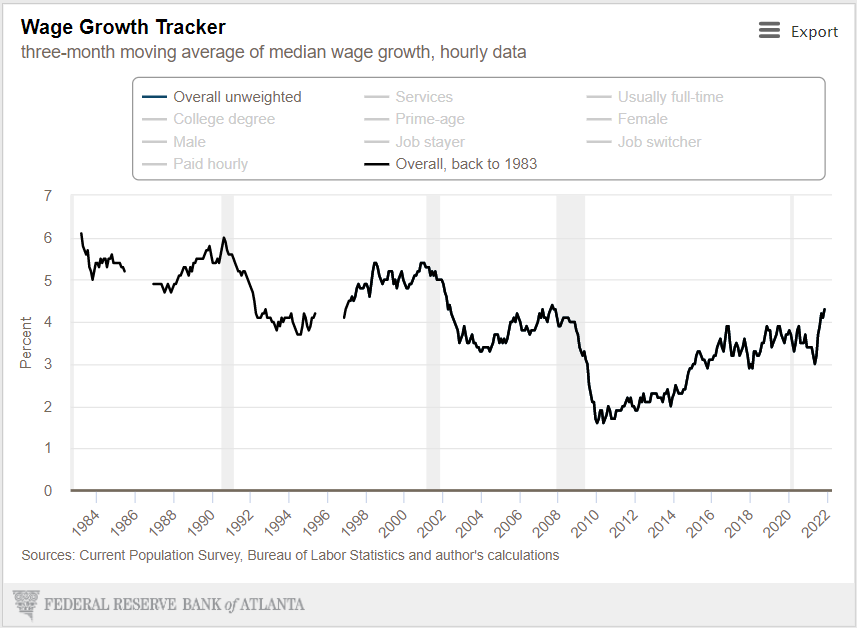
U.S. households who are also facing rising food prices, have seen some of these increases offset by continued wage growth. Wage increases are currently at the highest level since the global financial crisis:
Central banks begin to respond to inflationary pressures
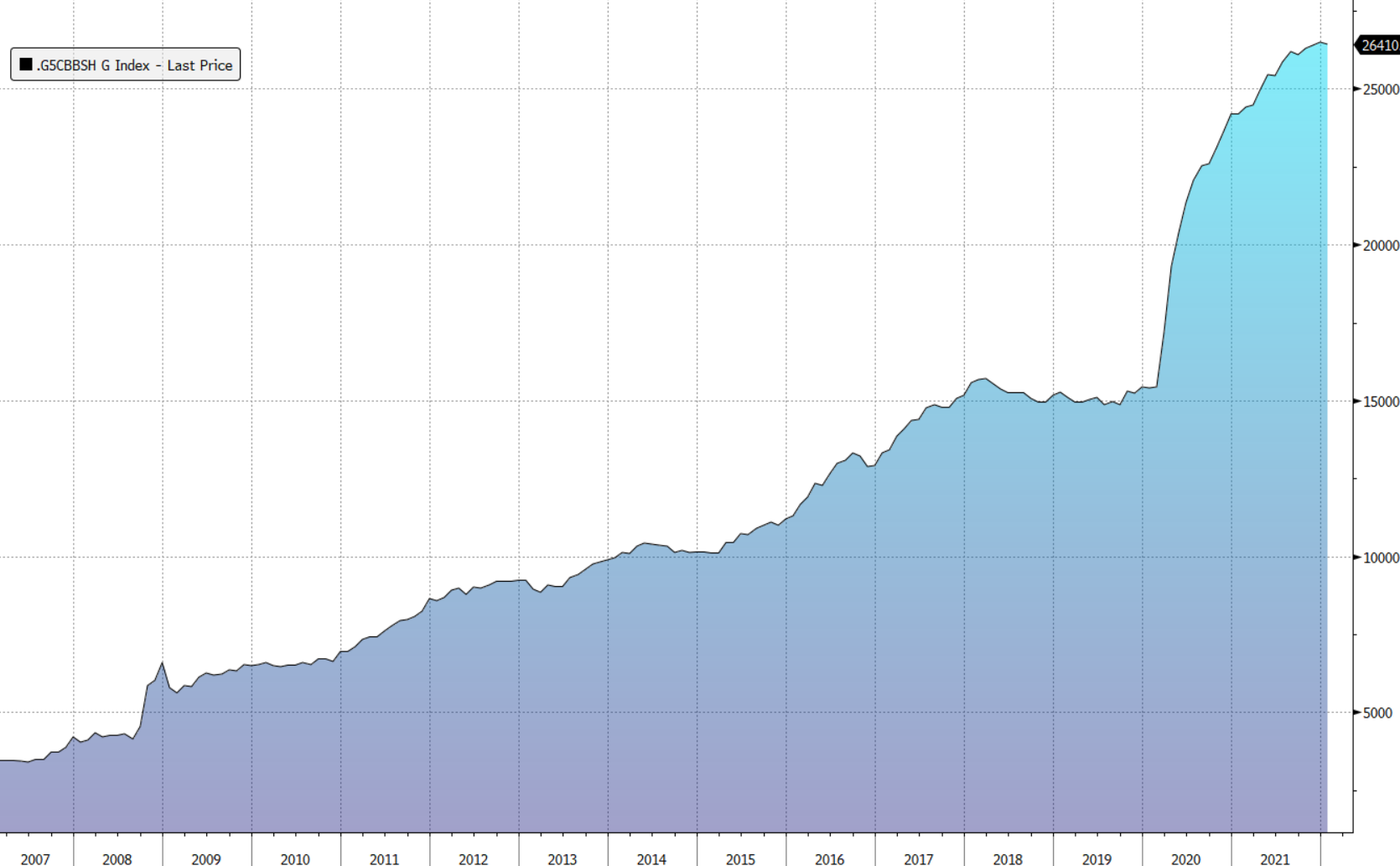
Rising food prices are an important part of overall inflationary pressures. In response, central banks have started to take note and have recently started to trim their bond buying:
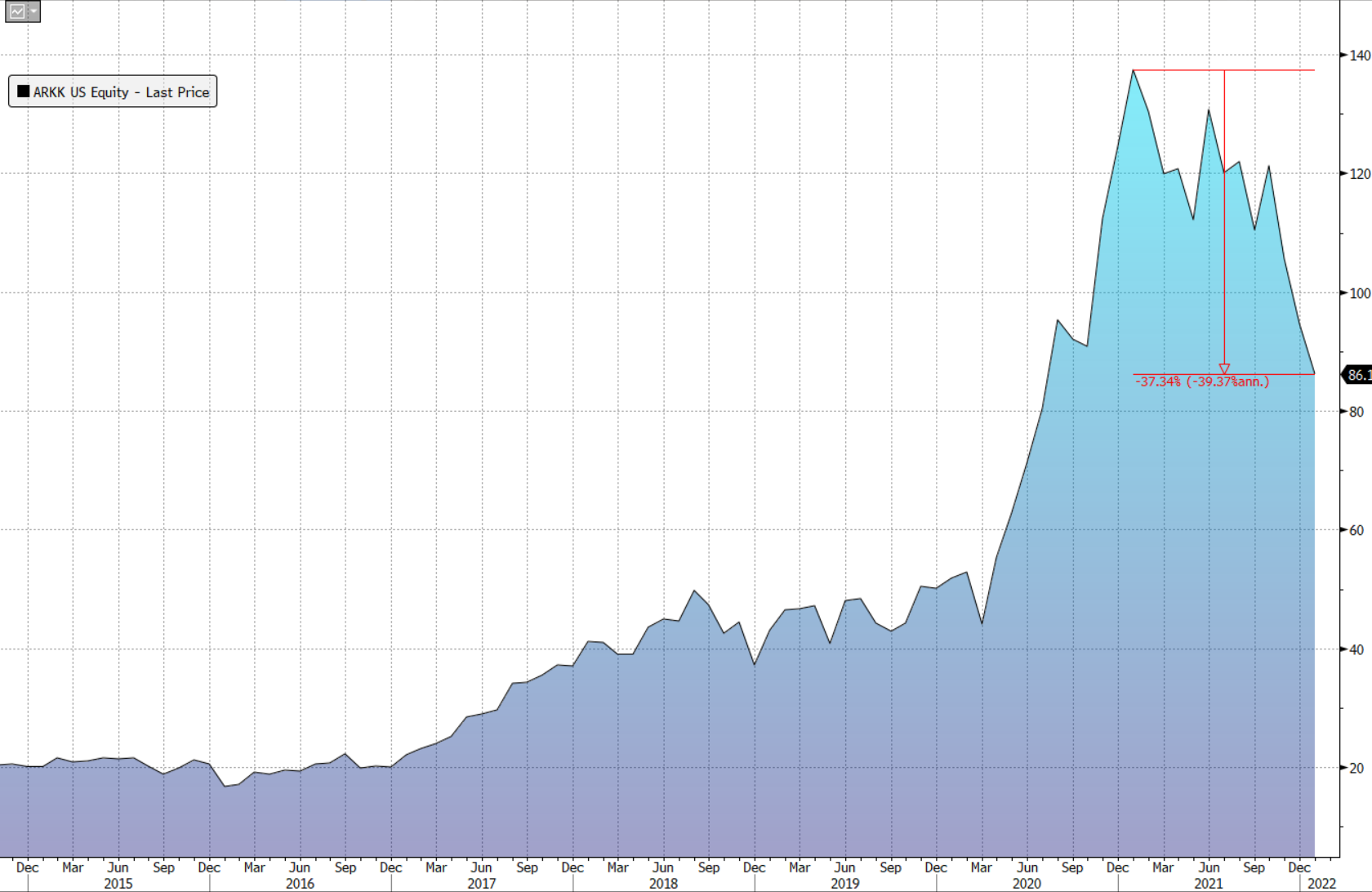
Investors in growth stocks respond to central banks' policy pivot
Exciting high revenue growth but loss-making technology companies are now officially in bear market territory, as depicted by ARK's Innovation Fund. The fund is now down over 37% since its peak in early 2021:
Articles
Ray Dalio's big picture views: A year of transition
Having studied both market and geopolitical history, Dalio is well equipped to share his views on the big picture for the next few years. His recent blog post is a worthwhile read as it touches upon several interesting elements including: the market cycle, the internal political cycle and the external geopolitical issues we face.
Dalio is particularly worried about the 2024 U.S. election cycle, stating:
"In any case in 2024 in the United States there is an uncomfortably high probability that neither side will accept losing, which could lead to a type of civil war in which there is rule by power rather than rule by law."
Given Russia's desire to have more influence on Ukraine and China's goal of consolidating Taiwan, Dalio believes they will both likely take advantage of American internal weakness/conflict.
EU plans to label natural gas and nuclear projects as "green"
Reuters has reported that the European Union has drawn up plans to label some natural gas and nuclear energy projects as "green" investments.
A draft of the European Commission's (EC) proposal, seen by Reuters, would label nuclear power plant investments as green if the project has defined a plan and secured funds and a site to safely dispose of radioactive waste. The new nuclear plants must receive construction permits before 2045 to be labeled as green.
The EC believes that both natural gas and nuclear power generation are "transitional" activities, i.e. not fully sustainable, but have lower emissions and do not lock in polluting assets.
Unsurprisingly, there is a split between EU countries on the inclusion of nuclear power. Germany, Austria and Luxembourg oppose nuclear power while the Czech Republic, Finland and France, which generate around 70% of their power from the fuel, see nuclear as crucial to phasing out CO2-emitting coal fuel power.
Buy the Umbrella Issue #2 wrote about the likelihood that the EU would pivot on nuclear energy. It is clear now that discussions are in fact taking place behind close doors, signaling that it could happen sooner rather than later.
Until next time...
Thank you for reading this week’s issue. If you found it interesting, please consider sharing it with a like-minded friend or family member.
If you have any questions or feedback, please reach out!
Have a great week.
Why ‘Buy the Umbrella’?
Individuals, many of whom also run businesses and governments, tend to not think of the downside when the present is stable, and the future is looking positive (usually when we feel most in control).
Just because it is currently sunny, does not mean it will never rain. We need to buy the umbrella before it rains. Otherwise, by the time we are running around looking for an umbrella in the middle of a storm, they tend to be in short supply.
At the same time, we cannot allow our awareness of risk to make us fearful, pessimistic, or paranoid, as this too works against us over the long-term.
Having the right mindset in advance is critical. The challenge is getting the right balance between being optimistic about the future and being able to not only withstand future crisis, but in fact grow stronger due to the opportunities they tend to present. It is not enough just to be conservative. One needs to be willing to put cash to work when others feel least comfortable doing it. To do that with confidence, we need to have a foundational understanding of business, markets and human psychology.
Our mission is to learn as much about the world as possible, and in doing so, to try to find investment opportunities with favourable risk/reward characteristics. These should, over the long term, help build sustainable wealth.